
Table of Contents
Overview
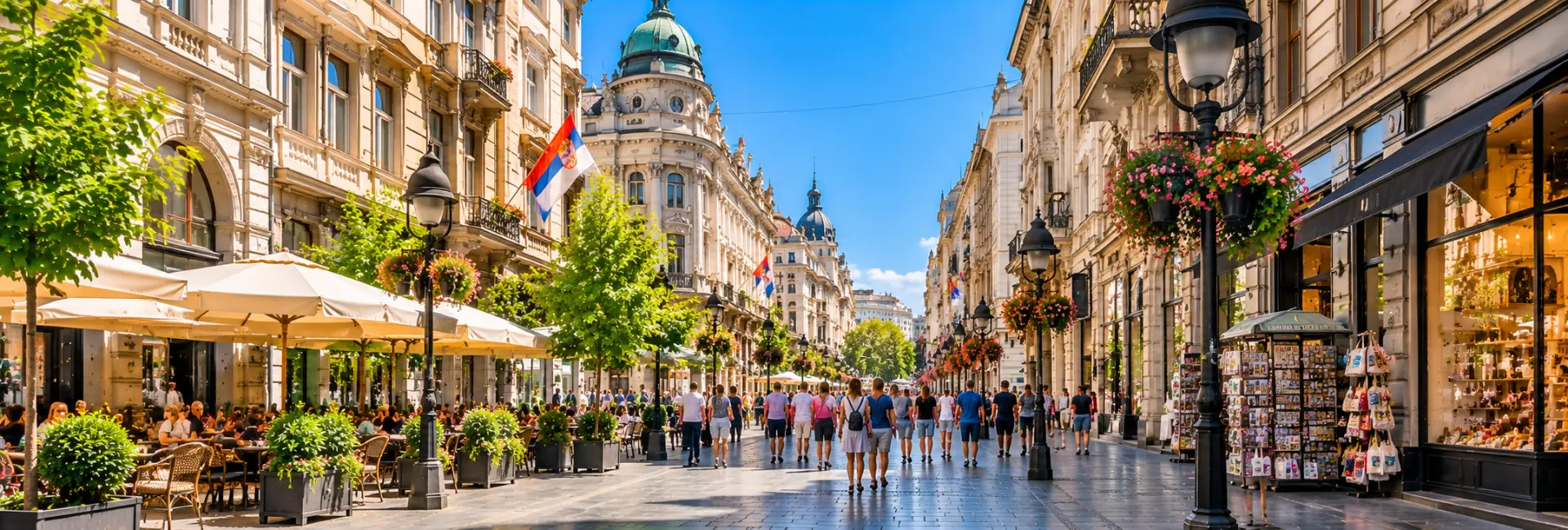
Knez Mihailova is Belgrade's main pedestrian promenade and the closest thing the city has to a living room. Running roughly a kilometre from Republic Square toward Kalemegdan Park and the fortress, it is a car-free ribbon of granite paving, shade trees and 19th-century façades. Locals use it to meet friends, cross town on foot or simply be seen, and visitors tend to find themselves on it within hours of arriving.
The street is as much about layers of time as it is about shopping. Beneath the paving lie traces of Roman Singidunum, the surface follows a route laid out by Serbia's first trained urban planner, and the buildings along it range from a modest 1830s inn to Art Nouveau cafes and contemporary glass-fronted retail. Cafes, bookshops, galleries, cultural institutes and street performers fill the space between.
A walk from end to end takes only fifteen or twenty minutes, yet most people spend far longer, drifting between terraces, side passages and the viewpoints at the Kalemegdan end.
History
Roman Foundations
The route of today's street follows the central axis of the Roman city of Singidunum, one of the main roads leading into it. Archaeologists have found graves from the first and second centuries, remains of a fourth-century house with painted walls, and a stretch of second-century cobblestones at the corner with Kralja Petra Street. New discoveries still surface whenever builders dig in the area.
Ottoman and Austrian Eras
In the sixteenth century the Ottomans repaired the old Roman water supply and added a new aqueduct with public fountains along the line of the street. Gardens and neighborhoods with several mosques grew up around it. After the Austrians took the city in 1717 they pulled down much of the older housing. The name Delijska, given to a short stretch in Ottoman times, is the only street name in Belgrade that has survived from that period.
A Street Is Planned
The modern street dates from 1867, when Emilijan Josimović's city plan set out a wide thoroughfare linking the town center with the fortress. Building began in the spring of 1869, and wealthy merchant families soon raised townhouses and shops along it. Two years after the assassination of Prince Mihailo Obrenović in 1868, the city officially named the street in his honor.
From Shopping Street to Pedestrian Zone
By the early twentieth century it was Belgrade's fashionable promenade, home to the city's first purpose-built department store and, in 1906, its first cinema. Postwar reconstruction followed, and in 1987 the street reopened as a pedestrian zone after about six months of works, designed by architect Branislav Jovin. That redesign gave it the black granite paving, a row of oak trees and antique-style lamp posts that define its look today.
Recognition / Status
Knez Mihailova was placed under protection in 1964 as a spatial cultural-historical unit, the first monument of that type in Belgrade. In 1979 it was upgraded to a unit of great importance under the care of the Republic of Serbia, and it is listed in Serbia's register of protected heritage.
Protection covers more than individual buildings: it recognizes the street as a whole, including its scale, layout and the character of its façades. Individual buildings along it may carry their own protection as well.
The status carries practical consequences. Redevelopment here is closely watched by conservationists and the public, and projects such as the Rajićeva shopping and hotel complex at the Kalemegdan end of the street have sparked lively debate about how new architecture should sit within a historic setting.
Architecture & Streetscape
A Mix of Styles
Walking the street is a quick course in how Belgrade modernized. The oldest surviving buildings are modest, while the mansions of the 1870s and 1880s show the shift from Ottoman-era building traditions toward Central European styles, with Romantic and Renaissance Revival façades, ornate cornices and carved stonework. Later arrivals include Secession-style buildings from the early twentieth century and late Art Nouveau and early Art Deco from the 1920s.
Paving, Trees and Street Furniture
The 1987 reconstruction gave the street its present texture. Wide slabs of dark granite make for smooth walking, a row of oak trees provides patches of shade, and replica gas-style lamps add period flavor in the evening. Midway along, a white marble drinking fountain carved from Venčac stone commemorates the old Delijska fountain that once stood nearby.
Width and Rhythm
The street changes feel as you move along it. Near Republic Square it opens into broad, busy stretches full of shop windows, while the upper part toward Kalemegdan becomes calmer, with more cultural venues, bookshops and cafes. Cross streets and short passages break the line and lead to quieter corners.
Notable Landmarks
- Serbian Academy of Sciences and Arts (No. 35): a stately building from the 1920s, home to a major library, archives and a gallery.
- Nikola Spasić Endowment (No. 33) and Passage (No. 19): a Renaissance Revival house from 1889 and a Secession-style passage from 1912, both tied to the generous Belgrade merchant Nikola Spasić.
- Grčka Kraljica (No. 51): built in 1835 and one of the oldest surviving buildings in the old core, it began life as an inn.
- Srpska Kruna (No. 56): an 1869 Romantic-style building that was once the most modern hotel in the city and now houses the City of Belgrade Library.
- Marko Stojanović's House (Nos. 53-55): an 1889 Renaissance Revival residence that now hosts the Gallery of the Academy.
- The 1870s block (Nos. 46-50): three neighboring buildings that marked a clear break with traditional Balkan architecture.
- Ruski Car: a 1926 cafe-restaurant at the corner of Obilićev Venac, in late Art Nouveau and early Art Deco style, and a classic meeting spot.
- Fountain and plaques: the marble fountain and commemorative plaques for urbanist Emilijan Josimović and the young volunteers who rebuilt the street in 1949.
The street is also home to several foreign cultural institutes, including Instituto Cervantes and the Goethe-Institut, which add to its reputation as a cultural address as well as a commercial one.
Many of these buildings tie into stories about the people who built the street. Merchants, bankers and publishers commissioned the houses, and a number of them were later converted into hotels, banks, consulates and cultural institutions. One kafana here was the first place in Belgrade where residents could hear a phonograph, in 1896, and it became the city's first cinema ten years later.
Ways to Experience It
A Simple Stroll
The classic approach is to start at Republic Square, walk downhill past the shops and terraces, and finish at Kalemegdan Park, where the street ends at the edge of the fortress grounds. Allow time to look up, since the best architectural details sit above the shop signs.
Cafes, Shopping and People-Watching
Terraces line much of the street, and a coffee or lunch here is as much about the view as the menu. International chains share space with local bookshops, jewelers and souvenir sellers, and street musicians often perform in the open stretches.
Culture and Side Trips
Galleries, a major library and cultural institutes make it easy to add an exhibition or reading room to the walk. Side streets lead to quieter courtyards and, at the lower end, toward the bohemian lanes and old-town neighborhoods around Kosančićev Venac and Studentski Trg.
Guided Walks
Walking tours of central Belgrade usually include the street, and a guide can bring out the Roman, Ottoman and Habsburg layers that are easy to miss when walking alone.
Best Time to Visit
Mornings are the quietest time, with open paving, soft light on the façades and cafes just starting up. It is a good moment for photographs and for browsing without the crowds.
Late afternoon and evening are when the street shows its social side. Terraces fill, performers appear, and Belgraders make the traditional evening promenade, especially on weekends.
Spring and early autumn are the most comfortable seasons for lingering outdoors. In summer, the oak trees help but afternoons can be hot, so plan a cafe break. Around the winter holidays, the street is often decorated with lights and draws seasonal shoppers, giving it a festive feel even in cold weather.
Visitor Tips
- Entry is free and the street is open at all hours, though shops and cafes keep their own schedules.
- The paving is broad and generally flat, which suits strollers and wheelchairs, although some side entrances and older buildings have steps.
- As in any busy tourist area, keep bags closed and phones secure in crowded stretches.
- Prices at central cafes and restaurants are often higher than on nearby side streets, so consider stepping a block off the main line for a cheaper meal.
- Look for the passages and courtyards that open off the street. They are easy to walk past and offer quieter spots for a break.
- Opening hours for galleries, libraries and shops change, so check current times for any venue you plan to visit.
Nearby Attractions
- Republic Square: the southern gateway to the street, with the equestrian monument to Prince Mihailo, the National Theatre and the National Museum.
- Kalemegdan Park and Belgrade Fortress: at the opposite end of the street, offering ramparts, museums and sweeping views over the Sava and Danube rivers.
- Terazije: the historic central square and boulevard just beyond Republic Square, lined with grand buildings.
- Skadarlija: a cobbled bohemian quarter known for traditional restaurants and live music, a short walk from Republic Square.
- Kosančićev Venac: an old neighborhood near the river with narrow lanes and historic houses, reached from the fortress end of the street.
- Nikola Tesla Museum: a museum devoted to the scientist and inventor, within walking distance of the center.
FAQs about visiting Knez Mihailova Street
What is Knez Mihailova Street known for? +
It is Belgrade's main pedestrian and shopping street, protected as a historic urban landmark. It is known for its 19th-century buildings, cafes, shops and its role as the city's favorite place for a walk.
How long is the street and how long does a walk take? +
The street runs about a kilometre from Republic Square to Kalemegdan Park. Walking straight through takes around fifteen to twenty minutes, but most visitors plan an hour or two with stops.
Is Knez Mihailova Street free to visit? +
Yes. It is a public pedestrian street open at all times, so you only pay for what you choose to buy, such as food, drinks or museum entries nearby.
Where does the street start and end? +
It begins at Republic Square in the city center and ends at the edge of Kalemegdan Park, close to the fortress. Terazije lies just beyond the Republic Square end.
When is the best time to go? +
Mornings are calm and good for photographs, while late afternoon and evening bring the liveliest atmosphere. Spring and early autumn offer the most pleasant weather.
Is it suitable for children and people with limited mobility? +
Generally yes, since the street is car-free with wide, flat paving. Some older buildings and side entrances have steps, so check access at individual venues.
What can I buy or do along the street? +
You will find fashion and international brands, bookshops, souvenir sellers, cafes, restaurants, galleries and cultural institutes. Street performers add atmosphere in busy periods.
Is the street safe at night? +
It is busy and well used in the evening, and most visitors find it comfortable. As in any crowded city center, keep an eye on your belongings and stay aware of your surroundings.
