
Table of Contents
Overview
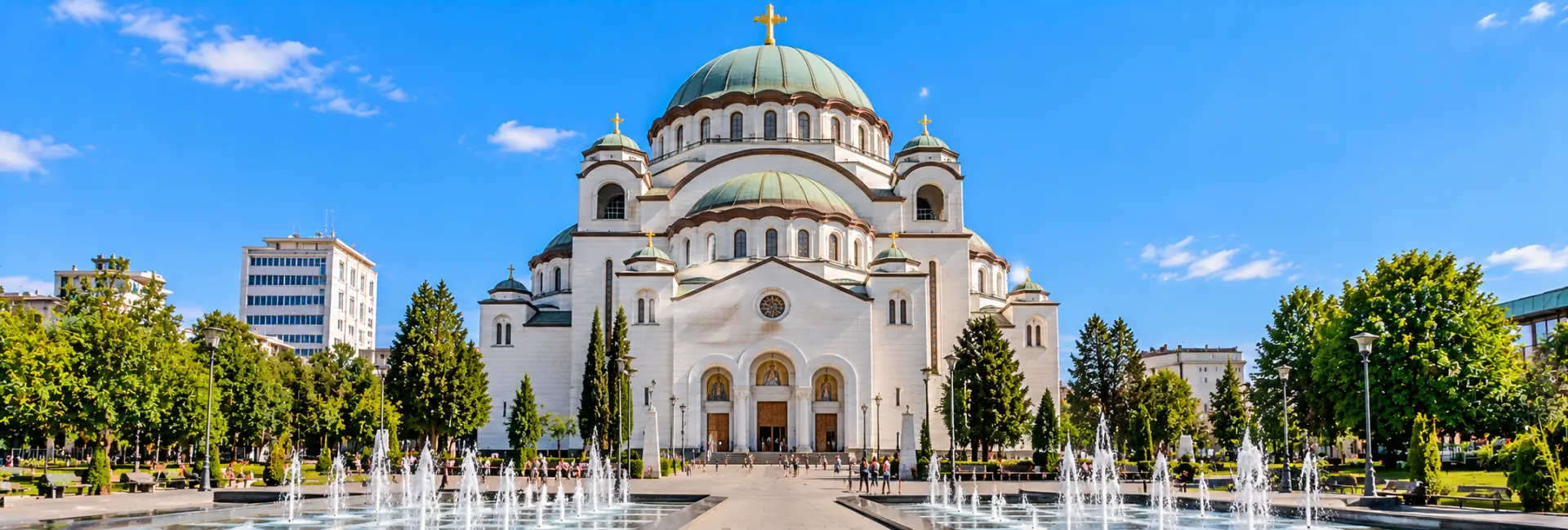
Rising from the Vračar plateau, the Church of Saint Sava is the building most people picture when they think of Belgrade. Its white marble walls and gilded cross are visible from many parts of the city, and its silhouette greets travelers arriving by road or by river. Serbs call it Hram Svetog Save, "the Temple of Saint Sava," using the traditional word for a church.
It is the largest Serbian Orthodox church and ranks among the biggest Orthodox churches anywhere, with a main floor that can hold roughly 7,000 worshippers. The church honors Saint Sava, the royal son turned monk who organized the independent Serbian church and is remembered as the nation's patron saint. Although it is often described as a cathedral, it is not formally one: the seat of the Archbishop of Belgrade is the Cathedral of Saint Michael the Archangel.
Scale is what draws people in, but the interior is what keeps them there. Gold mosaics blanket the walls, arches and domes, and the whole space glows even on a grey day. It is also a living place of worship, with services held daily, so a visit blends sightseeing with a glimpse of Serbian religious life.
History
A Site Tied to Memory
In 1594, Serbs in the Banat rose against Ottoman rule. In response, the Ottoman authorities had the relics of Saint Sava, kept at Mileševa Monastery in the southwest, brought to Belgrade and burned in public in 1595. Historians still debate the exact spot, but the Vračar plateau became the place most closely linked with the event in popular memory.
Three centuries later, in 1894, an initiative took shape to honor the saint with a great church, and a building society was founded the next year. Much of the land came from Francis Mackenzie, a Scottish missionary who had helped develop this part of the city. In 1900 the future church was declared a national undertaking.
Decades of Competitions and Debate
Settling on a design took far longer than anyone expected. A competition in 1906 produced no accepted entry, and another in 1926–27 ended without a winner. The project eventually passed to architects Bogdan Nestorović and Aleksandar Deroko, who reshaped the plans around the proportions of Hagia Sophia in Istanbul and made the building considerably larger than early proposals had envisioned.
Construction, Interruption and Revival
Building began in 1935, but World War II stopped work in 1941 with the walls only partly raised. Over the following decades the unfinished shell was used as a car park, a storage yard and even a play area. Granite cut for the church was reused in 1948 for the Tomb of the People's Heroes at Kalemegdan. The communist authorities rejected the Church's repeated requests to continue, and permission only arrived in 1984.
A liturgy was celebrated among the bare walls in 1985, and construction restarted that August under architect Branko Pešić, who adapted the design to modern prefabricated reinforced concrete. The most dramatic moment came on 26 June 1989, when the central dome, weighing about 4,000 tonnes and assembled at ground level, was raised into place.
Completion
The wars and sanctions of the 1990s paused work once more. Building resumed in the early 2000s, and the exterior was finished by 2004. The interior mosaic program ran from 2016 to 2020. The total cost was reported at around 100 million euros, funded by a mix of Serbian state money, a contribution from the Russian government and private donations. Finishing work on the building has continued in the years since.
Architecture & Design
Shape and Scale
The church follows a Greek-cross plan measuring roughly 91 metres from east to west and 81 metres from north to south. The square beneath the central dome is close to 40 metres across, and the highest point, the tip of the cross, stands about 78 metres above the ground. Four bell towers anchor the corners, and semi-domes step down from the central dome toward each arm of the cross.
The Dome
The double-shelled dome has an inner diameter of about 30.5 metres and is the widest of any Eastern Orthodox church. It rests on four massive piers and four pendentives, the curved triangular surfaces that carry a round dome over a square space. Crowning it is a gold-plated Serbian cross about 10 metres tall.
Materials and Engineering
The design is Neo-Byzantine in spirit, echoing Serbian and Byzantine church traditions, yet the building itself is a product of twentieth-century engineering. Its structure is largely precast reinforced concrete, with foundation piles reaching around 17 metres down to solid rock. Compared with the original plans, the new approach cut the building's weight by roughly a third or more.
The exterior is faced in polished white Volakas marble from Greece, covering about 12,000 square metres, with cornices in red Finnish granite. The contrast between the bright stone and the dark skyline of Vračar is part of why the church is so visible from a distance.
Cultural & Religious Significance
A Symbol of Serbian Identity
Saint Sava, born Rastko Nemanjić, was a prince who chose monastic life, founded the independent Serbian church and became its first archbishop. His influence on Serbian education, law and spiritual life runs deep, and the church that bears his name has become a symbol of national continuity. Building it on a site linked to the destruction of his relics gave the project an extra layer of meaning.
Every year on 27 January, the saint's feast day and a school holiday, children and families gather for a liturgy here.
A Place for Public Moments
Beyond regular worship, the church hosts occasions that matter to the whole country. Funerals held here include those of Prime Minister Zoran Đinđić in 2003 and Patriarchs Pavle in 2009 and Irinej in 2020. On Orthodox Christmas Eve, the plateau in front of the church fills with crowds for the traditional lighting of the Yule log.
Heritage Recognition
In 2021 the surrounding Vračar plateau was placed under protection as a cultural-historical site known as the Saint Sava Plateau, reflecting both the church and the historical events associated with the location. The building itself was paid for largely through donations collected over generations, which is one reason many Serbs feel a personal connection to it.
Notable Features
The Gold Mosaics
The interior is covered by roughly 15,000 square metres of mosaics made from around five million tesserae, designed by the Russian artist Nikolay Mukhin and produced by artists trained in Moscow and Saint Petersburg. They follow the gold-ground tradition of late Byzantine art. The largest scene, in the dome, shows the Ascension of Christ and covers about 1,230 square metres.
The Crypt
Beneath the main church lies a crypt of around 1,800 square metres, home to a church dedicated to Saint Prince Lazar. Its lower, more intimate scale offers a very different mood from the vast space above, with richly decorated marble, mosaics and frescoes. Many visitors consider it as memorable as the main hall.
Chandelier and Iconostasis
Hanging beneath the dome is a bronze wheel chandelier about 20 metres in diameter, among the largest in the world. The iconostasis, the screen that separates the altar from the nave, is built of Carrara marble, spans roughly 20 metres and weighs about 100 tonnes.
The Bells
The church has 49 bells, including four large swinging bells in the southwestern tower and a 45-bell carillon that is the only one of its kind in the Balkans. The carillon regularly plays the Hymn of Saint Sava, so it is worth listening for as you approach.
Around the Building
Outside stands a bronze statue of Saint Sava by the Russian sculptor Vyacheslav Klykov, unveiled in 2003. Close by is the small Old Church of Saint Sava, a reminder of the modest chapel that stood here before the great building rose.
Visiting Etiquette & Tips
Entry to the main church is free for individual visitors, and the building is generally open daily from morning until evening, with the chapels opening a little earlier and closing a little sooner. The crypt and the upper galleries may have separate hours and conditions, and guided options are offered through the church's tourism department, so confirm current details before you go.
- Dress modestly: cover shoulders and knees, and expect to remove hats inside. Tourists are not held to the stricter standards some worshippers follow, but respectful clothing is expected.
- Keep voices low and move quietly, especially near the iconostasis and the icons where worshippers pause to pray.
- Avoid walking through the building during a liturgy if you can. Tour groups are not admitted during services, and individual visitors should stay at the back.
- Photography is generally tolerated in the main spaces, but turn off the flash, avoid photographing people at prayer, and follow staff instructions.
- Elevators serve the dome galleries, which offer a closer look at the mosaics and a different view of the interior.
- Allow time for the crypt as well as the main hall, since many people underestimate how much there is to see.
Best Time to Visit
For a calm visit, go early in the morning on a weekday, when crowds are thin and the interior is quiet. Late afternoon is also pleasant, though it is wise to arrive well before closing so you have time to see the crypt.
Spring and early autumn bring mild weather for the walk across the plateau and for lingering outside. In summer, midday light falls strongly on the entrance front, which suits photographers, but the heat can make the plateau uncomfortable.
Major religious dates draw large crowds and long services. These include 27 January, Orthodox Christmas Eve on 6 January and Easter, whose date varies each year. They are memorable if you want to see the church at its most vibrant, but they are not ideal for quiet sightseeing.
Nearby Attractions
- Karađorđe Park: the church sits within this green space, which also holds a monument to Karađorđe, the leader of the First Serbian Uprising.
- Nikola Tesla Museum: a walk of roughly fifteen minutes away, it covers the life and inventions of the famous scientist.
- Slavija Square: the busy roundabout at the foot of the plateau, a convenient starting point for exploring Vračar's cafes and streets.
- Tašmajdan Park and the Church of Saint Mark: a pleasant green area with Belgrade's second-largest church, ideal for comparing two very different Orthodox buildings.
- Kalemegdan Fortress: farther toward the river, it rounds off a day of sightseeing with views over the Sava and Danube.
FAQs about visiting the Church of Saint Sava
Is the Church of Saint Sava free to enter? +
Individual visitors can enter the main church without paying. Guided tours of the church, crypt and galleries are arranged separately through the church's tourism department, and their prices should be checked before you go.
How long do I need to visit? +
Plan on about an hour for the main hall and crypt, and longer if you want a guided tour or to visit the galleries. Add time for a stroll around the grounds and the park.
What should I wear? +
Dress modestly, with shoulders and knees covered and hats removed indoors. You do not need formal clothing, but beachwear and very short outfits are not appropriate.
Is it a cathedral? +
It is often called one because of its size, but formally it is a church. The seat of the Archbishop of Belgrade is the Cathedral of Saint Michael the Archangel in the old town.
Is the church finished? +
The structure and exterior have been complete since 2004, and the main mosaic program was finished in 2020. Some finishing work has continued since, so occasional scaffolding or restricted areas are possible.
How do I get there? +
The church stands at Krušedolska 2a on the Vračar plateau. A common approach is to walk from Slavija Square along Bulevar Oslobođenja, and city buses and trams also serve the area.
Can I take photos inside? +
Photos are generally fine in the main areas for personal use, but be discreet, avoid flash, and do not photograph worshippers or services. Staff may restrict photography in certain parts.
Is it suitable for children and visitors with limited mobility? +
Yes, in general. The main hall is spacious, and elevators connect to the dome galleries. For specific accessibility needs, contact the church's information service ahead of your visit.
