
Table of Contents
Overview
The Museum of Yugoslavia is the main place in Belgrade to explore the story of a country that no longer exists. Yugoslavia was formed after the First World War, reshaped after the Second, and dissolved in the 1990s, and this museum collects and interprets objects from across that long and complicated history.
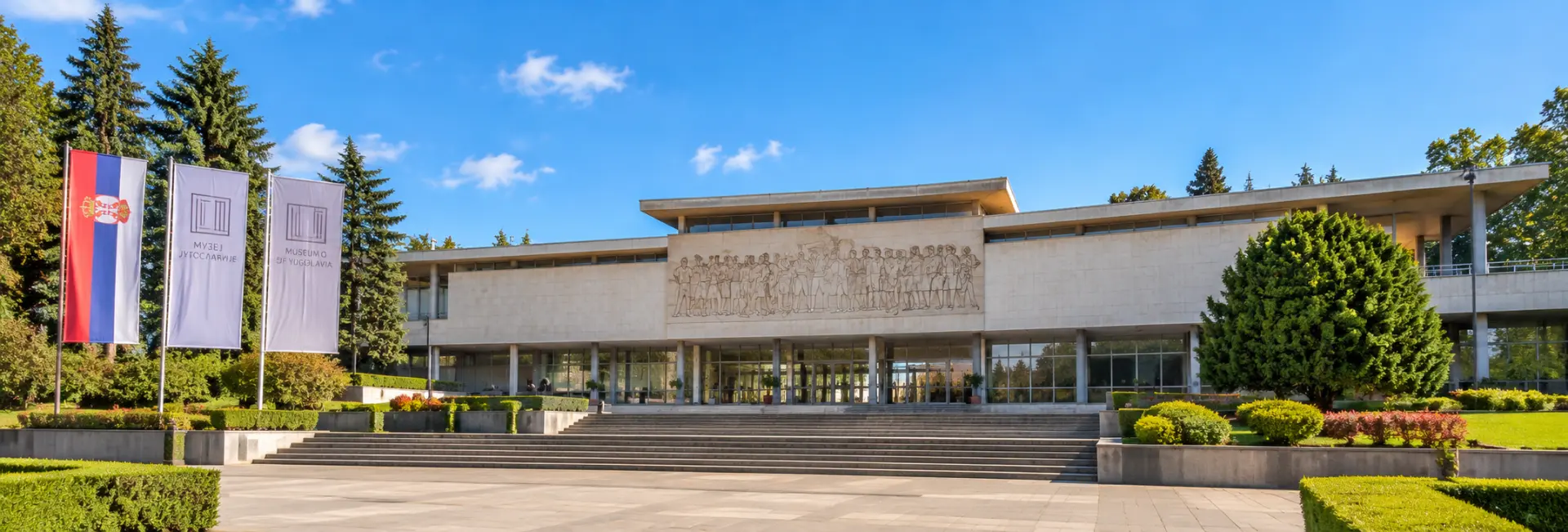
The museum is not one building but a small complex in a green, hillside park in the Dedinje district. It brings together the 25 May Museum, the Old Museum and the House of Flowers, where Josip Broz Tito, the long-time leader of socialist Yugoslavia, is buried together with his wife Jovanka.
Visitors arrive with very different expectations. Some come to understand how the federation was built and how it fell apart, others to see the gifts and personal items of a world leader, and many are drawn by nostalgia or curiosity about a political experiment that still shapes the Balkans today.
History of the Museum
From Memorial Centre to Museum
The institution grew out of the Memorial Centre named after Tito, which was set up to keep his papers, collections and the records connected with his work and with the wider history of Yugoslavia. When the federation broke apart, the centre and the Museum of the Revolution of the Peoples and Ethnic Minorities of Yugoslavia were merged. The resulting museum was founded in 1996 as the Museum of the History of Yugoslavia.
Years of Closure and Reopening
After the breakup of the federation, the complex stood closed to the public for a long period, and the ceremonial guards at the tomb were withdrawn. It later reopened and gradually became a regular stop for visitors to Belgrade. In 2013 the institution was officially given the status of a cultural institution of exceptional importance.
A New Name and a New Approach
The museum shortened its name to Museum of Yugoslavia in 2016. Work on a fresh permanent exhibition had begun years earlier, in 2009, with a project that invited discussion and self-reflection about what such a museum should say and how it should say it. That process is why the programme today mixes collection displays with talks, interventions and temporary exhibitions that question the way the past is presented.
Architecture & Buildings
The 25 May Museum
The largest building of the complex takes its name from 25 May, the date celebrated in Yugoslavia as Tito's birthday and as Youth Day. The city of Belgrade presented the building to Tito for his 70th birthday, and it opened in the early 1960s. Its long, modernist halls were designed for exhibitions and for the large public events of the period.
The Old Museum
Built in 1964-65, the Old Museum was created to display the many gifts Tito received from Yugoslav and foreign delegations or brought back from his travels. Today it is used for parts of the museum's own collection and for experimental exhibitions that reinterpret the permanent display.
The House of Flowers
The House of Flowers was completed in 1975 to a design by the architect Stjepan Kralj. It was originally built as a winter garden close to Tito's residence, a place where he could relax while in Belgrade. A central hall once held a fountain, and rooms for work and rest were arranged around it. After his death, the central space was adapted to hold his tomb, and a terrace opposite the entrance still looks out over the city.
Gift Shop and Café
The complex also contains a museum shop and a café, both useful for a break between buildings. The shop sells books, postcards and souvenirs connected to the museum's themes, and the café offers a pleasant place to sit in the park before or after walking up to the House of Flowers.
The Park Setting
The three buildings share a green park of about three hectares, and the combined built area is just over 5,000 square metres. The grounds give the visit a calm, memorial quality that contrasts with the busy streets of central Belgrade.
Collections & Exhibits
A Large and Varied Collection
According to the museum, its holdings run to more than 75,000 objects. They illustrate the idea of Yugoslavia from the creation of the state to its disappearance, and include documents, photographs, artworks, uniforms, everyday items and film material that relate to political, cultural and social life across the 20th century.
Gifts and Personal Items
One of the best-known parts of the collection is the large group of presents given to Tito during his years as president, together with personal objects connected to him. These pieces range from ceremonial items to handmade tokens of admiration, and they reveal how people and states chose to honour a leader who played an outsized role on the world stage.
The Relay of Youth Batons
Another distinctive display features the batons from the annual Relay of Youth, in which young people carried a symbolic message across the country each year toward Tito's birthday celebration. Many of the batons were handmade and decorated by local communities, so they also work as a record of regional craft and local pride.
Art and Design of the Era
The collection also reflects the artistic side of the federation. Posters, paintings, sculpture and design objects show how Yugoslav artists responded to public life, from official commemorations to more personal themes. Looking at them alongside the political material gives a fuller sense of how culture and politics were intertwined across the six republics.
Interpreting the Past
The museum treats the collection as a resource for studying social memory, not only as a set of trophies. Temporary shows and programmes regularly examine topics such as war, imprisonment, resistance and political change, which gives the complex a more reflective tone than a straightforward tribute.
Must-See Highlights
With limited time, these are the parts of the complex that most visitors consider essential.
- The tomb of Josip Broz Tito and Jovanka Broz inside the House of Flowers, set in a bright, glass-lit hall.
- The display of gifts and personal items associated with Tito, which shows how far his diplomatic contacts reached.
- The Relay of Youth batons, one of the most distinctive and photogenic parts of the collection.
- The terrace of the House of Flowers, which has a view over Belgrade.
- The Old Museum's rotating displays and interventions, where the museum questions its own permanent exhibition.
- The park itself, which makes a quiet spot to pause between buildings.
Ways to Experience It
Self-Guided Visit
The simplest approach is to walk the complex at your own pace, beginning in the main museum building, moving through the Old Museum, and finishing at the House of Flowers. The House of Flowers exhibition includes English texts, which helps international visitors explore independently.
Guided Tours
The museum has offered regular expert-led tours on weekends, typically at 11:00 in English and 12:00 in Serbian. A guide helps place objects in their historical context, which is especially useful for visitors who are new to Yugoslav history.
Talks and Special Programmes
Beyond the permanent displays, the museum hosts discussions, lectures and temporary exhibitions. If you are interested in a particular theme, such as the political ideas behind Yugoslavia, check the current programme before choosing the day of your visit.
Best Time to Visit
Time of Year
Late spring and early autumn are especially pleasant because the park is green and the weather suits both indoor and outdoor parts of the visit. Summer is quieter inside but can be hot on the open paths between buildings, while winter is cold but rarely crowded.
Day and Time
Weekday mornings are generally the most relaxed. Weekends are the choice if you want a guided tour, though you should expect more people around the House of Flowers during those hours.
Anniversary Dates
Dates tied to Tito's life, particularly around his birthday celebrations in May and the anniversary of his death on 4 May, can draw visitors from across the former Yugoslavia. These days offer a lively atmosphere but can also mean longer waits and larger groups.
Visitor Tips
Planning
- Opening hours, ticket prices and tour times change from time to time, so confirm them on the museum's official website before you go.
- Allow two to three hours if you want to see all three buildings and walk through the park.
- Wear comfortable shoes, since the complex involves walking on gentle slopes between buildings.
Respect and Etiquette
The House of Flowers is both a tomb and a memorial, so keep your voice low and follow any posted guidance on photography. Visitors hold a wide range of views about Tito and about Yugoslavia, and the museum is a space where those differing perspectives meet.
Getting There
The museum lies in the Dedinje district, a short distance from Hajd Park and the Partizan stadium area. Taxis and ride-hailing services are the easiest option from the city centre, and local buses stop near the entrance. The museum is also sometimes listed under its earlier street address, Botićeva 6, so you may see either name on maps and older guidebooks.
Nearby Attractions
The museum fits neatly into a half-day exploring southern Belgrade.
- Hajd Park: A large green space close to the museum that suits a relaxed walk after the visit.
- Dedinje Royal Compound: The former royal residences in Dedinje, an elegant neighbourhood that was home to royalty and later to the political elite.
- Topčider Park: A historic park with strong links to 19th-century Serbian history, reachable by a short taxi or bus ride.
- Partizan stadium area: A well-known sporting landmark close to the museum for football fans.
FAQs about visiting the Museum of Yugoslavia
What is the Museum of Yugoslavia? +
It is a public history museum in Belgrade dedicated to the history of Yugoslavia and to the life and work of Josip Broz Tito. It brings together the 25 May Museum, the Old Museum and the House of Flowers.
Is Tito buried at the museum? +
Yes. Tito and his wife Jovanka are buried in the House of Flowers, which stands in the museum grounds. Tito was laid to rest there in May 1980, a few days after his death.
What is the House of Flowers? +
It is a building completed in 1975 that was first used as a winter garden near Tito's residence. After his death it became his burial place, and the name was kept because the term mausoleum was not used at the time.
How long does a visit take? +
Most visitors spend between two and three hours to see the three buildings and walk through the park. History enthusiasts may want longer, especially if they join a guided tour.
Are there guided tours? +
Expert-led tours have been offered at weekends, usually in English at 11:00 and in Serbian at 12:00. Confirm the current schedule on the museum's website before you travel.
Is the museum suitable for children? +
Yes, with some caveats. The grounds are easy to walk and there are plenty of visual objects, though much of the content is historical and political, so younger children may enjoy it less than adults.
What is the best time to visit? +
Weekday mornings are typically the quietest, and late spring or early autumn gives the best weather for the outdoor paths between buildings. Weekends are better for tours but busier.
How do I get to the museum? +
It lies in the Dedinje district, and a taxi or ride-hailing service is the simplest option from central Belgrade. Local buses also stop nearby, and the site is close to Hajd Park.
Why do some maps show a different address? +
The complex has historically been listed under Botićeva 6, while the museum's own materials now use Mihaila Mike Jankovića 6. Both refer to the same site.
