
Table of Contents
Overview
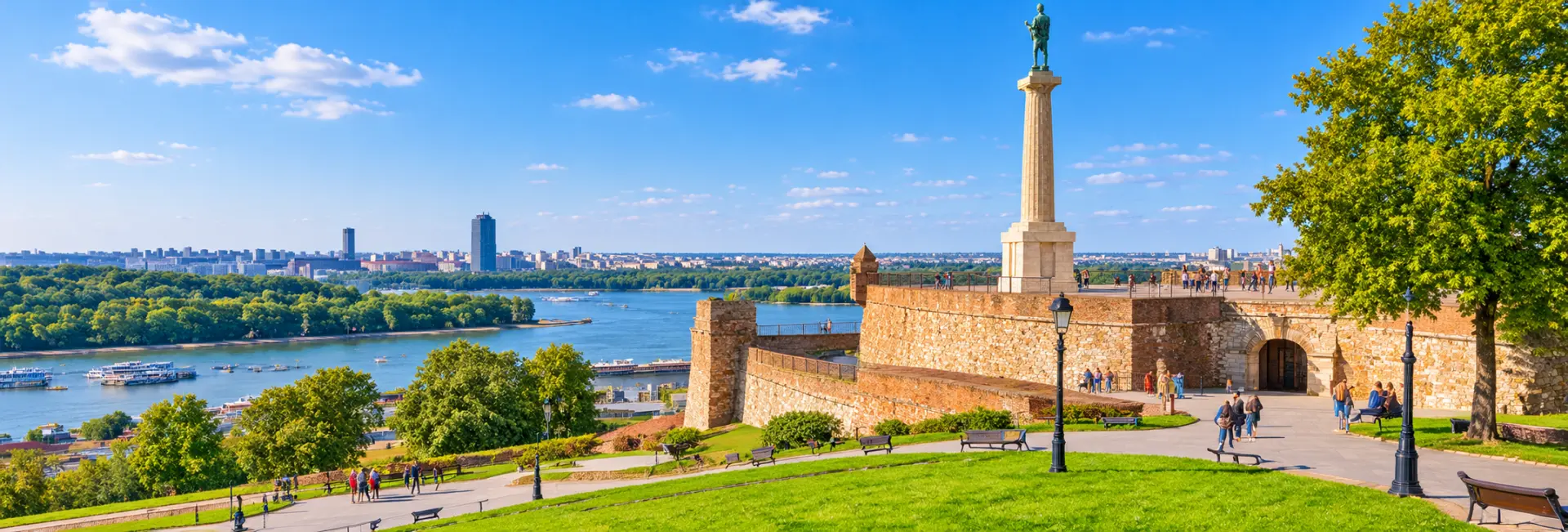
Kalemegdan Park is the largest park in Belgrade and one of the most important historical places in the city. It sits on a cliff roughly 125 metres above the point where the Sava flows into the Danube, so a walk here comes with wide river views and some of the best sunsets in the capital.
The park spreads across the old open ground in front of the Belgrade Fortress, which means history is never far away. Stone ramparts, gates, churches and towers rise at the edge of the lawns, while broad promenades, benches and fountains give the area the relaxed feel of a neighbourhood park.
Locals use Kalemegdan every day for strolling, sport, meeting friends and bringing children to the zoo. Visitors tend to treat it as the natural first stop in Belgrade, a place where you can understand the shape of the city and its layered past in a single afternoon.
History
A Battlefield Turned Park
The name comes from two Turkish words. Kale means fortress, and megdan means an open square or field, which together describe a plain that was kept empty for centuries so defenders could see approaching enemies. For long periods this strip of land separated the military fortress from the civilian town and was the scene of many conflicts.
The Handover of 1867
When Ottoman forces finally left Serbia in 1867, the keys to the city were handed to Prince Mihailo Obrenović. Soon afterwards the empty ground began to be reshaped for peaceful use, and plans and early works for a public park date from around 1869. New features were added gradually over the following decades.
Growth in the Early 20th Century
The 1920s and 1930s brought several of the park's best-loved additions, including the Cvijeta Zuzorić Art Pavilion, the Monument of Gratitude to France, a fountain sculpture of a fisherman, busts of poets and writers along the paths, and the Belgrade Zoo. Together they turned the former field into a cultural as well as a leisure space.
Heritage Status
The fortress and the park together were designated a Cultural Monument of Exceptional Importance in 1979, which is the highest category of heritage protection in Serbia. People often use the name Kalemegdan for the whole complex, although the park is only the younger part of it, separate from the ancient walled fortress that stands beside it.
Key Areas of the Park
Great Kalemegdan Park
The Great Park lies to the south of the fortress and is the larger of the two sections. It has wide promenades lined with trees, open lawns and plenty of shaded benches. It is where you will find the Monument of Gratitude to France, a tall white column topped by a female figure, and it is the area most people cross first when arriving on foot from the city centre.
Little Kalemegdan Park
The Little Park is the eastern part of the grounds and has a more intimate, garden-like atmosphere. Here stand the Cvijeta Zuzorić Art Pavilion, a yellow building dating from 1928 that hosts art exhibitions, and the entrance to the zoo. The terrace outside the pavilion is a popular place to sit in a deck chair on summer days.
The Cliff-Edge Terraces
The edge of the park nearest the rivers is where the views open up. The terraces and paths near the fortress walls look across the confluence toward New Belgrade and the plains beyond, and they are the favourite spots for photographers around sunset.
Monuments & Landmarks
The Victor Monument
The Victor, known in Serbian as Pobednik, is the best-known symbol of Belgrade. The bronze figure was created by the sculptor Ivan Meštrović and stands about 14 metres tall on a column, with a sword in one hand and a bird in the other. It was set up in 1928 to honour Serbia's wartime victories, and it was designated a protected cultural property in 1992.
Monument of Gratitude to France
This white column was raised in the interwar period to express thanks for French support during the First World War. It is one of several memorials in the park that reflect the close ties between Serbia and its allies of that era.
Ružica Church and the Chapel of St. Petka
At the edge of the fortress stand two small religious buildings. Ružica is often described as the oldest church in Belgrade, although its exact origins are uncertain. It was rebuilt several times, served as a gunpowder store in the 18th century, and was restored as a church in 1925. Both it and the nearby chapel can be visited free of charge.
The Roman Well
Despite its name, the Roman Well is neither Roman nor an ordinary well. It is a deep, fortified shaft built in the 18th century and surrounded by legends about prisoners and hidden treasure. These stories are better treated as folklore than as history, but the structure itself is atmospheric and well worth the short detour.
Greenery & the Belgrade Zoo
Paths and Shade
The park is crisscrossed by winding paths and tree-lined alleys that provide welcome shade in summer. Fountains, small sculptures and busts of writers appear at regular intervals, so even a simple walk feels like a gentle tour of the city's memory.
Belgrade Zoo
The zoo, officially founded on 12 July 1936, sits within the park and is the largest in Serbia. It covers around seven hectares and is home to roughly 210 species and about 800 animals. Belgrade means White City, and the zoo has a long tradition of keeping white animals, such as the white lions that many families come specifically to see.
A Park for Activity
Alongside the greenery there are sports courts, an old tennis court and open spaces where locals jog, play and relax. The rhythm of the park shifts through the day, with joggers early, families at midday and couples and friends gathering at the viewpoints as the light fades.
Ways to Experience It
A Slow Walking Route
A classic approach is to enter from the city side, cross the Great Park, pass the Monument of Gratitude to France, and continue toward the fortress walls. From there you can climb toward the Victor for the best panorama, then loop back through the Little Park to finish near the art pavilion or the zoo.
Combine with the Fortress
Many visitors treat the park and the fortress as a single outing. Allow at least an hour for the fortress alone and about twice that if you also want to wander the park properly. The fortress adds a military museum, gates, towers and underground spaces, while the park offers the softer, greener side of the same hilltop.
Sunset and Evening
If you only have time for one moment here, choose sunset. The light over the rivers and the glow on the stone make the cliff-edge terraces one of the most photographed spots in Belgrade.
Families and Culture
- Visit the zoo with children and plan a snack stop afterwards.
- Check the Cvijeta Zuzorić Art Pavilion for current exhibitions.
- Bring a picnic or a book and use the many shaded benches.
Best Time to Visit
Season
Spring and early autumn are the most comfortable seasons, with mild weather and colourful trees. Summer evenings are lively and pleasant once the heat fades, while winter can be cold and windy on the exposed terraces but is quiet and atmospheric.
Time of Day
Mornings suit walkers and photographers who want calm paths and clear light. Late afternoon into sunset is the most popular window, so expect crowds near the Victor and the river viewpoints around that time.
Weekdays and Weekends
Weekdays are quieter. Weekends bring locals, families and visitors in greater numbers, and the atmosphere is livelier but busier, especially in good weather.
Visitor Tips
- Wear comfortable shoes, since paths are long and the fortress area has slopes and steps.
- Bring water in summer and a windproof layer in winter, as the cliff edge can be exposed.
- The park is open to walk through freely, but separate attractions such as the zoo and museums have their own hours and ticket arrangements, so check current details before you go.
- Respect the churches by dressing modestly and keeping voices low if you step inside.
- Keep an eye on belongings in busy spots, as you would in any popular tourist area.
- If you are short on time, prioritise the Victor Monument, the cliff-edge views and a short stroll through the Great Park.
Getting there is straightforward. The park is on the edge of the old town, within walking distance of the main pedestrian streets, and trams and buses stop nearby.
Nearby Attractions
Kalemegdan is at the heart of old Belgrade, so many other sights are close by.
- Belgrade Fortress: The ancient and medieval citadel that borders the park, with gates, towers and a military museum.
- Knez Mihailova Street: The main pedestrian street, a short walk away, lined with shops, cafes and historic buildings.
- Kosančićev Venac: A historic quarter overlooking the Sava with narrow lanes and old houses.
- St. Michael's Cathedral: The city's main Orthodox church, set in the old town not far from the park.
- Princess Ljubica's Residence: A preserved early 19th-century house that shows how Belgrade's elite lived.
FAQs about visiting Kalemegdan Park
What is Kalemegdan Park? +
It is Belgrade's largest park, located on a cliff at the meeting point of the Sava and Danube rivers. It sits in front of the Belgrade Fortress and contains monuments, walking paths and the city's zoo.
What does the name Kalemegdan mean? +
It comes from Turkish and means roughly fortress field or battlefield. The name refers to the open ground that was kept clear in front of the fortress for centuries.
Is Kalemegdan Park free to enter? +
Yes, walking in the park is free. Some attractions nearby, such as the zoo and certain museums, have separate tickets, so check current prices and hours locally.
How long should I spend there? +
Plan about two hours for a relaxed walk through the park and the main viewpoints. If you also want to see the fortress thoroughly, allow half a day.
What is the Victor Monument? +
It is a bronze statue by Ivan Meštrović that was erected in 1928 and has become a symbol of Belgrade. It stands on a column near the fortress walls and overlooks the river confluence.
Is the park suitable for children? +
Very much so. There is plenty of space to run, the paths are easy to walk, and the zoo is one of the main attractions for families.
When is the best time to go? +
Late afternoon around sunset is the most scenic time, while mornings and weekdays are better if you want fewer people. Spring and autumn offer the most comfortable weather.
Is Kalemegdan Park the same as the Belgrade Fortress? +
Not exactly. The fortress is the ancient walled citadel, while the park is the younger green space developed on the open ground in front of it. Locals often use the name Kalemegdan for both together.
How do I get there? +
The park is on the edge of the old town and is easy to reach on foot from the main pedestrian streets. Trams, buses and taxis also stop nearby.
