
Table of Contents
Overview
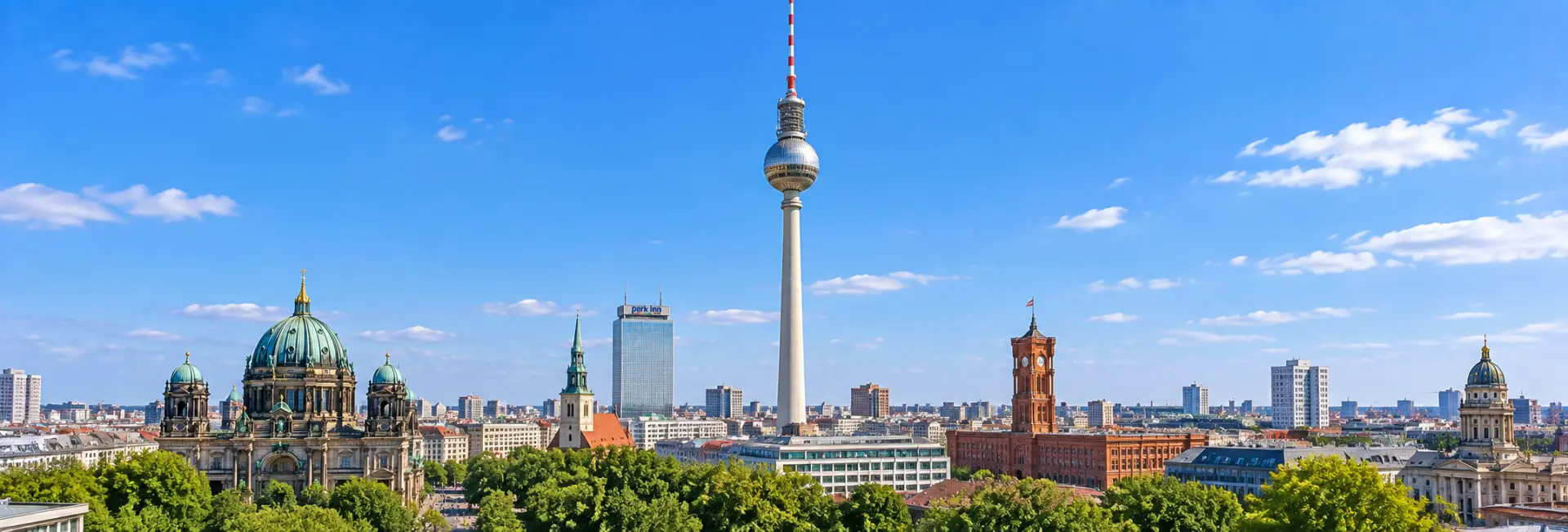
The Berlin TV Tower, known in German as the Fernsehturm, rises 368 metres above Alexanderplatz and is the tallest structure in Germany. Built by the East German government in the 1960s as both a broadcasting facility and a statement of technological confidence, it has since become one of the most recognisable symbols of the reunified city, visible from almost anywhere in central Berlin.
At around 203 metres, a steel sphere houses an observation deck and a revolving restaurant, offering uninterrupted panoramic views across the city on clear days. Beyond the view, the tower carries a distinctly Cold War story, including an unplanned optical effect that became a small act of quiet rebellion against the government that built it.
History
A Broadcasting Project with a Political Purpose
By the mid-1960s, East Berlin's existing television transmitters were no longer adequate for the growing broadcasting needs of the German Democratic Republic, and the government of Walter Ulbricht saw an opportunity to combine a functional solution with a powerful piece of political symbolism. An earlier plan to build the tower in the Müggelberge hills in the southeast of the city was abandoned because its height would have interfered with air traffic at nearby Schönefeld Airport, and the site was moved to the historic Marienviertel quarter near Alexanderplatz instead, requiring the demolition of much of the surrounding old town.
Construction and Opening
Construction began in 1965 under architect Hermann Henselmann, working with a team of East German engineers and planners. Using a climbing formwork technique, crews built the tapering concrete shaft first, before a prefabricated steel sphere was assembled on the ground and lifted into place near the top. The tower opened to the public on 3 October 1969, timed to coincide with the 20th anniversary of the founding of the GDR, and was, at the time, the second-tallest television tower in the world.
From Cold War Symbol to Shared Landmark
For two decades the tower stood as a literal and figurative high point of East German state propaganda, visible from West Berlin as a constant reminder of the divided city. The contrast was not lost on visiting foreign leaders either: US President Ronald Reagan referenced the tower directly during his 1987 speech at the Brandenburg Gate, pointing to the persistent cross-shaped reflection on its sphere as a symbol that could not be suppressed no matter how hard the authorities tried.
After German reunification, the tower's meaning shifted; rather than being torn down or reinterpreted as a relic of a discredited regime, it was embraced as a shared landmark of the unified capital, and it remains one of Berlin's most visited attractions today, drawing more than a million visitors a year.
Architecture & Design
The tower's design draws directly on the aesthetics of the 1960s space race: its slender, tapering concrete shaft evokes a rocket poised for launch, while the steel sphere near its summit was inspired by the look of the Soviet Sputnik satellite. The shaft narrows from roughly 16 metres in diameter at its base to about 9 metres higher up, divided into stages marked by small round windows on the exterior.
- Total height of 368.03 metres including antenna, following an antenna upgrade in 1997 that added roughly 3 metres to the original structure
- The steel sphere measures about 32 metres in diameter and sits roughly 200 metres above ground level
- The sphere's exterior is clad in more than a hundred stainless steel panels, chosen for their reflective, futuristic appearance
- A high-speed elevator carries visitors to the observation level in around 40 seconds
One unintended design quirk became famous in its own right: when sunlight strikes the steel panels at certain angles, it forms a bright cross-shaped reflection visible from the ground, a phenomenon Berliners nicknamed "the Pope's Revenge" as a wry joke at the expense of the officially atheist East German state. According to popular accounts, embarrassed GDR officials went so far as to try treating the panels with special paints and chemicals to eliminate the effect, without success — the cross reappeared whenever the sun hit the sphere at the right angle.
Recognition & Status
Despite its politically loaded origins, the tower earned formal recognition even before German reunification and has retained it ever since.
- Granted official monument status by the East German government in 1979, a designation that carried over unchanged after reunification
- Regularly ranks among Germany's most-visited paid tourist attractions, with well over a million visitors annually in typical years
- Remains the tallest structure in Germany and one of the tallest freestanding structures in the European Union
- Continues to operate as an active broadcasting facility for television and radio signals alongside its role as a visitor attraction
- Has featured in international media coverage of Berlin for decades, often used as visual shorthand for the city in film, television, and photography
What to See There
The Observation Deck
The main draw is the 360-degree observation deck inside the sphere, which offers views stretching across central Berlin and, on especially clear days, as far as the surrounding countryside. Fixed telescopes around the deck help visitors pick out specific landmarks, and information panels identify major sights visible from each side of the tower.
The Sphere Restaurant
A short flight of stairs above the observation deck sits a revolving restaurant, which completes a full rotation roughly every half hour, allowing diners to take in the entire city skyline over the course of a meal.
The Base and Surrounding Park
At ground level, the tower stands within the Park am Fernsehturm, a landscaped public space that also serves as a popular meeting point and event area, with the medieval St. Mary's Church (Marienkirche) standing just to its west as one of the few older buildings to survive the tower's construction.
Views Across the City
From the observation deck, visitors can typically pick out landmarks including the Reichstag, Brandenburg Gate, Berlin Cathedral, and Museum Island to one side, and the Fernsehturm's own long shadow stretching across Alexanderplatz below on sunny mornings and afternoons.
Ways to Experience It
Most visits centre on the trip to the top, though there are a few different ways to approach it.
- Book a standard observation deck ticket online in advance for a specific time slot, which helps avoid the longest queues
- Reserve a table at the Sphere restaurant for a meal that doubles as an extended, rotating view of the city
- Take photographs from the surrounding park or nearby streets, since the tower's scale and reflective sphere make it a striking subject from ground level as well as from the top
- Combine a visit with a walk through the adjoining Nikolaiviertel and Alexanderplatz, both within a few minutes on foot
- Visit as part of a Berlin sightseeing pass, several of which bundle tower admission with other attractions or public transport
Best Time to Visit
Because the main appeal is the view, weather and timing make a bigger difference here than at many other Berlin attractions.
- Clear days offer by far the best visibility, so checking the forecast before booking a timed ticket is worthwhile
- Sunset is a particularly popular time slot, giving views of the city skyline lit in golden light followed by the illuminated cityscape after dark
- Weekday mornings tend to be quieter than weekends and midday hours, especially during the busy summer tourist season
- Booking well ahead is advisable during peak season and around public holidays, when timed slots can sell out
- Winter visits can offer crisper, haze-free air on cold, clear days, occasionally rewarding visitors with longer sightlines than in hazier summer weather
Visitor Tips
A few practical details help make a visit to the tower go smoothly.
- Advance, timed-entry tickets are strongly recommended, since walk-up queues can run long, especially in summer
- The observation deck and restaurant are reached by elevator, making the tower accessible to visitors who cannot use stairs
- Bags may be subject to a security check before entering, similar to airport-style screening
- Visibility can be limited on hazy, overcast, or very windy days, so it's worth checking conditions if the view is the main reason for visiting
- Alexanderplatz station, served by multiple U-Bahn, S-Bahn, tram, and bus lines, sits directly next to the tower
- Restaurant reservations are handled separately from standard observation deck tickets, so book ahead if dining is the priority
Nearby Attractions
The tower's location at Alexanderplatz puts several other central Berlin sights within easy walking distance.
- Alexanderplatz — Berlin's large central square and transport hub, lined with shops, the World Clock, and the Fountain of Friendship Among Peoples
- St. Mary's Church (Marienkirche) — a medieval church standing at the foot of the tower, one of Berlin's oldest surviving buildings
- Rotes Rathaus (Red Town Hall) — Berlin's distinctive red-brick city hall, a short walk to the southwest
- Nikolaiviertel — Berlin's reconstructed medieval old town quarter, with narrow streets, restaurants, and small museums
- Neptune Fountain — an ornate nineteenth-century fountain in the square between the tower and the Rotes Rathaus
FAQs about visiting the Berlin TV Tower (Fernsehturm)
How tall is the Berlin TV Tower? +
The tower stands 368.03 metres tall including its antenna, making it the tallest structure in Germany.
How high is the observation deck? +
The observation deck sits inside the steel sphere at roughly 203 metres above the ground.
What is the "Pope's Revenge"? +
It's the nickname for a bright cross-shaped reflection that appears on the tower's steel sphere in sunlight, an unplanned effect that became a wry joke at the expense of the officially atheist East German government that built the tower.
Do I need to book tickets in advance? +
Booking a timed-entry ticket online in advance is strongly recommended, since walk-up queues can be long, particularly during summer and around sunset.
Is there a restaurant at the top? +
Yes, a revolving restaurant sits just above the observation deck and completes a full rotation approximately every 30 minutes.
How long does the elevator take to reach the top? +
The elevator ride to the observation level takes around 40 seconds.
Is the Berlin TV Tower wheelchair accessible? +
Yes, the observation deck and restaurant are reached by elevator, making the tower accessible to visitors who cannot use stairs.
What's the best time of day to visit for views? +
Sunset is especially popular for combining daylight and illuminated night views, while clear weekday mornings tend to offer the quietest visit overall.
