Table of Contents
Overview
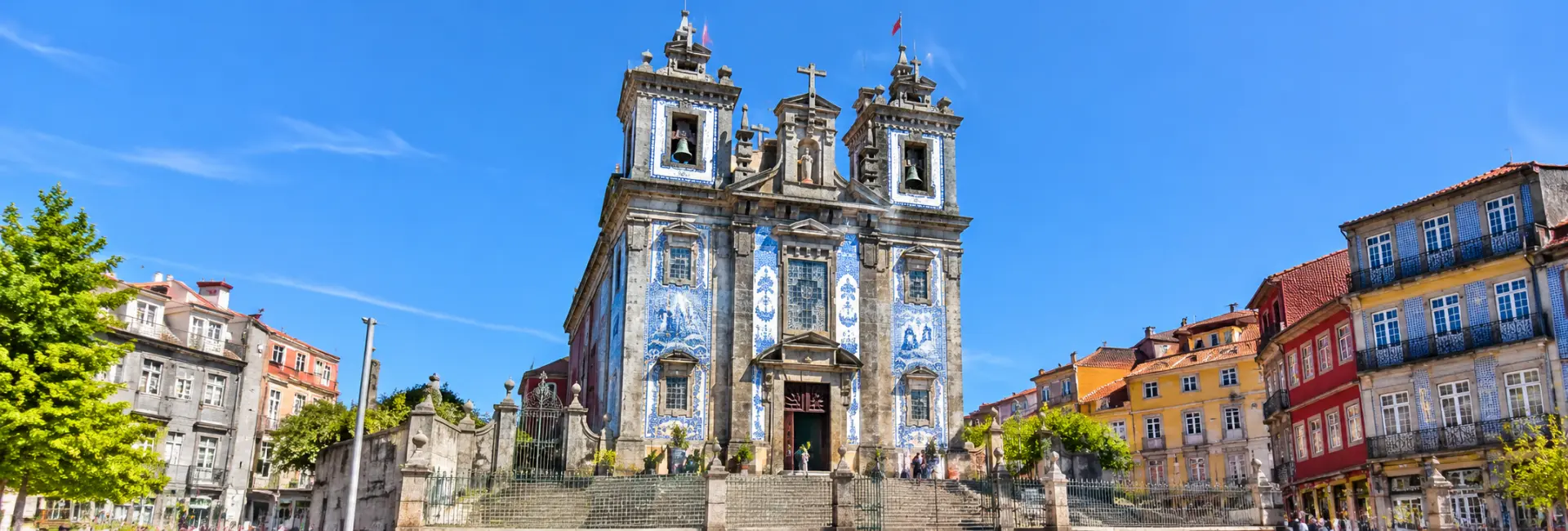
Standing at the edge of Praça da Batalha in central Porto, the Church of Saint Ildefonso (Igreja de Santo Ildefonso) is one of the city's most photographed buildings, though it is often overshadowed by better-known stops like São Bento Station. Its granite façade is wrapped in roughly 11,000 hand-painted blue-and-white azulejo tiles, turning an otherwise modest 18th-century parish church into a full-scale mural visible from across the square.
Completed in 1739 after thirty years of construction, the church is dedicated to Ildephonsus of Toledo, a 7th-century Visigothic bishop. It remains an active parish church with daily Mass, sitting quietly among the theatres, cinemas and cafés that now surround Batalha Square, and offering visitors free entry to both its tiled exterior and its gilded Baroque interior.
The building rewards a slower look than most visitors give it. The granite structure underneath dates to the church's original construction in the first half of the 18th century, while the tiled skin that draws the cameras was added nearly two hundred years later, making the façade something of a layered timeline in itself. For travellers exploring central Porto on foot, it sits close enough to São Bento Station and Clérigos Tower to fold naturally into a walking route, without needing a special detour or a ticket.
History
Origins on the Site
Long before the current building existed, a small chapel known as Santo Alifon occupied the same spot. No record survives of exactly when it was built, but it is mentioned in a text written by a bishop of Porto in 1296, making it one of the earliest documented references to the site. By the early 18th century the chapel had fallen into serious disrepair and was considered structurally unsafe.
Building the Present Church (1709–1739)
The old chapel was pulled down in 1709, and work on a new church began that same year. Construction stretched across three decades, a pace that reflected the scale of the undertaking rather than any single setback. The main body of the church, along with the carved tympanum above the entrance bearing the date 1730, was finished first. The following decade was spent raising the twin bell towers and completing the façade and entrance hall, and the finished building was formally blessed and inaugurated on 18 July 1739. No single architect is credited with the design; surviving records instead name the carpenters, stonemasons and locksmiths who carried out the work.
Later Changes and Discoveries
The church has needed repeated repair over the centuries. A severe storm in 1819 caused enough damage to require extensive restoration, and the building was struck by artillery fire on 21 July 1833 during the Siege of Porto, a conflict fought between rival claimants to the Portuguese throne. In 1967, the original windows were replaced with new stained glass designed by the artist Isolino Vaz. Renovation work carried out in 1996 in the entrance hall, on the ground once occupied by the old chapel's cemetery, uncovered nineteen graves, a physical reminder of how much older the site is than the current building.
Architecture and the Azulejo Façade
Form and Structure
The church is built almost entirely of granite, and its main body takes the shape of an elongated octagon rather than the more common rectangular nave, giving the interior a slightly unusual, wide feel. The plaster ceilings inside are decorative but restrained, in keeping with the plain, symmetrical granite façade outside. Two bell towers flank the entrance, each finished with carved cornices and dentil moulding and topped by a stone cross, a masonry sphere and a metal flagpole. A rectangular recess above the doorway holds a statue of Saint Ildefonso, the church's namesake. A freestanding stone obelisk stands beside the building; it originally lined up visually with the bell tower of the nearby Clérigos Church before being moved to its current spot in 1924, when the steps leading up to the church were altered to make room for shops.
The Tile Panels
What makes the church instantly recognisable is not its granite structure but the layer of azulejos applied on top of it nearly two centuries after the building was finished. In November 1932, the artist Jorge Colaço, who was already well known in Porto for his tile work at São Bento Station, completed a façade of about 11,000 blue-and-white ceramic tiles. The panels combine scenes from the life of Saint Ildefonso with imagery drawn from the Gospels, spreading across the full width of the front wall and up around the window surrounds and tower bases. Because the tilework was added so long after the church itself was completed, the building is often mistaken for being older than it actually is; the granite dates to the 1730s, while the tiles are a 20th-century addition.
Interior and Notable Features
The High Altar Retable
Inside, the church's main showpiece is its retable, designed by the Italian-born artist and architect Nicolau Nasoni, who left his mark on several of Porto's best-known landmarks. The piece was carved and installed in 1745 by the architect Miguel Francisco da Silva, and it blends Baroque and early Rococo woodcarving with the kind of gilded detail typical of Portuguese church interiors of the period.
Stained Glass and Organ
The current stained-glass windows date to 1967, when the originals were replaced with new designs by the artist Isolino Vaz, adding coloured light to what is otherwise a fairly restrained interior. The church also houses a pipe organ dating from the early 19th century, one of several furnishings that have survived the building's various rounds of repair.
Cultural and Religious Significance
The church takes its name from Ildephonsus of Toledo, a Visigothic bishop who led the diocese of Toledo, in present-day Spain, from 657 until his death in 667 and who is venerated for his Marian writings. Naming a Porto parish church after a Spanish bishop who died more than a thousand years before construction began reflects how far his cult had spread across the Iberian Peninsula in the medieval period.
Today the church functions first and foremost as an active parish, with Mass held daily and the building serving the surrounding neighbourhood of Santo Ildefonso, one of Porto's historic central parishes. That parish, in turn, gave its name to a wider district and civil parish of the same name, so the church's identity is woven into how this part of the city refers to itself, well beyond anyone who steps inside to pray.
At the same time, its 1932 tile façade has made it a reference point for the city's wider tradition of architectural azulejo work, placing it alongside São Bento Station and the Capela das Almas as one of the clearest public showcases of the craft in central Porto. Because the tiling was commissioned as a 20th-century addition rather than part of the original 18th-century build, the church is also a useful example of how Porto's azulejo tradition kept evolving long after the city's Baroque period had ended, with artists like Jorge Colaço reviving and reapplying the craft to older buildings.
Visiting Etiquette and Tips
- Entry to the church is free, though it functions as an active place of worship rather than a paid attraction, so there is no ticket office or set visiting route.
- Daily Mass is held inside; visitors are welcome to look around outside service times, but should keep noise to a minimum and avoid walking through the nave while Mass is in progress.
- Modest dress is appreciated, as with any working Catholic church in Portugal, particularly if visiting during a service.
- The best photographs of the tiled façade are usually taken from across Praça da Batalha rather than up close, since the scale of the tilework is easiest to appreciate from a distance.
- The granite steps at the entrance can be slippery in wet weather, which is worth keeping in mind given Porto's frequent rain.
- Opening hours and Mass times can shift around religious holidays, so it's worth checking current times locally rather than assuming a fixed daily schedule.
Best Time to Visit
Because the church's main draw is its tiled exterior, lighting matters more than the season. Early morning or late afternoon sun tends to bring out the depth of the blue-and-white tilework better than the flatter light of midday, and both periods also mean fewer people crossing in front of the façade for photos. Praça da Batalha is a working city square rather than a tourist-only stop, so it rarely feels overcrowded even in peak summer months, making the church an easy, unhurried visit at almost any time of year. Spring and autumn offer the most comfortable temperatures for lingering outside to take in the façade, while a visit during or just after rain can actually make the wet granite and glazed tiles look especially vivid.
Nearby Attractions
- Praça da Batalha – The square the church faces onto, home to the Art Deco Cinema Batalha and the São João National Theatre, both worth a look even from the outside.
- São Bento Railway Station – About a seven-minute walk away, its entrance hall is lined with a separate, equally famous set of azulejo panels, also involving work associated with Jorge Colaço.
- Capela das Almas – Another of Porto's tile-clad churches, a short walk from Batalha Square and a natural pairing with a visit to Santo Ildefonso.
- Bolhão Market – A historic covered market a few minutes' walk away, good for a food stop after visiting the church.
- Clérigos Church and Tower – A short walk through the surrounding streets, this Nicolau Nasoni-linked landmark offers panoramic views over the city for those who enjoyed Nasoni's retable inside Santo Ildefonso.
FAQs about visiting the Church of Saint Ildefonso
What is the Church of Saint Ildefonso known for? +
It's best known for its façade of roughly 11,000 blue-and-white azulejo tiles, added in 1932 by artist Jorge Colaço, which depict scenes from the life of Saint Ildefonso and imagery from the Gospels.
Is the church free to enter? +
Yes, entry is free, since it's an active parish church rather than a paid attraction, though donations are typically welcomed.
How much time should I spend there? +
Most visitors spend 15 to 30 minutes taking in the façade and stepping inside to see the retable and stained glass, making it an easy stop rather than a half-day activity.
Is the church's tile façade the original building? +
No. The granite church itself was completed in 1739, while the azulejo tiles that make it famous were added separately, nearly two centuries later, in 1932.
Can I visit during Mass? +
Mass is held daily and visitors can usually still enter, but it's best to move quietly, stay toward the back, and avoid wandering through the nave while a service is underway.
How do I get to the church? +
It sits on Praça da Batalha in central Porto, within easy walking distance of São Bento Station, and is well served by the city's trams and bus routes that pass through the square.
What's a common mistake visitors make here? +
Many travellers walk past quickly on their way to São Bento Station without realising the façade rewards a slower look, or they photograph it from directly underneath instead of stepping back across the square for the full effect.
What else is worth visiting nearby? +
Praça da Batalha, São Bento Station, Capela das Almas, Bolhão Market and Clérigos Tower are all within easy walking distance and pair well with a visit to the church.