
Table of Contents
Overview
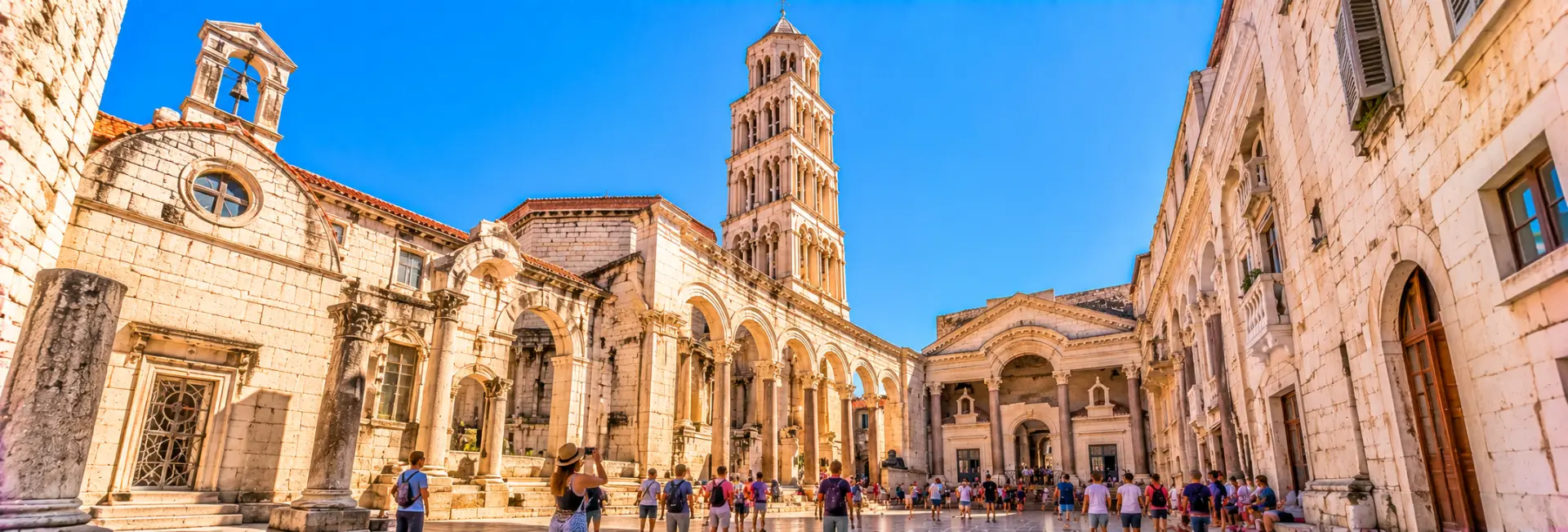
The Cathedral of Saint Domnius is the spiritual and visual centrepiece of Split. It stands on the east side of the Peristyle, the central square of Diocletian's Palace, and its slender Romanesque bell tower is the most recognisable landmark in the city. What makes it truly unusual is that the building itself began life as the Roman emperor Diocletian's mausoleum, and it has served as a Christian church for well over a thousand years.
It is widely described as one of the oldest cathedrals in the world still in use within its original structure. Walking inside, you pass from a Roman funerary monument into a church filled with medieval carving, Gothic altars and Baroque additions, all contained in one compact, round space.
The cathedral is both a place of worship and one of the most visited attractions in Split, so a visit combines sightseeing with the atmosphere of a working church.
History
An Emperor's Tomb
Diocletian built the octagonal mausoleum as part of his palace in the years around 300 AD, intending it as his final resting place. The emperor was known for the severe persecution of Christians that took place under his rule, a detail that gives the building's later history a striking irony.
From Mausoleum to Cathedral
After the Roman era, survivors from the nearby city of Salona sheltered inside the palace and adapted the mausoleum for Christian worship, an event usually placed in the 7th century. The relics of two early martyrs, Saint Domnius, a bishop of Salona, and Saint Anastasius, were brought to the new church and given places of honour. Diocletian's sarcophagus was removed, and its fate is unknown.
Medieval and Baroque Additions
Over the following centuries, the cathedral gained a Romanesque entrance, a pulpit, carved choir stalls and a bell tower. In the 17th century, the eastern side was extended to create a choir, and the main altar was built in the Baroque style. Each period left a visible layer, so the interior reads like a compact history of Split in stone and wood.
Architecture and Design
A Roman Mausoleum in Disguise
From the outside the building is an octagon, once ringed by a colonnade of marble and granite columns, while inside it forms a circular space topped by a high dome. A carved Roman frieze runs around the interior, a reminder of the building's original funerary purpose. The massive stone blocks and clean geometry are classic Roman engineering, and the structure has survived almost intact.
Later Changes
The most significant alteration is the Baroque choir added in the 17th century, which extended the building to the east and interrupted the original colonnade. Some art historians regret this change, but it gave the cathedral the long axis that a working church needs. The result is a hybrid building, where an ancient round tomb has been adapted to serve a Christian liturgy.
Two Dedications
The church is formally dedicated to the Assumption of the Virgin Mary, while the bell tower is dedicated to Saint Domnius. In daily use, the whole complex is known simply as the Cathedral of Saint Domnius, or Sveti Duje in Croatian.
Cultural and Religious Significance
Saint Domnius, or Dujam in the local dialect, is the patron saint of Split. His feast day, 7 May, is also the Day of the City of Split, marked by a procession and celebrations that bring the cathedral back to the centre of public life. A second patron, Saint Anastasius, shares a place of honour inside.
The cathedral remains the seat of the Archdiocese of Split-Makarska, and regular services are still held. That continuity is central to its meaning. Few places in the world have been used for worship for so long in the same building, and it links the Roman, early Christian, medieval and modern phases of Split in a single space.
The cathedral is also part of the UNESCO World Heritage listing for Split, inscribed in 1979 for the Historical Complex of Split with the Palace of Diocletian. Together with the Peristyle in front of it, it is considered one of the most important surviving parts of the palace.
Notable Features Inside
The Doors of Andrija Buvina
The main entrance is closed by a pair of walnut doors carved in 1214 by the Split craftsman Andrija Buvina. They are covered in scenes from the life of Christ, and they are among the rare medieval wooden doors in Europe to survive in their original setting. Since the carving is delicate, look at it closely and from several angles.
The Pulpit and Choir Stalls
A hexagonal Romanesque pulpit, dating from the 13th century and richly carved, stands inside the nave. The cathedral also preserves wooden choir stalls from the first half of the 13th century, now placed in the Baroque choir.
The Altars
Two late-Gothic altars sit in the side niches. The altar of Saint Domnius, built in 1427 by Bonino da Milano, is topped by a canopy that was frescoed with the four evangelists a couple of years later. The altar of Saint Anastasius, completed in 1448 by Juraj Dalmatinac, is celebrated for its Flagellation relief and counts among the finest sculptures in Dalmatia. A later Baroque altar by the Venetian sculptor Morlaiter, made in 1767, now houses the relics of Saint Domnius.
The Choir
The 17th-century choir contains an archbishop's throne, large paintings of scenes from the life of Saint Domnius and a 14th-century wooden crucifix of unusual Y-shaped form.
The Bell Tower
A Symbol of the City
The bell tower rises about 57 metres and is the emblem of Split. Construction began in the 13th century and continued, in stages, until around the middle of the 16th century. A thorough restoration between 1890 and 1908 replaced the upper storey to match the style of the lower levels, which is why the tower looks so cohesive today. Stone lions flank the portal at its foot.
The Climb
You can climb the tower for a 360-degree view over the palace grid, the Riva, the harbour, Marjan hill and the islands beyond. The staircase is steep and narrow in places, so take your time and avoid the climb if you are afraid of heights. Tickets for the tower are usually sold separately from the cathedral, though combination tickets are available.
Treasury, Crypt and Baptistery
The Treasury
The cathedral treasury, kept in a medieval building next to the cathedral, holds one of the most valuable church collections in the region. It includes reliquaries, icons, liturgical vestments, illuminated manuscripts and documents in Glagolitic script. Among its prized items are some of the oldest manuscripts preserved in Croatia, together with Romanesque paintings of the Virgin.
The Crypt of Saint Lucy
Beneath the cathedral lies a vaulted crypt, now a chapel dedicated to Saint Lucy, reached through a separate door on the south side. It is quiet, dim and cool, even in the middle of summer, and offers a contemplative contrast to the bustle outside. A mass is held here each year on her feast day in December.
The Baptistery
Just west of the Peristyle stands the former Temple of Jupiter, converted into a baptistery dedicated to Saint John. It is included in the combined cathedral ticket and rounds out the visit with a second well-preserved Roman building.
Ways to Experience It
- Visit the cathedral interior: allow at least 30 minutes to see the doors, pulpit, altars and choir at an unhurried pace.
- Buy a combination ticket: several combined tickets cover the cathedral, crypt, treasury, baptistery and sometimes the tower, which usually works out cheaper than paying separately.
- Climb the bell tower: the best way to see how the palace was laid out and to take in the sea views.
- Join a guided tour: a good guide can explain the Roman, early Christian and medieval layers and help you spot details that are easy to miss.
- Attend a service: visiting during Mass is a quiet, memorable way to experience the building as a living church, as long as you take part respectfully.
- Time your visit with 7 May: the feast of Saint Domnius brings processions and a festive atmosphere to the Peristyle.
- Finish with the Peristyle: sit on the steps of the square for a coffee and look back up at the tower.
Visiting Etiquette and Tips
- Dress modestly: the cathedral is an active place of worship, so cover shoulders and knees and avoid beachwear.
- Keep quiet and be respectful: speak softly, switch off phone sounds and step aside from worshippers.
- Check photography rules: photography is usually allowed in many areas, but flash and tripods may be restricted, and photographing people at prayer is discouraged.
- Expect ticket changes: prices, combination options and opening hours are updated regularly and may vary by season, so confirm them with the official cathedral sources before you go.
- Allow for services: parts of the building may be closed to sightseeing during Mass and on major religious days.
- Take care on the stairs: the tower climb is demanding, and the stone steps in and around the complex can be slippery.
- Watch for crowds: the Peristyle is one of the busiest spots in Split, and pickpockets sometimes work the queues.
- Accessibility: the building has steps, uneven floors and narrow passages, so check access arrangements if you use a wheelchair.
Best Time to Visit
Seasons
Spring and autumn give the best mix of mild weather and manageable crowds. In July and August the cathedral and tower queues can be long, especially in the middle of the day when cruise visitors arrive. In winter the cathedral is quiet and atmospheric, although the treasury and some other parts of the complex may have shorter hours or be closed.
Time of Day
Opening early or arriving shortly after the doors open is the best way to avoid queues, and the tower is cooler and clearer in the morning. Late afternoon brings warm light on the stone, and evenings often bring a livelier mood on the Peristyle, though the cathedral interior will usually be closed by then.
FAQs about visiting the Cathedral of Saint Domnius
What is the Cathedral of Saint Domnius? +
It is the Catholic cathedral of Split, housed in the Roman mausoleum that the emperor Diocletian built for himself. It is often described as one of the oldest cathedrals in the world still in use within its original structure.
Why is it called the Cathedral of Saint Domnius? +
The cathedral is named for Saint Domnius, or Sveti Duje, a bishop of Salona who became the patron saint of Split. The church is formally dedicated to the Assumption of Mary, but locals use the saint's name for the whole complex.
Do I need a ticket to enter? +
Yes, visitors need a ticket to see the cathedral interior, and there are separate or combined tickets for the bell tower, treasury, crypt and baptistery. Prices and rules change, so check the official sources before you go.
How long should I spend there? +
Allow about 30 to 45 minutes for the cathedral interior, plus extra time for the bell tower, crypt, treasury and baptistery if you plan to see them all. A full visit to the whole complex can take around two hours.
Is the bell tower climb difficult? +
It is a steep, narrow climb, so it can be tiring and may be uncomfortable for those who dislike heights. The 360-degree views are widely regarded as worth the effort.
Is there a dress code? +
Yes. Because it is an active place of worship, visitors should cover their shoulders and knees and dress respectfully.
Can I visit during Mass? +
You can attend services, but sightseeing may be limited or paused during worship, so it is best to plan your tour outside service times.
