
Table of Contents
Overview
Diocletian's Palace is not a ruin you look at from behind a fence. It is a Roman imperial palace that Split grew inside, around and on top of, and today it forms roughly half of the old town. People live in its walls, drink coffee in its courtyards and walk through its ancient gates on the way to work.
The palace was built at the turn of the 4th century AD as the retirement residence of the Roman emperor Diocletian. It is laid out like a fortified compound, with strong walls, towers and four gates, and it covers an area of about 30,000 square meters beside the Adriatic shore.
Visitors come for a few standout spaces: the Peristyle, the grand ceremonial courtyard at the center; the Cathedral of Saint Domnius, which began life as the emperor's mausoleum; the small Temple of Jupiter; and the vast vaulted cellars below ground. Between them lie narrow lanes that mix Roman stone with medieval houses, Renaissance details and modern shops.
The result is one of the best-preserved Roman building complexes anywhere in the world, and a rare place where ancient history is part of everyday city life.
History
An emperor's retirement home
Diocletian ruled the Roman Empire from 284 and chose to abdicate in 305, an unusual decision for an emperor. He had his retirement palace built near Salona, the capital of the Roman province of Dalmatia, on a bay along the coast. Construction is generally dated to the years around 295-305, and the evidence suggests that parts of the palace were still unfinished when he moved in.
After Diocletian
When Diocletian died, the palace continued to be used by members of the imperial family and later by the empire's administration. As Roman power declined, the complex gradually fell out of official use.
Refugees move in
In the 7th century, Salona was sacked by Avars and Slavs, and refugees from the city took shelter inside the strong walls of the abandoned palace. They adapted the Roman rooms to everyday life, and the mausoleum was consecrated as a Christian church. That moment marks the beginning of the medieval town of Split.
A city built inside a palace
Over the following centuries, Split spread through and beyond the old walls. Houses were added to the Roman streets, windows were cut into the ancient walls, and later periods left their mark in Romanesque, Gothic and Renaissance buildings. The layers of history are still plain to see on almost every corner.
Modern protection
The historical complex of Split with the Palace of Diocletian was inscribed on the UNESCO World Heritage List in 1979, and the area is protected as one of Croatia's greatest cultural treasures.
Architecture and Layout
A palace and a fortress in one
The compound was laid out on a rectangular plan and enclosed by walls and towers, so it combined the comforts of a luxury villa with the strength of a military camp. This mix of residence and fortress is one of the features that makes it so unusual among Roman buildings.
The four gates
Each side of the walls had a gate, and each gate has its own character and name.
- The Golden Gate on the north side was the main entrance, facing the road that led toward Salona.
- The Silver Gate on the east side opens toward the old market area.
- The Iron Gate on the west side leads to the main square of the medieval city.
- The Bronze Gate on the south faces the sea, and it is simpler than the others, which suggests it may have served as a service entrance.
Two halves
The southern half of the compound held the emperor's apartments and the sacred buildings, including the temples and the mausoleum, grouped around the great peristyle court. The northern half contained barracks, storage and workshops. A main street running between the gates divided the palace into these zones.
Materials and water
The palace was built from local limestone and imported marble, and a Roman aqueduct carried water to it from the Jadro river, several kilometers away. Parts of the aqueduct can still be seen outside the town.
The Peristyle, Cathedral and Temple
The Peristyle
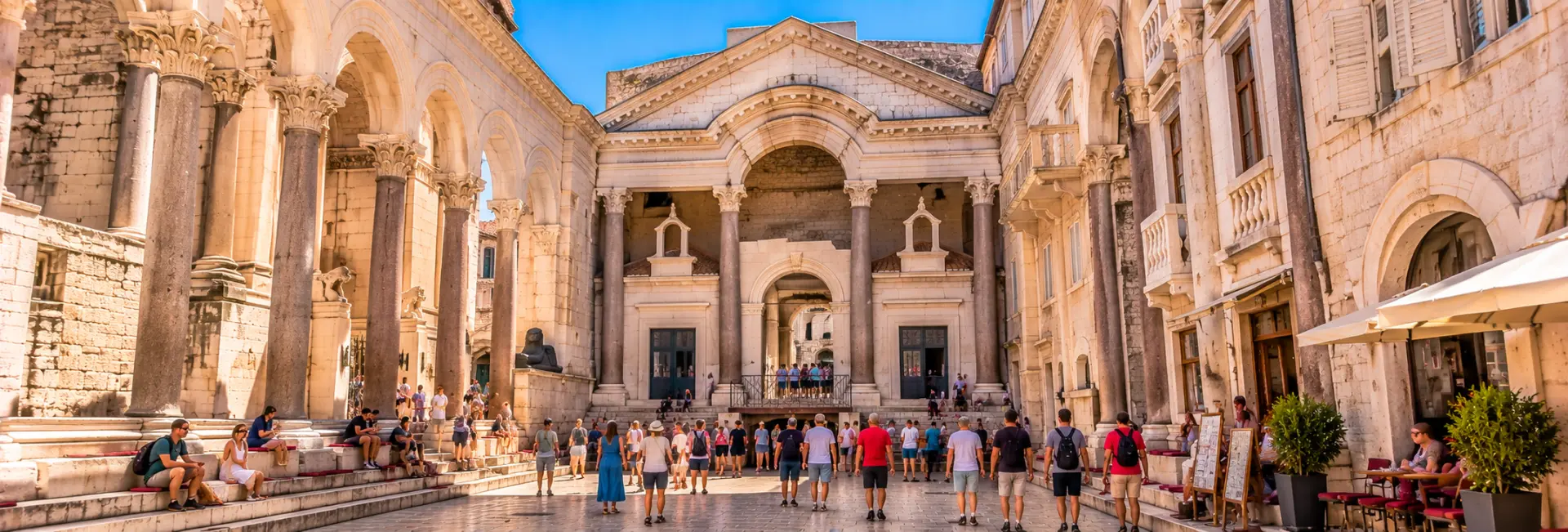
The Peristyle is the ceremonial heart of the palace, an open-air courtyard framed on three sides by tall columns and arches. On the fourth side a monumental staircase rises toward the vestibule, a domed entrance hall that once led into the imperial apartments. Today the courtyard is Split's favorite meeting place, with café tables set between ancient columns and performances held here in summer.
Sphinxes brought from Egypt in Roman times still stand in the courtyard. One, carved from black granite, has lost its head over the centuries, while another remains intact facing the cathedral entrance.
The Cathedral of Saint Domnius
The octagonal building beside the Peristyle was built as Diocletian's mausoleum, and in the 7th century it was turned into a church. It is often described as the oldest Catholic cathedral in the world still used in its original structure, and it is dedicated to Saint Domnius, a bishop who was martyred under Roman rule. The ironies of history are hard to miss.
The medieval Romanesque bell tower beside it rises to about 57 meters and offers wide views over the old town, the harbor and the sea, although the climb involves a steep spiral staircase.
The Temple of Jupiter
Opposite the cathedral, a small barrel-vaulted building is traditionally called the Temple of Jupiter. It is one of the best-preserved Roman temples in Croatia and was later converted into a baptistery. Inside are the sarcophagi of medieval archbishops of Split.
The Cellars
A palace under the palace
Beneath the southern half of the palace lies a vast set of vaulted halls, often called the substructures. They were built to level the sloping ground and to carry the weight of the imperial apartments above, and they mirror the plan of the rooms overhead, which has helped researchers understand the original layout.
One of the best-preserved in the world
The cellars are considered among the best-preserved structures of their kind anywhere. They were first used for storage, and they remained intact beneath the growing city while the rooms above them were rebuilt and reused over the centuries.
Visiting today
The cellars are entered from the Bronze Gate on the Riva waterfront and from the Peristyle area. Parts of the vaulted halls are used for exhibitions, galleries and shops, and some sections have free passage while others are ticketed. Walking through the cool, echoing spaces is a good way to escape the midday heat.
Recognition and Cultural Significance
UNESCO World Heritage
The Palace of Diocletian was inscribed together with the historic core of Split on the UNESCO World Heritage List in 1979. The listing recognizes how the palace charts the development of architecture on the Adriatic coast, from classical Roman design through the medieval period.
A living monument
Few ancient sites in the world have been continuously lived in for more than 1,700 years. The palace shows how a city can reuse and reshape a monument instead of leaving it as a museum piece, and that continuity is one of its greatest values.
A symbol of Split
For the people of Split, the palace is more than a tourist attraction. It is the center of social life, a place for festivals and processions, and the image that appears on postcards, souvenirs and local pride alike.
A story of reversal
The conversion of a pagan emperor's tomb into a Christian cathedral, in a building named for one of the emperor's own martyrs, is one of the most striking stories of reuse in European history. It captures the spirit of the whole palace, where each age rewrote the one before it.
Ways to Experience It
Wander freely
The simplest way to experience the palace is to walk into it through any gate and let the narrow streets lead you. Much of the complex is open at all hours and free to enter, and you will find small courtyards, hidden stairways and ancient doorways at almost every turn.
Take a guided tour
A local guide can explain how the old Roman plan still shapes the streets and can point out details that are easy to miss, such as reused columns, inscriptions and the traces of the original walls.
Visit the sites with tickets
The cathedral, bell tower, crypt, treasury and baptistery each have their own admission arrangements, and combined tickets are often available for several of them. The cellars are also ticketed in part.
Sit and watch
One of the best ways to enjoy the Peristyle is to sit at a café, order a coffee and watch the light change on the stones. Evening is especially atmospheric, when the space is lit and often filled with music.
Walk the edges
Circling outside the walls shows the scale of the compound, from the Riva promenade along the sea wall to the Golden Gate and the old market area on the east side.
Best Time to Visit
Season
The palace can be visited all year, but its character changes with the seasons. Summer is lively and hot, with festivals and open-air events, but also large crowds and strong sun. Spring and autumn offer the best balance of mild weather, good light and manageable numbers of visitors. In winter the streets are quieter and more local, although some venues have shorter hours.
Time of day
- Early morning is the calmest time, ideal for photographs of the Peristyle and the gates without crowds.
- Midday is hot and busy, which makes the cool cellars a good choice for that part of the day.
- Evening brings a relaxed atmosphere, with lit stonework, café life and occasional performances.
Cruise ship days can bring many visitors at once, so checking the port schedule can help you plan a quieter visit.
Visitor Tips
- Allow at least two hours for a first visit, and more if you want to climb the bell tower, enter the cathedral and walk through the cellars.
- Check current opening hours and ticket details before you go, as they change with the season and may differ between sites.
- Wear comfortable shoes, because the polished stone paving is slippery, especially when wet.
- Dress respectfully for the cathedral, with shoulders and knees covered.
- Be prepared for a steep climb if you plan to go up the bell tower, as the spiral staircase is narrow and not suitable for everyone.
- Look for combined tickets, which often cost less than buying each admission separately.
- Keep an eye on your belongings in the busiest areas, as in any popular tourist spot.
Accessibility
The main streets and the Peristyle are largely level, but the stone is uneven in places, and many of the interior sites involve steps. Visitors with limited mobility should check access for each site before visiting.
Nearby Attractions
The Riva
The palm-lined waterfront promenade runs directly along the southern wall of the palace. It is the best place for a seaside walk, a drink with a view of the harbor and a look at the palace walls from outside.
Golden Gate and the statue of Gregory of Nin
Just outside the north gate stands a large statue of the medieval bishop Gregory of Nin. Many visitors rub its toe for good luck, and the spot is a favorite for photographs of the gate.
Pazar Market
The open-air market next to the east wall sells fruit, vegetables, flowers and local products, and it is a good place to see everyday life in Split.
People's Square
The main square of the medieval town lies just outside the west gate. It is surrounded by Gothic and Renaissance buildings and by cafés, and it makes an easy extension of a walk through the palace.
Salona
A short trip from the city leads to the ruins of Salona, the Roman capital of Dalmatia and the city from which the refugees fled to the palace. The site includes an amphitheater and other ancient remains, and it gives useful context for the palace.
FAQs about visiting Diocletian's Palace
What is Diocletian's Palace? +
It is a Roman imperial palace built around 295-305 AD as the retirement residence of the emperor Diocletian. It now forms about half of the old town of Split and is a UNESCO World Heritage Site.
Do you need a ticket to visit Diocletian's Palace? +
The streets, gates and the Peristyle are open to walk through at no charge. The cathedral, bell tower, crypt, treasury and parts of the cellars have separate admission, so check current prices before you go.
How long does a visit take? +
Plan on at least two hours for a first visit, and more if you want to see the cellars and climb the bell tower. A quick walk through the main streets can be done in less than an hour.
What are the main sights inside the palace? +
The highlights are the Peristyle, the Cathedral of Saint Domnius and its bell tower, the Temple of Jupiter, the vestibule and the underground cellars. The four historic gates are also worth seeing.
Is it true that people still live in Diocletian's Palace? +
Yes, the palace is part of a living neighborhood, with homes, shops, cafés and restaurants inside its walls. That continuous use is a large part of what makes it special.
What are the cellars of Diocletian's Palace? +
They are a large set of vaulted halls under the southern part of the palace that supported the emperor's apartments above. They are among the best-preserved structures of their kind and are open to visitors, with some areas ticketed.
What is the best time to visit? +
Early morning and evening are the most pleasant times, with softer light and smaller crowds. Spring and autumn are the most comfortable seasons, while summer is lively but hot and busy.
Is Diocletian's Palace accessible for visitors with limited mobility? +
The main streets and the Peristyle are mostly level, but the stone paving can be uneven and slippery, and many interior sites involve steps. Visitors who use wheelchairs should check access for each individual site.
