
Table of Contents
Overview
The Peristyle is the ceremonial heart of Diocletian's Palace and the most atmospheric public square in Split. It is a compact, stone-paved courtyard framed by columns, arches and ancient walls, and it has been the city's natural meeting point for more than 1,700 years. Few places in Europe allow you to sit on a Roman monument's steps with a coffee in your hand, but here that is part of everyday life.
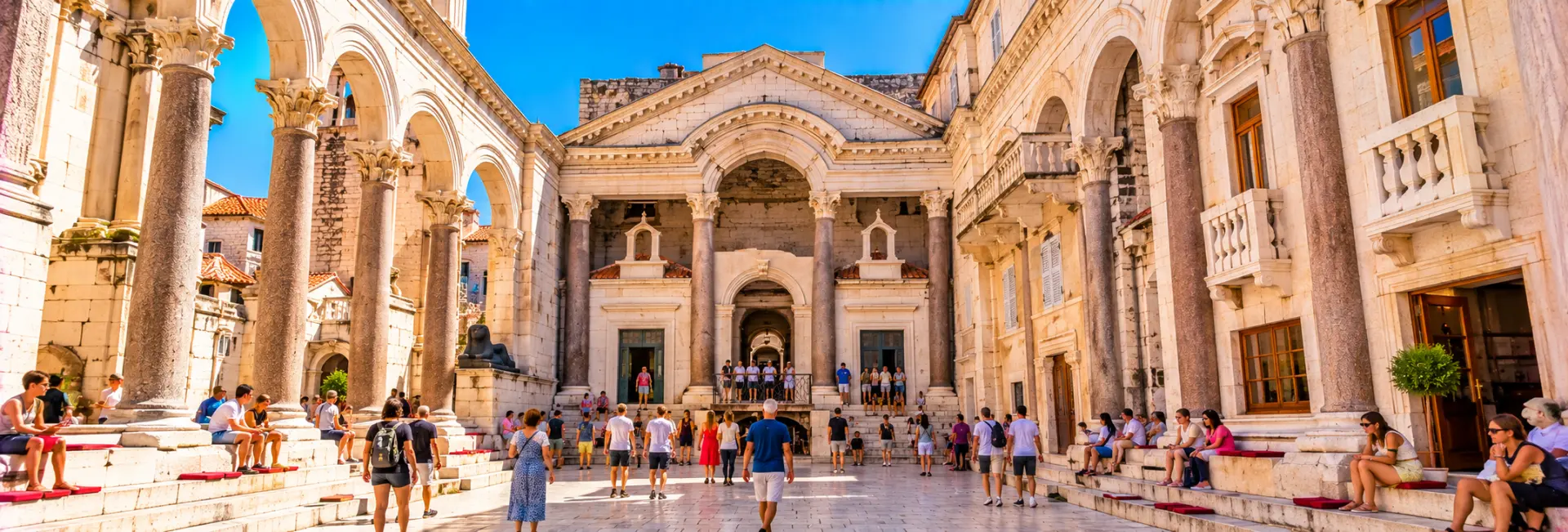
Locally known as Peristil, the square sits at the crossing of the palace's two main streets, the Cardo and the Decumanus. On its east side stands the cathedral, built as Diocletian's mausoleum, while on the south side a grand portico leads into the Vestibule, once the formal entrance to the emperor's private apartments.
Because the square is open-air and free to enter at any time, it is one of the easiest and most rewarding stops in Split. Even a short pause here shows you how Roman design, medieval life and modern café culture overlap.
History
A Stage for the Emperor
The Peristyle was designed as a monumental forecourt, built when the palace was constructed around the year 300 AD. Visitors approached the emperor's residence through this space, passing between the religious buildings on either side. It served as a stage for imperial ceremony, a setting that presented Diocletian as a powerful ruler with divine support, since he claimed a special link to the god Jupiter.
From Ceremony to Town Square
When the Roman era ended and people began settling in the palace, the square changed purpose. It became a marketplace, a religious gathering space and, eventually, the main public square of the town. Houses and noble townhouses were built against the colonnades, and the arches and columns were incorporated into later walls, which is partly why so much of the ancient fabric survives.
Rediscovery
The Peristyle was recorded in detail in the 18th century, when the architect Robert Adam surveyed the palace and published his drawings in 1764. His work introduced the monument to a wider European audience and helped fix many of the names still used today.
Architecture and Design
The Layout
The Peristyle is a rectangle roughly 27 metres long and 13.5 metres wide, bordered by steps and framed by colonnades on three sides. The east and west sides each have six columns topped with Corinthian capitals, linked by semicircular arches that support a heavy moulded cornice. Arches resting directly on columns, rather than a flat beam, were a bold choice for the period.
Materials
The columns are made of limestone, marble and pink granite, some of it imported from Egypt, and the contrast between the white stone and the warm granite gives the square its distinctive colour. Originally, stone screens stood between the columns, separating the mausoleum and the temples from the public space, though these are no longer in place.
The South Portico
At the south end, four columns carry a triangular pediment above an arched entrance, forming a monumental façade that marks the way into the Vestibule. Together with the colonnades, it gives the square a strong sense of symmetry, as if a stage set had been preserved for nearly two millennia.
The Sphinx and Imperial Symbolism
One of the Peristyle's most striking details is the black granite sphinx that sits near the cathedral steps. It is around 3,500 years old, and it is believed to have been brought from Egypt as part of Diocletian's decorative scheme. Diocletian is said to have imported a group of sphinxes to adorn his palace, and today only a few survive in the city, including a headless example in front of the Temple of Jupiter.
The sphinx is a reminder that the emperor wanted his residence to look as impressive as possible. Egyptian objects carried prestige, and placing them in a courtyard designed for audiences and ceremonies strengthened the image of power and antiquity he wished to project.
The red and pink tones of the granite columns also played a role. Colour and rare stone were part of imperial display, and in a place intended to impress visitors, the materials said as much as the architecture. Today, the sphinx has become an informal mascot of the square, and visitors often pause beside it for photographs.
What to See Around the Square
- Cathedral of Saint Domnius: on the east side, the former mausoleum now houses Split's cathedral, entered through a Romanesque portal beneath the bell tower.
- Bell tower: rising about 57 metres above the square, it is the city's best-known landmark and offers panoramic views for those willing to climb.
- The Vestibule: a short walk through the south portico leads to a circular hall whose dome has a wide opening to the sky, a favourite spot for photographs and for informal singing because of its acoustics.
- Temple of Jupiter: a few steps west, the small Roman temple was later turned into a baptistery and is still remarkably intact.
- The medieval townhouses: look at the western side, where later buildings lean against the ancient columns and arches.
- The sphinx: on the cathedral side of the square, it is an easy detail to miss in the crowds.
- The cathedral treasury and crypt: nearby, ticketed attractions that continue the story beyond the open-air square.
Restoration and Preservation
The Peristyle's long life has not been trouble-free. Over the centuries it was altered, added to and repaired, and by modern times the stone was dirty, weathered and in need of careful attention. Between 2003 and 2013, the City of Split and the Croatian Conservation Institute carried out a major, ten-year restoration project, regarded as one of the most significant conservation efforts in Croatia.
The work involved archaeological investigation, scientific testing of the stone and detailed cleaning and conservation of the columns, arches and cornices. A key goal was to protect the ancient architecture without erasing the later layers of the square's history, since those layers are part of what makes the Peristyle so valuable.
The result is a cleaner, brighter square that still feels lived in. Preservation remains an ongoing task, particularly given the heavy footfall in summer, so visitors are asked to treat the monument with care and avoid climbing on columns or leaning against delicate stonework.
The Peristyle Today
Cafés on the Steps
The most popular way to enjoy the Peristyle is to sit on the stone steps, often with a drink from one of the surrounding cafés, and watch the activity around you. Café terraces spill across parts of the square, and the steps create a natural amphitheatre where locals and visitors share the same view. It is a lively place, at its best when you slow down and let the scene unfold.
Music and Events
Because it is such a dramatic setting, the Peristyle is also used for performances. During the summer festival season, it becomes an open-air stage for concerts, opera and theatre, and sound from events can carry across the palace and out toward the waterfront. Spontaneous singing by local groups is also a familiar part of the atmosphere, especially around the Vestibule.
A Meeting Point
Locals use the square as a landmark for arranging to meet, and many visitors find that it becomes their reference point in the Old Town. From here, every gate, main street and major sight is within a short walk.
Ways to Experience It
- Sit on the steps: the classic experience, best with a coffee in the morning or a drink in the evening.
- Walk the four sides: circle the square slowly to see the colonnades, the portico and the cathedral façade from different angles.
- Step into the Vestibule: a free, atmospheric addition that takes only a few minutes.
- Climb the bell tower: look down on the Peristyle from above to understand how it fits into the palace plan.
- Take a guided tour: a guide can explain the carvings, columns and imperial symbolism that are easy to miss on your own.
- Catch a performance: check the summer festival programme for concerts and theatre in the square.
- Visit at dusk: as the light fades, the stone turns golden and the mood becomes more intimate.
Best Time to Visit
Seasons
Spring and early autumn give the most comfortable conditions, with warm light and smaller crowds. In July and August the Peristyle is at its busiest, especially around midday when tour groups and cruise visitors converge. Winter is quieter and the square feels more like a local meeting place, although cafés may have limited seating and weather can be damp.
Time of Day
Early morning is the best time for photographs and a peaceful look at the architecture before the crowds arrive. The middle of the day is the busiest and hottest period. Evenings bring a relaxed, lively atmosphere, with soft lighting on the stone and a good chance of music.
Visitor Tips
- Entry is free: the Peristyle is an open public square, and you can visit at any hour. Only the cathedral, tower, crypt, treasury and baptistery charge admission.
- Check café prices: terraces in such a prime location are generally more expensive, so look at the menu before sitting down.
- Protect the monument: do not climb on the columns, scratch the stone or lean on delicate carvings.
- Watch your belongings: crowded moments attract pickpockets, so keep bags closed and phones secure.
- Wear grippy shoes: the stone steps and paving can be slippery, particularly in wet weather.
- Expect noise: nearby rooms and apartments mean the area can be loud late in summer, which is worth knowing if you are booking accommodation close by.
- Dress respectfully near the cathedral: if you plan to go inside, cover shoulders and knees.
- Accessibility: the square is mostly level in the centre, but its edges are stepped and the surrounding lanes are uneven.
FAQs about visiting Peristyle Square
What is the Peristyle in Split? +
It is the central courtyard of Diocletian's Palace, built as a ceremonial forecourt around 300 AD. It is framed by columns and arches, flanked by the cathedral, and still serves as the main public square of the palace.
Is it free to visit the Peristyle? +
Yes. The square is open air and free at all hours. You only pay for specific attractions nearby, such as the cathedral, bell tower, crypt, treasury and baptistery.
How big is the Peristyle? +
It measures roughly 27 metres by 13.5 metres, which makes it a compact space. Its intimate scale is part of its charm and is why it feels so lively when it is full.
What is the black statue near the cathedral? +
It is an ancient Egyptian sphinx, around 3,500 years old, believed to have been brought to Split during Diocletian's time as part of the palace decoration. It sits beside the steps and is one of the square's best-known details.
Can I sit on the steps? +
Yes, sitting on the steps is a popular local habit. Café tables often fill the lower level, and you can sit on the stone further up, as long as you treat the surfaces with care.
What is the best time of day to visit? +
Early morning is best for peace and photographs, while evening offers atmosphere and sometimes music. Midday in summer is hot and crowded.
How do I get to the Peristyle? +
It lies at the centre of the palace, reached on foot from any of the gates. The quickest route from the waterfront is through the Bronze Gate and up the steps from the basement passage.
