
Table of Contents
Overview
Pjaca, officially Narodni trg or People's Square, is the largest square in Split's old town and its most lively everyday gathering place. It lies just outside the western wall of Diocletian's Palace, reached through the Iron Gate, and it has served as the heart of the city's civic life for roughly seven centuries.
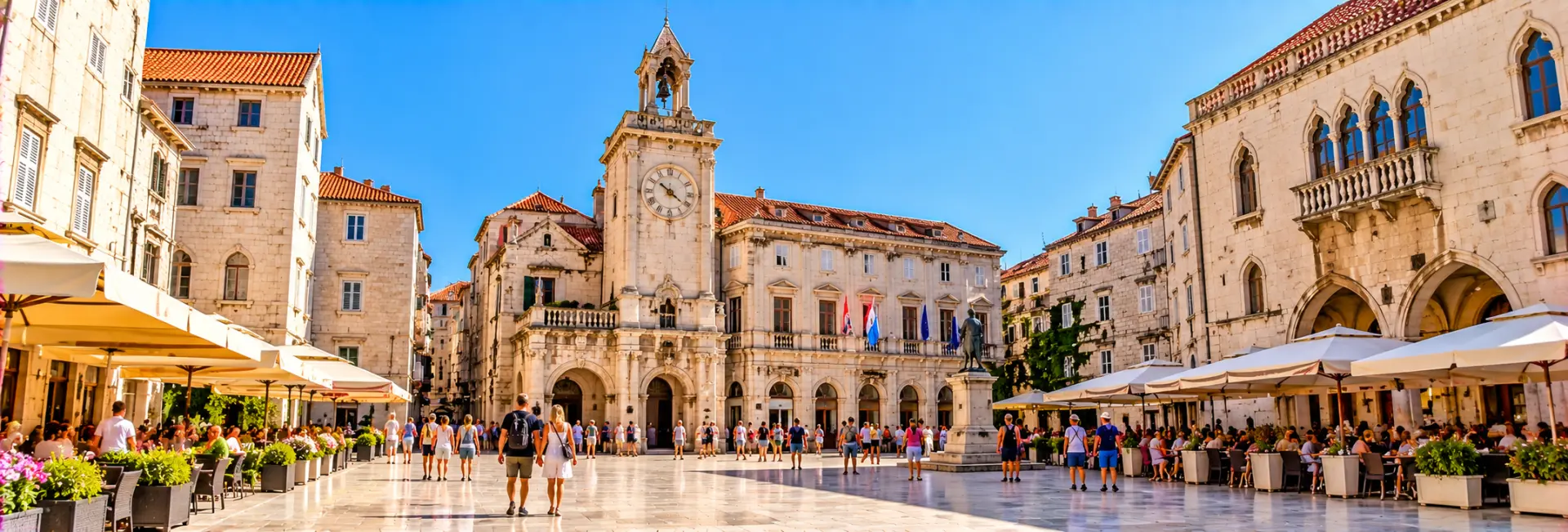
Where the palace's Peristyle feels Roman and ceremonial, Pjaca feels medieval and practical, a stage for markets, politics, coffee and gossip. Around its pale stone paving stand a Venetian Gothic town hall, a tower with an unusual 24-hour clock, a late Romanesque palace and a Secession-style building at the far end.
The name Pjaca is the local form of the Italian piazza, ultimately from the Latin word platea, and residents use it far more often than the official name. The square is free, always open and an ideal place to pause with a coffee after a morning among the palace ruins.
History
Beyond the Palace Walls
As Split's population outgrew Diocletian's Palace, people began to build outside its western wall, and Pjaca was among the first areas settled beyond the old Roman perimeter. By the 13th century at the latest, the open space had taken shape. It was originally known as St Lawrence's Square, after a church whose remains were later found in the middle of the square.
The Venetian Civic Centre
After Venice took control of Split, the church was demolished and replaced with a complex of municipal buildings, including the rector's and communal palaces. Much of this Late Gothic ensemble is thought to date from between about 1433 and 1455. Its construction moved the centre of public life away from the Peristyle and into this new square.
Loss and Survival
Most of the Venetian complex was demolished by the municipal authorities in 1821, and only the building known today as the Old Town Hall survived. Despite its modern name, it was historically the place where official proclamations and court judgments were read to the public.
The Modern Era
The 19th and early 20th centuries added new layers, including the Secession-style Nakić Palace at the western end, completed in 1902. Through every change in government, from Venetian to Austrian to modern Croatian, the square has remained a place where Split goes to shop, meet and watch the world go by.
Architecture & Streetscape
A Square of Many Styles
Pjaca is an architectural patchwork rather than a single planned composition. Late Romanesque, Gothic, Renaissance and Secession buildings sit side by side, and the surrounding façades reflect the different eras and powers that shaped Split. Many of the houses once belonged to wealthy notaries, merchants and scholars, which explains the refined window details above the shopfronts.
Recycled Stone
One of the pleasures of walking around the square is spotting reused material. The old municipal tower near the Iron Gate is built partly from Roman stones taken from the palace, a reminder that medieval Split literally grew out of its imperial past.
Venetian Influence
Michelin describes Split as a Venetian-style city, and nowhere is that clearer than here. In front of the Old Town Hall once stood a flagpole whose stone base was decorated with the city's coat of arms and the Lion of St Mark, the emblem of Venice, and it flew the flag of the Republic. The Gothic windows, arcades and carved details that remain are a direct legacy of that era.
The Open Space Itself
The square is large by old-town standards, paved in pale stone and ringed with café terraces. Its openness is a deliberate contrast to the narrow lanes of the palace interior, and it gives the buildings room to be appreciated from a distance.
Notable Landmarks
The buildings around Pjaca reward a slow lap of the square. These are the ones worth looking for:
- The Old Town Hall (Stara gradska vijećnica): The star of the square, this 15th-century Venetian Gothic building is the sole survivor of the old municipal complex. Its triple arcade, supported by columns with carved capitals, gives it a graceful, open look, and today it hosts exhibitions rather than officials.
- The clock tower: A tall Romanesque tower-house beside the Iron Gate carries a historic clock whose face is divided into 24 hours rather than 12, showing the whole day on a single dial.
- The Palace of Ciprianis: This late Romanesque house on the southeastern corner dates to 1394 and was built for a nobleman from the island of Korčula.
- Karepić Palace: A small Renaissance palace from the 16th century, linked to the Old Town Hall by Late Gothic double windows.
- Nakić Palace: The grand white building at the western end dates from 1902 and is designed in the Secession style that was fashionable across the Austro-Hungarian world.
- The Morpurgo bookshop: A long-running bookshop on the square, often described as one of the oldest in this part of Europe, and a charming stop for browsers.
Local Life & Culture
A Square for Everyday Life
For centuries Pjaca has been where ordinary life played out. Fruit sellers, second-hand book stalls and lively debates all filled the space, and today the square remains a place to meet friends, run errands and linger over coffee.
The Morning Gathering
A much-loved local tradition sees retired residents gather here in the morning, often over coffee at the Gradska Kavana café, to read the headlines aloud and comment on the state of the world. Visitors can still watch this ritual unfold, and it says more about the square's character than any plaque could.
Where Palace and City Meet
The square sits directly at the exit of the Iron Gate, so it forms a natural hinge between the ancient palace and the medieval town that grew around it. Stand at one edge and you can see Roman stonework reused in the clock tower, Venetian Gothic arches across the way and a Secession façade at the far end, all within a single glance. It is one of the easiest places in Split to read the city's layered history without a guidebook.
Shops, Cafés and Terraces
The ground floors are filled with cafés, shoe and fashion shops, a bookshop and restaurants, while upper floors include apartments. This mix of daily commerce and heritage is what keeps the square feeling lived-in rather than preserved behind glass.
Ways to Experience It
- Coffee and people-watching: Take a terrace table and spend 20 minutes watching the square. It is the easiest, most authentic way to experience Pjaca.
- A self-guided architecture walk: Circle the square slowly, working through the landmarks above and noticing how the styles change from one façade to the next.
- Exhibitions: The Old Town Hall has hosted rotating exhibitions by contemporary artists and photographers, so check what is on during your visit.
- Browsing and shopping: Pop into the bookshop or the surrounding boutiques for a break from sightseeing.
- Guided old-town tours: Many walking tours pass through Pjaca after the Iron Gate and add stories about the buildings and the people who lived here.
- Photography: The clock tower, the Old Town Hall arcade and the contrast of pale stone against blue sky make particularly rewarding shots.
Best Time to Visit
Seasons
Pjaca is pleasant all year, but the character changes with the weather. Summer fills the terraces with visitors and gives the square a festive, outdoor feel, though midday heat can be strong. Spring and early autumn offer comfortable temperatures and a more relaxed pace, while winter is quiet and local, with fewer tourists and a gentler atmosphere.
Time of Day
Morning is the best time to catch the traditional coffee crowd and enjoy the square at its calmest, before the day's tours arrive. Late afternoon and evening bring a livelier mood as people gather for drinks, and the façades take on a warm glow. Because the square never closes, you can simply walk through whenever suits your day.
Visitor Tips
- Cost and hours: The square is a public space, free to enter at any time. Individual businesses and exhibitions keep their own hours, so check opening times for the Old Town Hall.
- Finding it: Enter from Diocletian's Palace through the Iron Gate on the west side, or approach from the neighbouring streets of the old town.
- Café prices: As with most central squares, terrace drinks tend to cost more than in side streets, so check the menu before sitting down.
- Footing: The stone paving is polished smooth by centuries of footsteps and can be slippery when wet, so wear shoes with decent grip.
- Accessibility: The square itself is a largely flat pedestrian area, which makes it comfortable for wheelchairs and pushchairs, although the narrow lanes leading to it can be uneven.
- Belongings: The area is busy at peak times, so keep valuables secure as you would in any popular tourist spot.
- Time needed: A quick look takes 10 to 15 minutes, while a coffee break and a slow look at the buildings can easily fill an hour.
Nearby Attractions
- The Iron Gate: The western gate of Diocletian's Palace leads from the square into the old Roman complex and is one of its best-preserved entrances.
- The Peristyle: The palace's central courtyard, framed by columns and arches, is only a few minutes' walk from the square.
- The Temple of Jupiter: The well-preserved Roman temple, later a baptistery, lies just west of the Peristyle.
- Cathedral of St Domnius: Diocletian's mausoleum turned cathedral stands beside the Peristyle, with a bell tower that offers rooftop views.
- Republic Square (Prokurative): A grand square west of the palace, open to the sea and surrounded by neo-Renaissance arcades, it makes a good companion stroll.
- The Gregory of Nin statue: Ivan Meštrović's giant bronze bishop stands outside the Golden Gate on the north side of the palace.
- The Riva promenade: The seafront walkway outside the palace's southern wall is a short walk from Pjaca and is ideal for an evening stroll.
FAQs about visiting Pjaca (People's Square) in Split
What is Pjaca? +
Pjaca is the local name for Narodni trg, or People's Square, the largest square in Split's old town. It lies just outside the western wall of Diocletian's Palace and has been a civic and social centre for centuries.
Why is it called Pjaca? +
The word is the local form of the Italian piazza, which in turn comes from the Latin platea, meaning a broad open space. Residents use Pjaca far more often than the official name.
How do I get to Pjaca? +
Walk through Diocletian's Palace and exit by the Iron Gate on the west side, and the square opens up in front of you. It is also easy to reach on foot from the neighbouring streets of the old town.
Is it free to visit? +
Yes. The square is an open public space with no entry fee and no closing time. Cafés, shops and the Old Town Hall exhibitions keep their own hours and prices.
What are the main sights? +
The Venetian Gothic Old Town Hall, the tower with the 24-hour clock, the Palace of Ciprianis and the Secession-style Nakić Palace are the main highlights. The Morpurgo bookshop and the café terraces add local colour.
Why does the clock have 24 hours? +
The historic clock on the tower beside the Iron Gate shows the whole day on a single dial instead of two 12-hour cycles. It is one of the square's most distinctive and photographed features.
How long should I spend there? +
A quick walk-through takes 10 to 15 minutes. Add a coffee and a slow look at the façades, and an hour passes easily.
When is the best time to go? +
Early morning is the calmest and gives you the best chance of seeing local residents at their traditional coffee gathering. Evenings are livelier, with a warm glow on the old stone.
