
Table of Contents
Overview
The Old Town of Split is one of the few historic city centres where you can walk from a Roman emperor's palace to a Venetian square, a Habsburg-era theatre and a lively fish market in a matter of minutes. It is compact, largely pedestrian and still very much lived in, which gives it a texture that purpose-built tourist districts rarely achieve.
At its core stands Diocletian's Palace, built around the year 300 AD. Over the centuries the town spilled out of the palace walls to the west and north, adding Gothic palaces, Renaissance courtyards, Baroque details and nineteenth-century boulevards. The result is a layered, sometimes chaotic mix that rewards slow exploration.
Whether you have a few hours or a few days, the Old Town is best treated as one continuous experience rather than a checklist of sights. Its lanes, squares, stairways and waterfront all connect, and almost everything lies within a ten-minute walk of the sea.
History
From Palace to Town
After the Roman era, the palace stood largely empty until the 7th century, when refugees from the ruined city of Salona sheltered within its walls. They adapted the imperial rooms and corridors into homes and churches, and a new town slowly took shape. By 1105 the community was governing itself while accepting the overlordship of the Hungarian-Croatian kings.
The Venetian Centuries
In 1420 Split came under Venetian protection, and it remained part of the Venetian Republic until 1797. Venice fortified the town and encouraged the construction of Gothic palaces, many of them in the district that grew up just west of the old palace walls. Much of the medieval townscape visitors admire today dates from this period.
French and Austrian Eras
Napoleon's brief rule in the early 1800s brought significant urban changes under Marshal Marmont, including street planning, demolition of obsolete structures and the early shaping of the waterfront. Austrian administration then continued until 1918, adding civic buildings such as the National Theatre and the neo-Gothic touches seen on older halls. Each regime left its mark, and Split today feels like a place where none of those layers has been erased.
UNESCO Status and Protection
The heart of the Old Town is protected as the Historical Complex of Split with the Palace of Diocletian, inscribed on the UNESCO World Heritage List in 1979. The listing recognises both the Roman palace itself and the historic city that developed around it, treating them as a single, continuous monument rather than a ruin with a town beside it.
UNESCO's property data places the inscribed area at roughly 21 hectares, a small footprint for a place with such depth. That density is part of the draw, and also part of the challenge, since the same few streets must accommodate residents, businesses, heritage conservation and large numbers of visitors.
The City of Split manages the site together with heritage and conservation bodies. For visitors, the practical effect is that the centre has remained a living town instead of a sanitised museum, with locals still using the squares and lanes as part of everyday life.
Architecture and Streetscape
A Layered Look
The Old Town's architecture changes within a few steps. Inside the palace, you see Roman limestone walls, reused columns and arched gateways. Just beyond the western gate, medieval Gothic windows and carved stone portals take over. Further west, grander neoclassical and nineteenth-century façades line the main streets and squares.
Narrow Lanes and Small Details
The lanes are narrow, winding and often steep in places, with stairways, tiny courtyards and doorways that hint at what lies behind them. Look up as well as ahead, since coats of arms, carved lintels, balconies and wrought-iron lamps are easy to miss at street level. Many streets are paved in polished pale stone that glows at sunset and can be slippery when wet.
Squares as Living Rooms
Each square has its own character and function. Some are formal and open, such as the large arcaded space near the Riva, while others are tucked into gaps between buildings, with a single café table or a stone well. They are the Old Town's social spaces, and it is worth pausing in them rather than simply passing through.
Key Areas of the Old Town
Diocletian's Palace
The Roman core contains the Peristyle courtyard, the cathedral and bell tower, the Temple of Jupiter and the vaulted basement halls, all enclosed by the four historic gates. It is the best place to begin, since the other districts make more sense once you understand the palace layout.
People's Square (Pjaca)
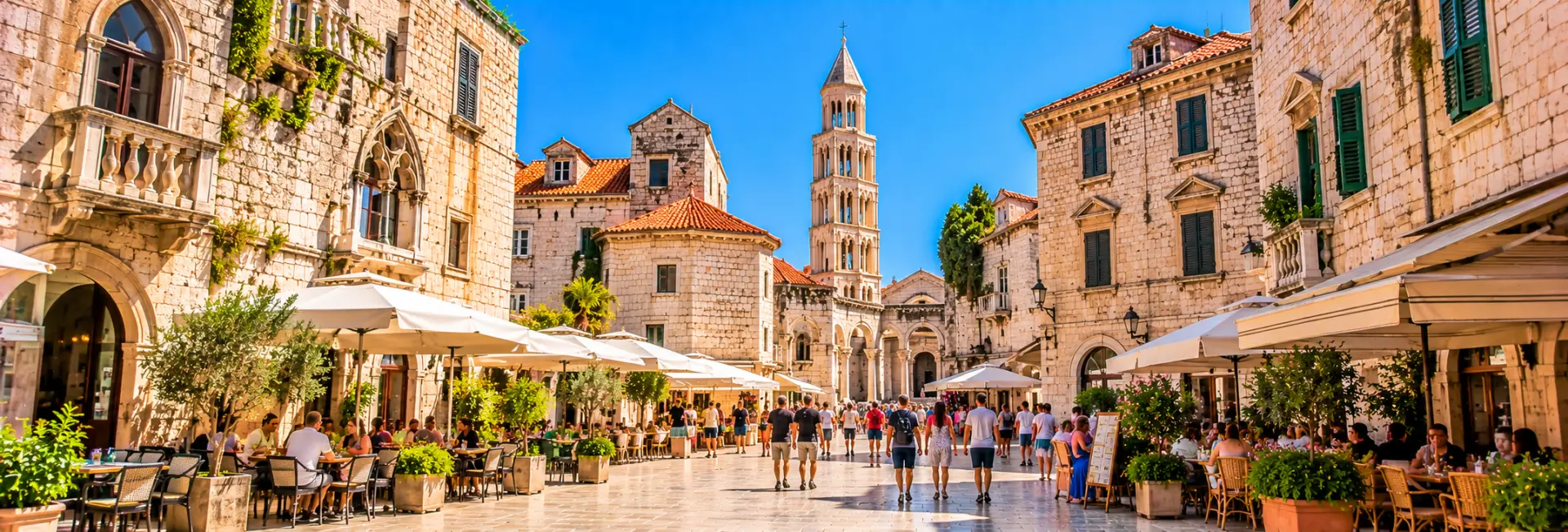
Just outside the western Iron Gate lies Narodni trg, usually called Pjaca by locals. Mentioned in records from the 13th century, it was the first part of the town to develop outside the palace. Today it is a broad, café-lined space paved in white stone, overlooked by the Gothic Old Town Hall with its Venetian-style loggia.
Fruit Square
A short walk away, Voćni trg, officially Trg Braće Radić, was once a fruit market. A statue of the poet Marko Marulić, regarded as the father of Croatian literature, stands here in front of the Baroque Milesi Palace, and the Venetian Tower rises beside it.
Republic Square and Marmontova Street
West of the centre, the neo-Renaissance arcades of the Prokurative open to the sea and form a more formal, almost Venetian-style space. Marmontova Street links this area to the Riva and runs inland past shops and the fish market toward the Croatian National Theatre.
Veli Varoš and Matejuška
At the western edge of the centre is Veli Varoš, a tangle of lanes and old stone houses that grew up as one of the earliest expansions outside the town's defences. Nearby, the little harbour of Matejuška has long sheltered the boats of local fishermen and still gives a glimpse of everyday maritime life.
Notable Landmarks
- Cathedral of St Domnius and bell tower: originally Diocletian's mausoleum, now a cathedral with a Romanesque tower offering sweeping views over the rooftops and harbour.
- Old Town Hall: a Gothic building on People's Square with a ground-floor loggia of Venetian-Gothic arches, now used for exhibitions.
- Papalić Palace and the City Museum: a 15th-century Gothic palace housing the city's history collection, a good place to understand how the Old Town evolved.
- Cambi Palace and other Gothic palaces: noble townhouses that show the Venetian-era style found around the western squares.
- Split Synagogue: one of the oldest synagogues in Europe still in use, tucked into the lanes near the Peristyle.
- Venetian Tower: a surviving fragment of the old fortifications, standing quietly beside Fruit Square.
- Church of Our Lady of the Bell Tower: a small church built into the western gate of the palace.
- Croatian National Theatre: a bright, ornate building from 1893 that dominates the square at the top of Marmontova Street.
- Statue of Gregory of Nin: a large bronze outside the Golden Gate by the sculptor Ivan Meštrović, famous for the toe visitors rub for luck.
Markets, Food and Local Life
Markets
The open-air market beside the palace's eastern wall is one of the city's main meeting points, selling fruit, vegetables, herbs, nuts and local specialities. Nearby, the fish market just off Marmontova Street is the place where locals come early to buy the day's Adriatic catch. Even if you are not cooking, both are worth a visit for the colour and conversation.
Cafés and Dining
Coffee culture is central to life in Split. Terraces fill every square and many lanes, and locals can spend hours over a single drink. Restaurants inside the palace walls range from simple taverns to polished dining rooms, often with tables set among ancient stone. For a more local feel, step a few lanes away from the main squares, where prices and crowds tend to ease.
Everyday Life
Because residents still live in the centre, the Old Town has a daily rhythm. Mornings bring deliveries and market shoppers, afternoons are quiet, and evenings fill with strollers and diners. Seeing laundry strung between ancient walls or hearing neighbours chat from windows is part of the charm, and a reminder to treat the area as someone's home.
Ways to Experience It
- Follow a self-guided loop: start at the Riva, enter through the Bronze Gate, cross the Peristyle, leave by the Iron Gate to People's Square, continue to Fruit Square, then return via Marmontova Street and Republic Square.
- Join a guided walking tour: a local guide can explain the overlapping Roman, Venetian and Austrian layers and point out details that are easy to miss.
- Visit a museum or exhibition: the City Museum and the exhibitions in the Old Town Hall give a good historical context.
- Climb the cathedral bell tower: the view shows the palace grid and the rest of the Old Town in a single glance.
- Go market browsing: mornings are best for the fish and vegetable markets.
- See a performance: the National Theatre and summer events in the palace add an evening dimension.
- End the day by the water: the Riva at sunset is a fitting finale for any visit.
Best Time to Visit
Seasons
Late spring and early autumn offer the best balance of warm weather, long daylight and manageable crowds. July and August are the busiest and hottest months, particularly when cruise ships are in port, and the narrow lanes can feel crowded by midday. Winter is calm, with fewer visitors and a more local feel, although days are shorter and rain is common.
Time of Day
Early morning is the best time for photographs, markets and quiet lanes. The middle of the day is better for museums, shaded cafés or the basement halls. Late afternoon and evening bring beautiful light on the stone and the liveliest atmosphere in the squares.
Visitor Tips
- Entry is free: you can wander the streets and squares at any hour. Individual museums, the cathedral treasury, the bell tower and the basement halls charge admission, so check current prices and opening hours before you go.
- Wear sensible shoes: polished stone and uneven steps can be slippery, especially in the rain.
- Dress respectfully for churches: shoulders and knees should be covered inside the cathedral and other places of worship.
- Keep valuables secure: crowded squares and market areas attract pickpockets, so close your bags and keep phones out of back pockets.
- Plan luggage carefully: the centre is pedestrian only, with cobbles and stairs, so a small bag is easier than a large suitcase.
- Expect evening noise: if you stay in the Old Town, ask about noise levels, since squares and bars can stay lively late in summer.
- Respect residents: people live here year-round, so keep your voice down in residential lanes and avoid blocking doorways.
- Getting here: the ferry port, bus station and railway station are all a short walk away, and the Old Town can only be explored on foot.
FAQs about visiting the Old Town of Split
What does the Old Town of Split include? +
It covers Diocletian's Palace and the historic districts around it, including People's Square, Fruit Square, Republic Square, Marmontova Street, Veli Varoš and the Riva waterfront. Together they form a compact, walkable area where most main sights sit within a short stroll of one another.
Is the Old Town the same as Diocletian's Palace? +
Not exactly. The palace is the Roman core and the oldest part, while the Old Town also includes the medieval and later districts that grew outside its walls, with their own squares, palaces and markets.
Is it free to visit the Old Town? +
Yes, you can walk the streets, squares and Riva at no cost. Paid entry applies to specific attractions such as the basement halls, the cathedral treasury, the bell tower and some museums.
How much time do I need? +
Half a day is enough to see the main squares and the palace at a relaxed pace, though a full day lets you add museums, markets and the bell tower. Many visitors spread it over two days to enjoy the evening atmosphere.
What is the best time of year to go? +
Late spring and early autumn are ideal for pleasant weather and fewer crowds. Summer is lively but hot and busy, while winter is quieter with shorter days.
Is it worth staying inside the Old Town? +
Staying in the centre puts you within steps of the sights and gives a memorable atmosphere in the evenings. The trade-offs are possible late-night noise and the effort of managing luggage over cobbles and stairs, so some visitors prefer a base just outside the walls.
How do I get to the Old Town of Split? +
The historic centre sits beside the harbour, a short walk from the ferry port, bus station and railway station. Cars cannot enter the core area, so most visitors arrive on foot or by taxi to the edge and walk in.
