
Table of Contents
Overview
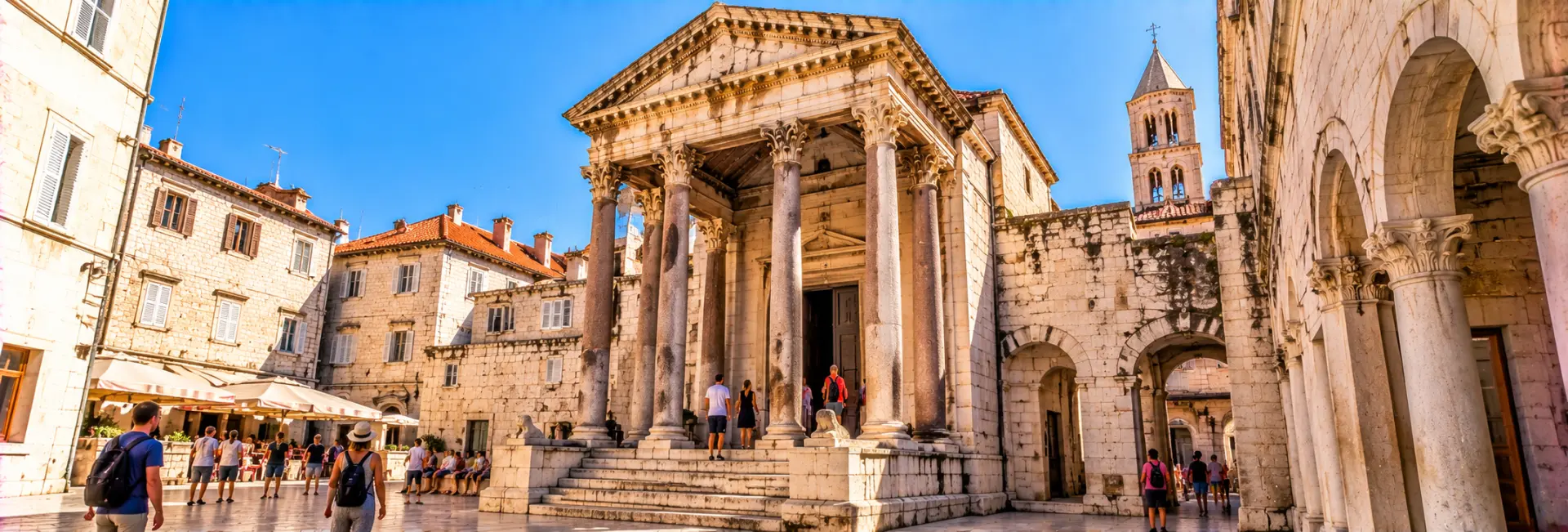
Tucked into a narrow lane just west of the Peristyle, the Temple of Jupiter is one of the best-preserved Roman religious buildings anywhere on the Adriatic coast. It is a small stone rectangle, yet it has stood in the same spot inside Diocletian's Palace for roughly 1,700 years.
Roman temples rarely survive with their roofs intact, and this one owes its survival to a change of purpose. In the early Middle Ages it was converted into the Baptistery of St John, and it has kept that role ever since. The result is a rare building in which a pagan shrine and a Christian sacred space share exactly the same walls.
The temple belongs to the Historical Complex of Split with the Palace of Diocletian, which UNESCO added to the World Heritage List in 1979. It is far quieter than the neighbouring Peristyle and cathedral, which makes it a rewarding stop for anyone who wants to see Roman Split without the crowds. Most visitors need only a short time here, but the details reward a slow look.
History
A Temple for the Emperor's Divine Patron
The temple was built between about 295 and 305 AD, as part of the palace that Emperor Diocletian had constructed on the coast near Salona, then the capital of the Roman province of Dalmatia. Diocletian took the title Jovius, tying his authority to Jupiter, the king of the gods. A temple to Jupiter standing close to the emperor's own mausoleum suited that image of divinely backed rule perfectly.
The building sat on the western side of the Peristyle, in the part of the palace devoted to religion. It is commonly described as one of three temples facing the central courtyard, the others honouring Venus and Cybele, but only the temple of Jupiter survives today.
An Unfinished Retirement
Diocletian abdicated in 305 AD, a rare step for a Roman emperor, and retired to his coastal residence. Because he arrived earlier than planned, construction on parts of the complex is thought to have halted before completion, and some elements of the temple appear to have been left unfinished.
From Pagan Temple to Christian Baptistery
As Christianity became the dominant faith of the empire, the palace slowly changed. The temple's conversion into a baptistery dedicated to St John the Baptist is traditionally placed in the 6th century, around the time a crypt beneath it was dedicated to St Thomas, although the exact date is not firmly documented.
There is a striking irony here. Diocletian presided over one of the harshest persecutions of Christians in Roman history, yet the shrine built for his pagan patron ended up serving the faith he tried to suppress. The new role probably saved the building too, since a structure in regular use was far more likely to be maintained than an abandoned shrine was to escape being stripped for stone.
Rediscovery and Admiration
Over the centuries, houses and shops filled the old palace and crowded in around the temple. When the Scottish architect Robert Adam surveyed the palace in 1757 and later published detailed engravings, the site reached a wide European audience and fed the growing Neoclassical taste for Roman design.
Architecture & Design
Plan and Platform
The temple is a compact rectangle raised on a podium in the traditional Roman manner. The raised base conceals a vaulted crypt below, which is why the main floor sits well above street level and the entrance is approached by steps. Its modest scale is part of its charm, since the whole building can be taken in at a glance.
The Coffered Barrel Vault
The standout feature is the stone barrel vault above the interior. It is divided into coffers, sunken panels that each carry a different central motif, so the ceiling rewards a few minutes of looking up. Unlike many ancient roofs, it is built entirely of stone rather than timber, which is a major reason the temple has lasted so well.
The Carved Doorway
The entrance is framed by an elaborately carved portal, a showcase of late Roman stonework that contrasts with the otherwise restrained exterior. Classical figures and decorative ornament surround the opening, and the doorway is worth studying before you step inside.
A Lasting Influence
The vault's design left a mark on later Dalmatian architecture. Its coffered form is often cited as an inspiration for early Renaissance builders in the region, most famously in Andrea Alessi's work at the baptistery in nearby Trogir.
Cultural & Religious Significance
Who Was It Really For?
Although the building is universally known as the Temple of Jupiter, scholars are not unanimous about its original dedication. Some have suggested it honoured other deities, including Asclepius, the god of healing. The Jupiter attribution remains the traditional one, and it fits Diocletian's close identification with the god.
A Living Baptistery
Christian use gave the building a second layer of meaning that continues today. The baptistery served the city's Christian community for centuries and still functions as a sacred space, which is why visitors are asked to behave with the same respect they would show in any church.
A Symbol of Continuity
Together with Diocletian's mausoleum, which became the Cathedral of St Domnius, the temple shows how the people of Split chose to reuse imperial architecture rather than replace it. The palace grew into a living town instead of a ruin, and the temple is one of the clearest proofs of that unbroken thread running from ancient Rome to modern Split.
Notable Features
The interior is small, but nearly everything in it has a story. These are the details most worth seeking out:
- The sphinx at the entrance: A headless black granite sphinx stands before the doorway. It is one of the Egyptian sphinxes Diocletian is said to have brought to adorn his palace, and it is more than 3,000 years old.
- The baptismal font: The font dates to the 13th century and was assembled from carved fragments of an 11th-century altar screen, a good example of medieval builders reusing older stonework.
- The medieval sarcophagi: Two stone coffins hold the remains of early archbishops of Split, including John and Lawrence, the latter of whom died in 1099.
- Meštrović's St John the Baptist: A large 20th-century bronze statue by the celebrated Croatian sculptor Ivan Meštrović dominates the interior and links the ancient space to modern Croatian art.
- The ceiling: The coffered stone vault is the single most impressive element, so pause and look up.
- The crypt: A crypt historically dedicated to St Thomas lies beneath the building. Access can vary, so it is worth asking at the entrance.
Visiting Etiquette & Tips
The Temple of Jupiter is easy to visit, but a few points make the experience smoother and more respectful.
- Finding it: The temple sits at the end of a narrow passage called Kraj Svetog Ivana, just off the Peristyle. From the small square at the back you only see the rear of the building, so walk around to the front for the full effect.
- Tickets: Entry to the interior generally requires a ticket, and it is often offered as part of a combined ticket for the wider cathedral complex. Prices and conditions change, so confirm them on site or with the official source before you go.
- Time needed: Most people spend 10 to 20 minutes inside, longer if they enjoy architectural detail.
- Dress and behaviour: Treat it as an active religious space. Cover shoulders and knees as you would in other churches, keep your voice low, and follow any posted rules on photography.
- Accessibility: Because the building stands on a raised podium and is reached by steps, step-free access is limited. Visitors with mobility needs should ask staff about options.
- Opening hours: Hours vary by season and by religious services, so check the current schedule rather than relying on printed guides.
Best Time to Visit
Seasons
Split is busiest from June to August, when the old town fills with visitors and the midday heat can be intense. Spring (April to May) and early autumn (September to October) offer a comfortable balance of mild weather, longer opening hours and thinner crowds, making them the best seasons for exploring the palace on foot.
Winter is the quietest period and the old town feels more local, though some opening hours may be shorter and the weather can be wet.
Time of Day
Early morning is usually the calmest moment, before tour groups arrive in force. Late afternoon is another good window, when the stone takes on a warm glow and the lanes around the temple start to empty. Because the interior is small, even a handful of visitors can make it feel busy, so timing matters more than it might seem.
Nearby Attractions
The temple sits in the middle of Diocletian's Palace, so most of Split's headline sights are only a few minutes' walk away.
- The Peristyle: The palace's grand central courtyard, framed by columns and arches, is steps away and is the natural next stop.
- Cathedral of St Domnius and Bell Tower: Diocletian's former mausoleum is now a cathedral, and its bell tower offers views over the rooftops and the harbour.
- The Palace Cellars: The vast vaulted substructures beneath the palace show how the building was laid out above and are one of the best-preserved parts of the complex.
- Pusti me proć: The name means "let me pass", and this is one of the narrowest streets in the city, running right beside the temple.
- The Golden Gate and Gregory of Nin: The northern entrance to the palace is guarded by Ivan Meštrović's monumental statue of the medieval bishop Gregory of Nin, whose toe visitors traditionally rub for luck.
- Riva Promenade: The seafront walkway outside the palace's southern wall is ideal for a coffee or a stroll after exploring the old town.
- Salona: The ruins of the Roman capital of Dalmatia lie just outside the city and give valuable context to the world Diocletian came from.
FAQs about visiting the Temple of Jupiter in Split
What is the Temple of Jupiter in Split? +
It is a Roman temple built between about 295 and 305 AD inside Diocletian's Palace, and it is one of the best-preserved ancient buildings in the complex. It was later converted into the Baptistery of St John, a role it still holds today.
Where exactly is it? +
It stands just west of the Peristyle in the old town, at the end of a small lane called Kraj Svetog Ivana. The back of the building faces a little square, so go around to the front to see the entrance and the sphinx.
Do I need a ticket to go inside? +
The interior generally requires a ticket, which is often available as part of a combined ticket for the cathedral complex. Prices and inclusions change, so check on site or with the official source before your visit.
How long does a visit take? +
Plan on 10 to 20 minutes for the temple itself, since the interior is compact. If you combine it with the Peristyle, cathedral and cellars, a full palace visit can easily fill two to three hours.
Why is a pagan temple now a Christian baptistery? +
Following the rise of Christianity, the temple was converted for Christian worship, traditionally dated to the 6th century. Reuse of this kind helped the building survive when many other ancient temples were demolished or abandoned.
Is the Temple of Jupiter suitable for children and visitors with limited mobility? +
Children usually enjoy the sphinx and the carved ceiling, and the visit is short. The raised entrance involves steps, so step-free access is limited and visitors with mobility needs should ask staff on arrival.
What is the best time to visit? +
Early morning on a weekday in spring or early autumn is usually the most relaxed. In summer, arriving as the doors open helps you avoid both the heat and the busiest tour-group hours.
What should I see nearby? +
The Peristyle, the Cathedral of St Domnius, the palace cellars and the narrow Pusti me proć street are all within a couple of minutes' walk. The Golden Gate and the Riva promenade are only slightly farther.
