
Table of Contents
Overview
On the slopes of the Marjan peninsula, looking out over the Adriatic, the Meštrović Gallery occupies the villa that Ivan Meštrović designed as his family home, workshop and showroom. Meštrović (1883–1962) is widely regarded as the most important modern Croatian sculptor, and this house holds a large share of his life's work in marble, bronze, wood and plaster.
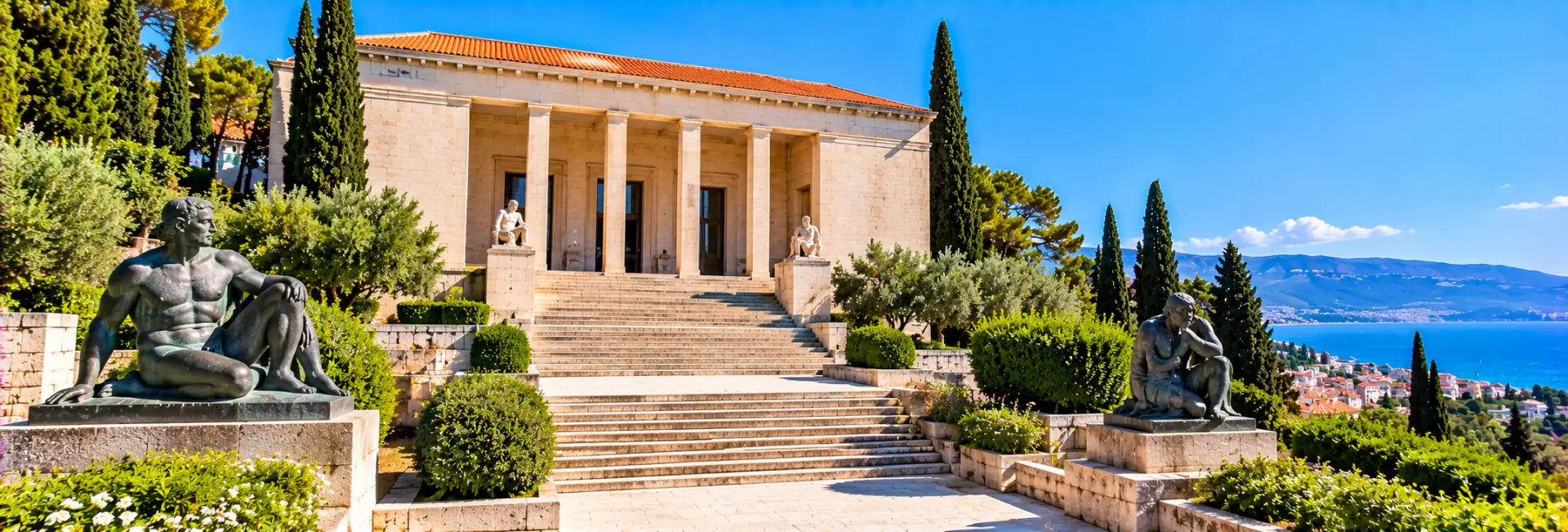
Unlike many museums, the setting here is part of the story. The building was planned by the artist himself, so visitors move through his dining room, his stone-faced halls and a sculpture park that he conceived as part of the whole composition. The gallery is considered an art monument in its own right.
It welcomed roughly 37,000 visitors in 2024, a modest figure by Split standards, which makes it a calm and rewarding escape from the crowds of the old town. It is a natural stop for anyone who has seen the Gregory of Nin statue outside the Golden Gate and wants to understand the sculptor behind it.
History of the Gallery
A Villa Takes Shape
Meštrović bought land on the Marjan peninsula in the 1920s, intending to build a summer home. The villa went up between 1931 and 1939 to his own design, with architects Lavoslav Horvat and Harold Bilinić developing the plans and the builder Marin Marasović running construction. From the start it was meant to serve three purposes at once: a family residence, a working studio and a place to exhibit his art.
The Family Years
The Meštrović family stayed in the villa from the summer of 1932 until 1941. In April of that year the family gathered there after the death of the artist's mother, and they were soon caught up in the Italian occupation of the city. Meštrović left for Zagreb, and although he had hoped to spend his later years in the house, it never became his permanent home. Relatives and other families lived in the villa for some years afterwards.
A Gift to the Nation
After emigrating to the United States following the Second World War, Meštrović donated the Split villa, three other properties and 132 of his works to the Croatian state. The donation is usually dated to 1952, although a few sources give 1951. It laid the foundation for the gallery, which was run first by the Conservation Institute for Dalmatia, then by the city of Split from 1955, and since 1991 has belonged to the Ivan Meštrović Foundation.
Closure and Reopening
The building was closed to the public for many years, partly because of its poor condition and partly because of the Croatian War of Independence in the 1990s. After an extensive renovation, a new permanent display opened on 18 May 1998.
Architecture & Building
A Home, Studio and Showcase
The villa is a neoclassical building with a stone façade, designed so that living quarters, working spaces and exhibition halls could coexist under a single roof. Its position overlooking the sea gives the grounds a sense of openness that suits the monumental scale of the sculptures inside and out.
Inside the Villa
On the ground floor, the central hall serves as a formal entrance, filled mostly with large marble statues that echo the stone of the façade. The dining room on the west side keeps the character of a family home, with Meštrović's furniture, paintings and bronze portraits of relatives. The hall on the east side is devoted to religious works, a recurring theme in his art.
Upstairs, the west wing displays early works from his Secession period, while the east hall shows sculptures made mostly between the two world wars. A separate side room is dedicated to the biblical figure of Job, and the large central hall is also used for special events.
The Sculpture Park
In front of the building, a garden and sculpture park hold a group of bronze works set against the sea view. Walking among them in the open air gives a very different impression from the quieter indoor halls.
From Home to Museum
Because Meštrović planned the villa as a residence and studio rather than a museum, turning it into a gallery required adjustments. The curators nonetheless kept the original character of the halls and rooms, so the house still feels lived-in rather than clinical.
Collections & Exhibits
According to published figures, the gallery's holdings include around 192 sculptures, nearly 600 drawings, several paintings, almost 300 architectural plans dating from 1898 to 1961, and two sets of furniture. A further group of works belonging to the artist's heirs is also housed here. Only part of this material is on show at any time.
Arranged by Theme
The permanent exhibition covers two floors and the outdoor park, and it is organised by theme rather than in strict chronological order. This approach lets you compare works from different decades side by side and see how motifs such as faith, suffering and the human form recur throughout his career.
A Range of Materials
Visitors can see original plaster models alongside finished pieces in bronze, marble and wood. Seeing the same artist handle such different materials is one of the gallery's quiet pleasures, because the stone pieces feel monumental while the carved wooden works are much more intimate.
Beyond Sculpture
The gallery also preserves a substantial archive of letters, photographs and documents connected with Meštrović's life, including family correspondence from the war years. The architectural plans are a reminder that he was a capable architect as well as a sculptor, and that this house was one of his own designs.
Must-See Highlights
Meštrović's output is vast, so a few signposts help you focus your time. These are among the works and spaces most often singled out:
- Cyclops: A powerful bronze that shows the dramatic, muscular style for which the sculptor became famous.
- Adam and Eve: A pair of walnut figures that demonstrate his skill in wood as well as stone.
- Persephone: One of the works from his mythological repertoire, shown among the gallery's key sculptures.
- The Job room: The dedicated side room upstairs gathers works on the biblical theme of Job and rewards a slow look.
- The religious hall: The east hall on the ground floor concentrates his sacred works, a defining strand of his career.
- The dining room: A rare chance to see the family's own furniture, paintings and bronze portraits in their original setting.
- The sculpture park: The bronzes in the garden are best appreciated with the Adriatic in the background.
Kaštelet-Crikvine
Not far from the villa stands Kaštelet-Crikvine, a Renaissance-style summer residence that once belonged to the noble Capogrosso family and dates back to the 16th century. Meštrović bought the property after finishing work on his own villa. It is sometimes referred to by the local name Kaštilac.
The Life of Christ Reliefs
The highlight is the Holy Cross chapel, which Meštrović remodelled in 1939 to house a cycle of carved wooden reliefs on the life of Christ. He created the cycle over several decades, between 1916 and 1950. Around 28 of these wooden reliefs, along with a pair of sculptures, are displayed here, and the intimate scale makes the experience very different from the villa.
A Combined Visit
Kaštelet-Crikvine is only a short walk from the main gallery, and the ticket for the villa has traditionally included entry to it. It is well worth the detour, especially if you enjoy the religious dimension of Meštrović's art.
Ways to Experience It
- Self-guided visit: Most people wander through at their own pace, starting with the ground-floor halls, continuing upstairs and ending in the sculpture park. Allow about an hour for the main exhibition.
- Guided city tours: Some sightseeing tours of Split include the gallery alongside the old town, which is useful if you prefer context from a guide.
- Garden time: The grounds invite you to linger. Sit near the sculptures and enjoy the view across the water.
- Add Kaštelet-Crikvine: Pair the villa with the nearby chapel to see the full range of Meštrović's work, from monumental marble to delicate wood carving.
- Special events: The central hall upstairs hosts occasional events, so check the schedule if you want to see the space used in a different way.
Best Time to Visit
Seasons
The gallery is open throughout the tourist season, and spring and early autumn are especially pleasant because mild weather makes the garden and the walk between the buildings more enjoyable. Summer is busy in Split generally, but the gallery rarely feels crowded, and the stone interior offers welcome relief from the midday heat.
In winter hours are usually shorter, so plan around the current schedule. The villa is also a good option on a rainy day, when the old town's open-air sights are less appealing.
Time of Day
Mornings are the quietest, giving you the halls almost to yourself. Late in the day, the light over the sea softens and the sculpture park takes on a warmer tone, making it a good time to finish with the outdoor works.
Visitor Tips
- Tickets: A single ticket has typically covered both the gallery and Kaštelet-Crikvine, with reduced rates for students, seniors and Split Card holders, and a family option. Confirm current prices and inclusions on the official website, as they change.
- Opening hours: Hours vary by season and the gallery is usually closed on one day a week, so check the current schedule before you set out.
- Getting there: City buses have served the area, including lines 7, 8, 12 and 21, and a taxi from the centre takes roughly 10 to 15 minutes. Confirm routes locally, as they may change.
- Time needed: Plan on around an hour for the main exhibition, plus extra for the garden and the nearby chapel.
- Comfortable shoes: The villa has two floors and the grounds involve some walking, so wear shoes you can stand in for a while.
- Accessibility and photography: Ask staff on arrival about step-free access and photography rules, since they may differ between rooms and the garden.
- Wi-Fi: The gallery offers a Wi-Fi access point, which is useful for reading about works as you go.
Nearby Attractions
- Marjan Hill: The forested peninsula above the gallery is Split's green lung, with walking paths and sea views that make a natural follow-up to a museum visit.
- Kaštelet-Crikvine: The nearby chapel with the Life of Christ reliefs is the obvious companion stop.
- The Gregory of Nin statue: Meštrović's giant bronze bishop stands outside the Golden Gate and is the most famous of his public works in the city.
- Diocletian's Palace: The Peristyle, the Cathedral of St Domnius and the Temple of Jupiter lie in the old town, a short taxi or bus ride away.
- The Riva promenade: The seafront walkway outside the palace is ideal for a coffee or meal after your visit.
FAQs about visiting the Meštrović Gallery in Split
What is the Meštrović Gallery? +
It is a museum dedicated to the sculptor Ivan Meštrović, housed in the seaside villa he designed as his home and studio. It displays sculptures, drawings, architectural plans and furniture.
Who was Ivan Meštrović? +
He lived from 1883 to 1962 and is widely regarded as Croatia's greatest modern sculptor. His best-known public works include the Gregory of Nin statue in Split.
Where is the gallery located? +
It stands on the Marjan peninsula on the west side of Split, at Šetalište Ivana Meštrovića 46. A taxi from the city centre takes about 10 to 15 minutes, and city buses also serve the area.
How long does a visit take? +
About an hour is enough for the main exhibition. If you add the garden and the nearby Kaštelet-Crikvine chapel, allow two to three hours in total.
Does the ticket include anything else? +
A single ticket has typically included Kaštelet-Crikvine, where the Life of Christ reliefs are on display. Check the current ticket terms before you go.
Is it worth visiting if I am not an art expert? +
Yes. The building is a fascinating piece of architecture in itself, the sculptures are accessible and dramatic, and the sea-facing garden makes the visit relaxing as well as educational.
What are the highlights? +
Highlights include the bronze Cyclops, the walnut Adam and Eve, the Job room, the religious works hall and the dining room, which still looks like a family home. The garden sculptures are also worth seeing.
When is the best time to go? +
Mornings in spring or early autumn are the calmest and most comfortable. The gallery is also a good choice for a rainy day or to escape summer midday heat.
