
Table of Contents
Overview
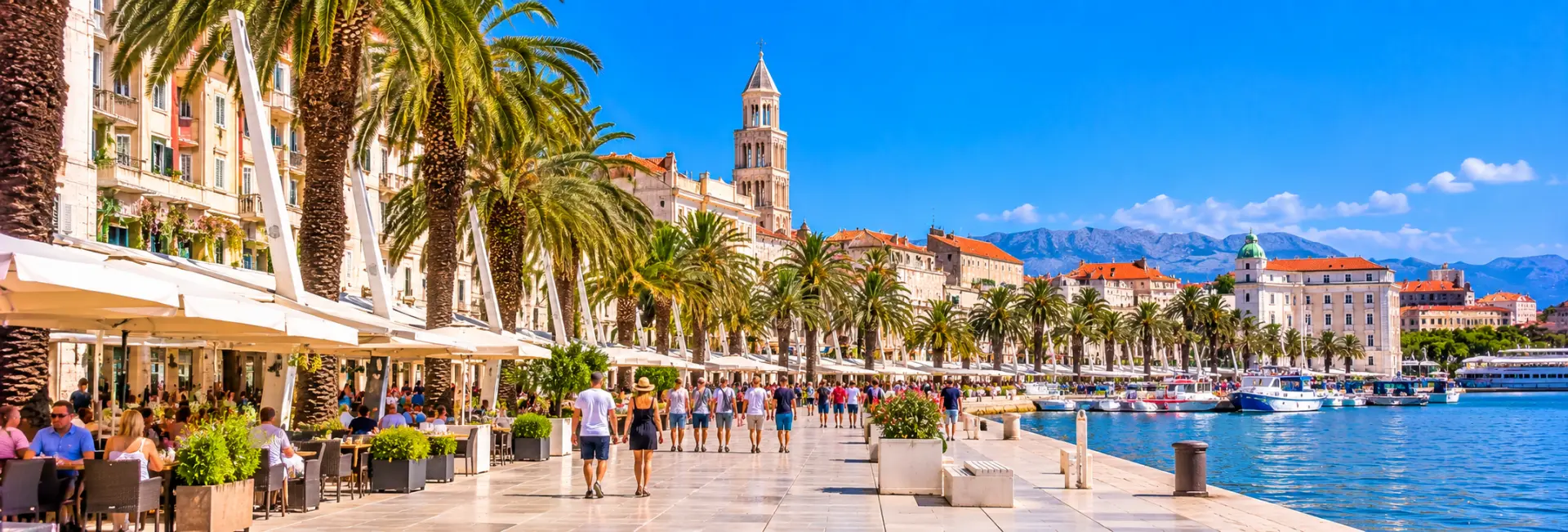
The Riva is Split's seafront promenade and, for most people, the first thing they see of the city. Its official name is Obala hrvatskog narodnog preporoda, meaning the Quay of the Croatian National Revival, but nobody in Split uses it. Locals simply say "the Riva", and they mean far more than a street. It is the city's open-air living room, a place to meet friends, linger over coffee and watch the harbour at work.
The promenade stretches roughly 250 metres along the southern wall of Diocletian's Palace, with the Adriatic on one side and tall Roman stone on the other. Rows of palm trees, wide pale paving, café terraces and benches facing the water give it a relaxed, theatrical feel at every hour of the day.
The Riva is free to enjoy, open around the clock, and works equally well as a morning coffee stop, a sunset stroll or a lively place to spend an evening.
History
A Wall That Met the Sea
When Diocletian had his palace built, its southern wall rose almost directly from the water, and the Bronze Gate allowed boats to reach the vaulted rooms inside. There was no promenade. Over the centuries the shoreline shifted and a strip of ground formed in front of the wall, and houses, shops and workshops were eventually built into the ancient stonework itself.
The French Shape the Waterfront
The Riva began to take its modern form in the early 1800s, during the period of French administration under Marshal Marmont. Older fortifications from the Venetian era were cleared away, and the material was used to extend the waterfront, especially toward the west. The idea of a wide public quay for strolling, rather than a defensive edge, set the pattern that continues today.
The 19th and 20th Centuries
Later in the 19th century, the city's reform-minded mayor Antonio Bajamonti pushed the waterfront further west, adding the elegant arcaded buildings known as the Prokurative beside what is now Republic Square. During the 20th century the Riva was paved, lined with palm trees and increasingly given over to pedestrians, gradually turning from a working harbour edge into the social centre it is today.
The 2007 Redesign
The Riva you see now is largely the result of a major rebuild completed in 2007. In 2005 the City of Split held an open design competition, and the winning proposal came from the Zagreb architecture studio 3LHD. Construction ran from 2006 to 2007, and the central, fully pedestrian stretch, covering roughly 14,000 square metres, was the focus of the first phase.
The brief set strict rules about respecting the palace, which is a UNESCO World Heritage Site, especially where the new surface meets the ancient wall. The designers responded with a clean, uncluttered look: pale stone paving laid in long, calm lines, tall light poles that give an even warm glow in the evening, and shade structures over the café areas. Custom street furniture and carefully planned planting completed the scheme.
Not everyone loved it immediately. Split residents have a reputation for being protective of their city, and the contemporary look took some getting used to. Today it works exactly as intended, giving the Riva a modern, open feel without competing with the Roman walls behind it.
Along the Promenade
The Riva is short enough to walk end to end in a few minutes, yet each stretch has its own mood.
The Western End
Toward the west, the promenade opens toward Republic Square and the neo-Renaissance Prokurative, an arcaded square open to the sea on one side. It is a more spacious, formal corner of the city, with views along the coast toward Marjan hill and plenty of room for events.
The Central Stretch
The middle section is the true heart of the Riva. Café terraces line the foot of the palace wall, the Bronze Gate opens into the palace's lower levels, and benches face the water. This is the busiest, most photogenic part, where locals and visitors share the same tables.
The Eastern End
Further east, the mood becomes more practical. The port authority building stands near the main ferry terminal, and travellers heading to the islands pass through here with their luggage. Boats, yachts and ferries moving across the harbour give this end a busy, maritime character.
The Riva in Local Life
A Daily Ritual
What makes the Riva special is not any single building but the way people use it. Residents arrive to meet friends, catch up on news and spend unhurried time over a coffee, often at the same table they have used for years. Dalmatians have a word, fjaka, for a pleasant state of unhurried idleness, and the promenade is where it is most easily practised. Tourists who slow down to match that rhythm tend to have the best experience.
Festivals and Public Celebrations
Because it is the city's biggest open public space, the Riva is also its stage. Concerts, fairs and processions take over the promenade during the year, and the pre-Lent carnival uses it as a natural route for parades and performances. In summer, music from festival events in the Peristyle can drift through the Bronze Gate and out toward the water, linking the ancient courtyard to the modern waterfront.
Where the City Meets the World
The Riva is also a point of arrival and departure. Travellers pass through on their way to the ferries, cruise passengers step off for their first look at Split, and diners from many countries share the same terraces. That mix of local routine and international visitors is a large part of the Riva's energy, and it is why locals and visitors alike regard a walk here as an essential part of any stay in the city.
Things to Do on the Riva
- Sit down for a long coffee: in Split, a single drink can fill a whole morning, and nobody will hurry you. This is the classic Riva experience.
- Take a sunset walk: the light on the palace wall and the harbour in the late afternoon is the best of the day.
- People-watch from a bench: the waterfront benches are free and there is always something happening, from street performers to families out for an evening stroll.
- Step into the palace: the Bronze Gate leads directly from the promenade into the basement halls and on toward the Peristyle.
- Catch an event: the Riva hosts concerts, fairs, processions and festival celebrations throughout the year, particularly in warmer months.
- Watch the boats: the harbour is full of ferries, yachts and fishing boats, and boat trips to nearby islands depart from the port close by.
- Enjoy a night out: after dark the bars and terraces fill up, and the atmosphere is relaxed rather than rowdy.
Best Time to Visit
Seasons
The Riva can be enjoyed all year, which is part of its appeal. Late spring and early autumn are ideal, with warm evenings, comfortable temperatures and lighter crowds. From June to August the promenade is at its liveliest and busiest, as ferry passengers, cruise visitors and beachgoers all pass through the same narrow strip of waterfront.
In winter the Riva is much calmer. The weather can be damp, but the cafés stay open and it feels more like a place where locals go about their lives.
Time of Day
Early morning is quiet, with the first coffees and the light on the palace wall. Midday in summer can be hot, with limited shade. Late afternoon and evening bring the best light and the strongest sense of occasion, so this is the moment to plan a walk if you only have time for one.
Visitor Tips
- It costs nothing to visit: the promenade is a public space. You only pay for what you order at a café or restaurant.
- Check menu prices first: waterfront venues price for the location, so look at the drinks list before sitting down.
- Watch your belongings: busy summer evenings attract pickpockets, so keep bags zipped and phones out of back pockets.
- Bring sun protection: shade is limited outside the café areas, so a hat and water are useful in summer.
- Easy for most visitors: the central stretch is flat, wide and step-free, which suits families with strollers and visitors with limited mobility.
- Expect noise at night: in peak season the area stays lively late, which matters if you are booking accommodation nearby.
- Getting here: the central Riva is pedestrian only. The ferry port, bus station and railway station are all within walking distance.
Nearby Attractions
- Diocletian's Palace: directly behind the promenade, entered through the Bronze Gate, with the Peristyle, cathedral and bell tower a few minutes inside.
- Republic Square and the Prokurative: a short walk west, a grand arcaded square open to the sea.
- Marmontova Street: a lively pedestrian shopping street leading inland from the western end.
- The open-air market: just outside the palace's eastern gate, a colourful place for fruit, vegetables and local products.
- People's Square: reached through the Iron Gate, the historic centre of the medieval town.
- Marjan hill: a forested peninsula west of the centre with walking paths and sea views, easy to reach on foot along the waterfront.
- Island ferries: the port beside the Riva has ferries and boats to nearby islands such as Brač and Hvar.
FAQs about visiting the Riva Promenade
What is the Riva in Split? +
The Riva is Split's main waterfront promenade, running along the south side of Diocletian's Palace. It is lined with palm trees, cafés and benches, and it serves as the social centre of the city for locals and visitors alike.
Is there an entrance fee? +
No. The Riva is a public promenade, free to visit at any hour. The only costs are for the food and drinks you choose to buy.
How long should I spend on the Riva? +
A walk from end to end takes only a few minutes. Most people stay between 30 minutes and a couple of hours, especially if they stop for coffee or a meal.
When is the best time to go? +
Late afternoon into the evening is the most atmospheric, with the best light and the liveliest crowd. For a quieter experience, go in the early morning or outside the summer months.
Is the Riva suitable for families and wheelchair users? +
Yes. The central promenade is flat, wide and step-free, so it is easy to move around with strollers or a wheelchair.
Is it expensive to eat and drink on the Riva? +
Waterfront venues generally charge more than cafés in the side streets because of their prime location. Check the menu prices before you sit, or enjoy the views from a free bench instead.
How do I get to the Riva? +
It sits at the edge of Split's Old Town, a short walk from the ferry port, bus station and railway station. The central part is pedestrian only, so plan to walk the last stretch.
