
Table of Contents
Overview
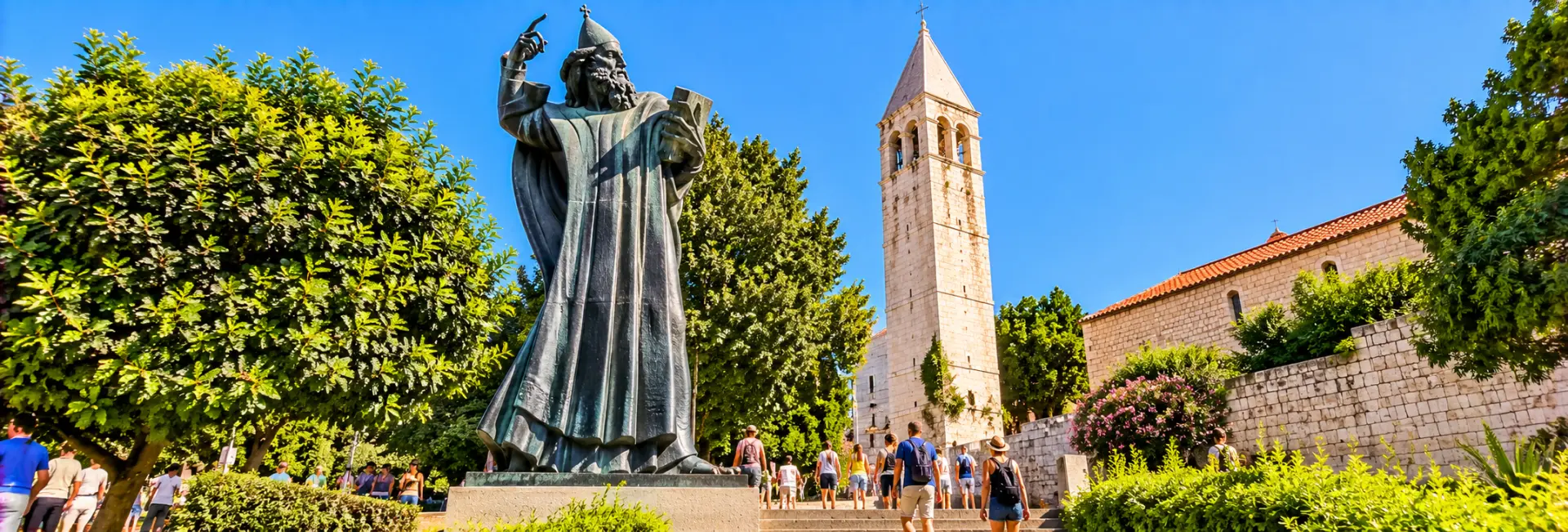
Just outside the Golden Gate, the northern entrance to Diocletian's Palace, a colossal bronze bishop looms over the old town wall. This is the statue of Gregory of Nin, known in Croatian as Grgur Ninski, created by the sculptor Ivan Meštrović and one of the most photographed monuments in Split.
The figure stands roughly 8.5 metres tall, robed and bearded, with one arm raised toward the sky. Visitors often joke that he looks more like a wizard than a medieval churchman, but for many Croats he is a powerful symbol of language and national identity.
The statue is open-air and free to visit at any hour. Most people come for two reasons: to admire an impressive piece of 20th-century public sculpture, and to rub its famously polished big toe for good luck.
Who Was Gregory of Nin?
A Bishop in Early Medieval Croatia
Gregory was a bishop of Nin in the 10th century, when that small coastal town was an important religious centre of the early Croatian kingdom. He enjoyed the protection of King Tomislav, the ruler traditionally regarded as the first king of the Croats.
The Dispute with Split
Historically, Gregory is best documented for a church dispute with the archbishop of Split over authority across Dalmatia and Croatia. Church councils held in the 920s ruled against him, placed him under the archbishop of Split, abolished his bishopric at Nin and moved him to the smaller see of Skradin.
How the Legend Grew
Tradition credits Gregory with introducing the Croatian language into church services at a time when Latin was incomprehensible to most worshippers. Historians point out that this image was largely shaped by 19th-century nationalist writers, who recast him as a champion of Croatian culture. Whatever the finer historical details, it is this legend that the statue celebrates and the reason he remains a beloved figure today.
History of the Statue
Unveiled in the Peristyle (1929)
Meštrović's statue was erected in September 1929 in the Peristyle, the central courtyard of Diocletian's Palace, and it appears on many pre-war postcards. Many commentators read the choice of location as a symbolic one. Gregory had lost his argument with the Latin-speaking church establishment of Split, and now a Croatian bishop stood at the very centre of the old Roman town.
Removal During the Second World War
In 1941, Italian occupying forces had the monument moved out of the city. It remained away from public view for the rest of the war years.
A New Home Outside the Golden Gate (1954)
The statue returned in 1954, re-erected just north of the palace, outside the Golden Gate and near Đardin park, where it still stands today. Some see poetic symbolism in the bishop now standing outside the walls of the old town he once clashed with, facing the entrance like a sentinel.
Restoration and Protection
A major restoration of the monument took place between 2013 and 2015, which is why the bronze appears sharp and detailed up close. The statue is also listed in the Register of Cultural Goods of Croatia, recognising its importance as a national landmark.
Design & Symbolism
Scale and Pose
Cast in bronze, the statue is about 8.5 metres tall, making it among the largest public monuments in Croatia, and it is reported to weigh around 13 tonnes. Gregory is shown in long robes, holding an open book in one hand while the other points upward, a pose that suggests both teaching and spiritual authority.
Meštrović's Style
Ivan Meštrović is widely regarded as one of the greatest Croatian sculptors of the 20th century, and this monument shows his taste for heroic scale and monumental forms. The bishop is a commanding, slightly stern presence rather than a gentle saint, which suits the story of a defiant churchman standing up to Rome.
Reading the Figure
The open book is usually read as a reference to scripture and the written word, while the raised finger works as a call to listen. Together they reinforce the language message at the heart of the legend, which is that faith should be heard and understood in the tongue of ordinary people. Looking up at the stern face from below, it is easy to see why the monument has become such a potent national symbol.
Part of a Trio
The Split monument is not the only one of its kind. Statues of Gregory also stand in Nin, the bishop's own seat, and in Varaždin, so Split's version is one of three that link very different corners of Croatia through the same figure.
The Lucky Toe Tradition
The statue's most famous feature is not its size but its left big toe. Unlike the rest of the figure, which is dark and weathered, the toe gleams a bright, golden shade, polished smooth by the hands of countless visitors over the decades.
How the Ritual Works
The custom is simple: make a wish, then rub the toe. Local belief holds that the wish will come true, and many visitors add that touching the toe also guarantees a return trip to Split.
Gold Against Bronze
The contrast is what makes the toe so easy to spot, even from across the square. The weathered bronze elsewhere has a deep, dark tone, so the glowing toe seems to call for attention and effectively marks where generations of visitors have stood. It is a rare case of public art being shaped as much by its audience as by its sculptor.
A Living Tradition
No one can say exactly when the habit began, but it has clearly grown with the statue's popularity. Today it is part of almost every first visit to the old town, and you will often see visitors queueing patiently for a turn. Even sceptics tend to join in, treating it as a small, cheerful ritual that connects them with the many people who have stood in the same spot.
Ways to Experience It
There is no ticket and no schedule, so you can experience the statue in whatever way suits your trip.
- Self-guided stop: Pair it with the Golden Gate on a walk through the old town. Entering the palace through the gate and walking south leads straight to the Peristyle.
- Guided walking tours: Many guided tours of Diocletian's Palace include a stop at the monument and add context about Gregory, Meštrović and the Golden Gate.
- Photography: The statue's scale and the old stone wall behind it make a striking composition. Stand back far enough to fit the whole figure and the gate in the frame.
- The toe ritual: Join the line, make a wish and give the toe a rub. It takes only a few seconds.
A popular way to build the visit into a wider walk is to start at the Riva promenade on the seafront and enter the palace through the Bronze Gate on the south side. Follow the main inner street north past the Peristyle and leave through the Golden Gate, and the statue greets you as you step outside. It makes a fitting finale, and you can easily loop back through the old town afterwards.
Best Time to Visit
Seasons
The statue can be visited at any time of year, since it stands in the open air. Summer brings the largest crowds, which means longer waits for the toe and busier surroundings. Spring and early autumn offer mild weather and fewer people, and winter is the quietest period, though the weather can be wet.
Time of Day
Early morning is usually the best moment for a calm visit and clear photographs, before tour groups arrive. Heritage data records the statue as facing roughly southeast, so front-on photos tend to be easiest in the morning. Late evening is another good option, when the crowds thin and the old walls take on a warmer tone.
Visitor Tips
- Cost and hours: The statue is free and open-air, so there are no tickets or opening hours to worry about.
- Finding it: It stands on the north side of the palace, outside the Golden Gate, and can be reached on foot from the Peristyle or along Ulica kralja Tomislava from the city centre.
- Accessibility: The approach from the city centre is a wide, flat pedestrian area that is generally comfortable for wheelchairs and pushchairs.
- Be considerate: Queue briefly rather than crowding the toe, and avoid climbing on the base or pedestal.
- Crowds: The area becomes busy at peak times, so keep an eye on your belongings as you would in any popular tourist spot.
- Time needed: Most visits last between 10 and 15 minutes, longer if you want to photograph the statue from several angles or explore the gate and park.
Nearby Attractions
The statue sits at the edge of the old town, so the rest of Split's top sights are within an easy walk.
- The Golden Gate (Zlatna vrata): The grandest entrance to Diocletian's Palace is directly behind the statue and was the main ceremonial gate from the north.
- Church of St Martin: A tiny early church is built into the wall above the Golden Gate and is one of the palace's most unusual details.
- Đardin Park: This green space near the statue is a pleasant spot to pause and take in the view of the palace walls.
- The Peristyle: The palace's central courtyard, where the statue originally stood, is a short walk south through the old town.
- The Temple of Jupiter: A well-preserved Roman temple turned baptistery lies just west of the Peristyle.
- Cathedral of St Domnius: Diocletian's former mausoleum stands beside the Peristyle, and its bell tower offers views across the city.
- Meštrović Gallery: Meštrović's former Split studio now houses a large collection of his sculptures, reliefs and drawings, which is ideal for anyone who wants to see more of his work.
FAQs about visiting the Gregory of Nin Statue in Split
What is the Gregory of Nin statue? +
It is a monumental bronze statue of the medieval bishop Gregory of Nin, created by Ivan Meštrović and standing outside the Golden Gate of Diocletian's Palace. It is one of Split's best-known landmarks.
Why do people rub the statue's toe? +
Local tradition says that rubbing the left big toe and making a wish brings good luck, and many visitors add that it also ensures a return to Split. Countless hands have polished the toe to a bright shine.
Who was Gregory of Nin? +
He was a 10th-century bishop of Nin who is remembered as a champion of using the Croatian language in church services. Historians note that much of this image was shaped by later nationalist writers, but the legend remains central to his reputation.
Where exactly is the statue? +
It stands just north of Diocletian's Palace, outside the Golden Gate and near Đardin park. You can reach it on foot through the palace from the Peristyle or along Ulica kralja Tomislava from the city centre.
Is it free to visit and when is it open? +
Yes, the statue is free and located outdoors, so you can see it at any time of day or night.
Why was the statue moved? +
It was first erected in the Peristyle in 1929 and was removed from the city in 1941 by Italian occupying forces. It was re-erected in its present location outside the Golden Gate in 1954.
How long does a visit take? +
Most people need 10 to 15 minutes for photographs and the toe ritual. If you add the Golden Gate and a short stroll in Đardin park, allow half an hour.
Is the area suitable for wheelchairs and families with young children? +
The approach from the city centre along Ulica kralja Tomislava is a flat, wide pedestrian area, so it is generally comfortable for wheelchairs and pushchairs. The statue is a quick, easy stop that children usually enjoy.
