
Table of Contents
Overview
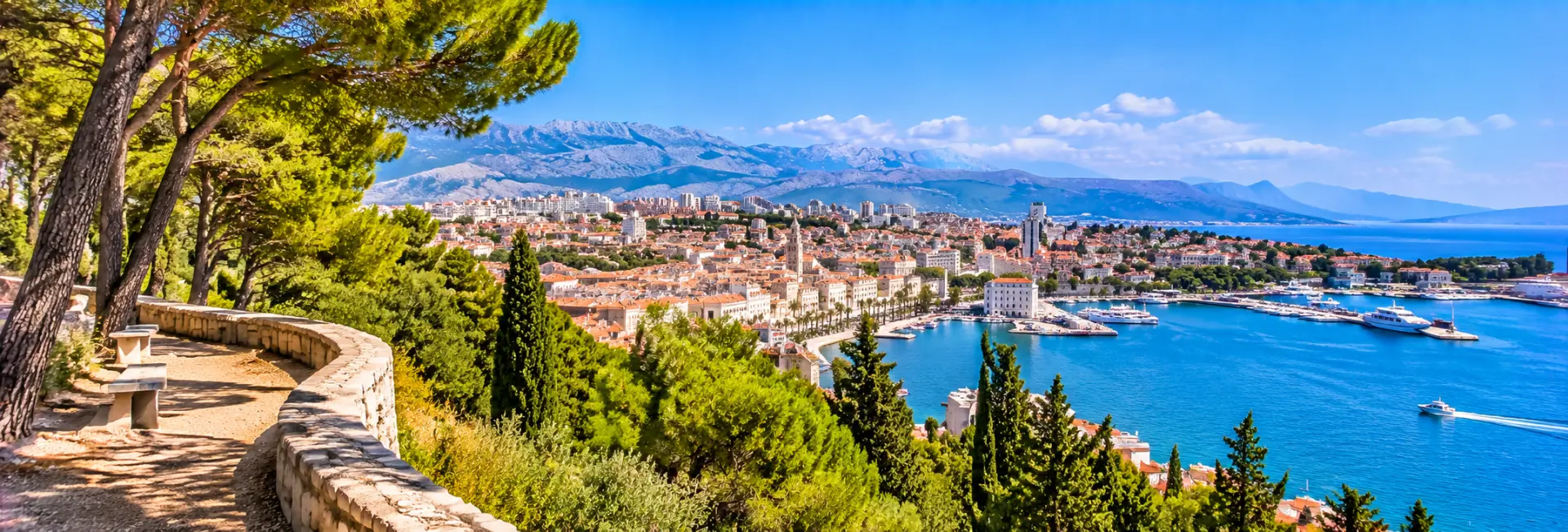
Marjan is the green hill that fills the western end of the Split peninsula, and the city's favourite escape from the stone streets of the Old Town. Rising to 178 metres, it is covered in pine forest and fringed by rocky coves, and it sits close enough to the centre that you can walk from the Riva to the first viewpoint in roughly half an hour.
Locals use it as a park, a running track, a swimming spot and a place to clear their heads. Visitors tend to come for the views, which take in the rooftops of the Old Town, the harbour, nearby islands and, on clear days, the mountains of the mainland. Together with its quiet paths, old chapels and small beaches, it makes a natural counterpart to the busy waterfront below.
Entry is free and the park is open for walking at any time of year, making Marjan one of the easiest and most rewarding half-day outings in Split.
History and Heritage
A Hill Protected for Centuries
Marjan has long mattered to the people of Split. A medieval city statute already forbade cutting down trees on the hill, an early sign of how much the community valued it as a shared resource. The name itself is believed to be very old, with early records mentioning it in a Latin form as far back as the 8th century.
Forests Planted by Hand
The dense pine woods that cover Marjan today are largely a modern creation. Aleppo pines were planted across the slopes between the late 19th and early 20th centuries, turning what had been a more open landscape into the green canopy visitors see now. In the same period, a local association raised funds to build paths, stairways and a restaurant, laying the foundations for Marjan's role as a public leisure space.
An Official Forest Park
In 1964 Marjan was officially declared a forest park, giving the hill legal protection under Croatian nature conservation law. It is now managed by a dedicated public institution, and the protection helps keep development away from the slopes that run so close to the city. For many residents, it is a symbol of Split as much as the palace itself.
Landscape and Nature
Marjan is a hill, a peninsula and a protected park all at once. It measures roughly 3.5 kilometres in length and 1.5 kilometres at its widest, and the protected forest park covers around three square kilometres, making it the largest green space within Split's city limits. Around half of the area is covered by pine woodland.
The forest is dominated by Aleppo pine, which gives the hill its resinous scent on warm days and provides welcome shade for walkers. Beneath the trees, rocky ground and Mediterranean shrubs create a typical Dalmatian landscape, and the hill is recorded as home to around 400 protected plant species. That biodiversity is one reason the area is managed as a park rather than as a recreation ground.
Because it juts out into the Adriatic, Marjan also acts as a natural breakwater for the bay, and the combination of forest, cliffs and sea gives it a very different character from the town it overlooks. Sections of the southern slopes meet the edge of residential districts, while the northern and western sides feel quieter and wilder.
Viewpoints and Trails
Vidilica, the First Viewpoint
The most popular route starts in the Varoš district at the western end of the Old Town. A climb of stairs leads to Vidilica, the first viewpoint, where a café terrace looks back over the red-tiled roofs, the bell tower of the cathedral and the harbour. It is the quickest way to get a panorama of the city, and most visitors can reach it in roughly half an hour from the Riva.
Telegrin, the Summit
Telegrin is Marjan's highest point at 178 metres, marked by a large cross and a Croatian flag. The name comes from a telegraph station that stood here during the Napoleonic period. The view from the top reaches across the city, the islands of Brač, Šolta and Čiovo, and the mountains of Mosor and Kozjak. Allow roughly an hour on foot to reach it from the eastern side at a relaxed pace, longer if you stop to rest.
Ridge and Coastal Paths
Paths run along the length of the hill, including the ridge route and the coastal road known as the Ivan Meštrović Walkway. Climbers also use the Šantine rocks, often called the third peak. For a gentler outing, the lower forest paths are wide, shaded and easy to follow, and join together to form loops of various lengths.
Chapels, Cemetery and Meštrović Gallery
Historic Chapels and Hermitages
Scattered through the forest and along the coast are small religious buildings that reflect centuries of hermit life on the hill. They include the little 13th-century church of St Nicholas, dedicated to the patron saint of fishermen, and the 15th-century church of St Jerome, along with Renaissance hermit caves cut into the rock. They are modest in scale, but in the quiet of the pines they give Marjan a thoughtful, almost secluded atmosphere.
The Old Jewish Cemetery
On the eastern slopes, close to the first viewpoint, lies the Old Jewish Cemetery, established in 1573. It contains more than 700 graves and was closed and placed under protection in 1945. It is a peaceful, reflective place and an important record of the city's Jewish community.
Meštrović Gallery
On the southern side of the hill, the Meštrović Gallery is housed in the former villa of Ivan Meštrović, Croatia's best-known sculptor. The collection displays his sculptures, drawings and furniture in a setting with garden views over the sea. Nearby, the Kaštelet complex preserves further works by the artist. Opening days and ticket prices change, so confirm them before you go.
Beaches and Coves
One of Marjan's best features is the way it combines forest walking with easy access to the sea. Several beaches lie along the base of the hill, and they are generally calmer and more local in feel than the main city beach at Bačvice.
- Kašjuni: a pebble beach on the southern coast, about 3.5 kilometres west of the Riva, with clear water and a relaxed atmosphere.
- Kaštelet: a small beach close to the Meštrović Gallery, with facilities and a restaurant, handy for combining art and a swim.
- Bene: a family-friendly beach and recreation zone on the far side of the peninsula, roughly a 40-minute walk from the centre.
- Smaller coves: a number of rocky bays between the main beaches offer quieter spots for swimmers who are happy to walk a little further.
The coastal path linking these beaches makes a pleasant day out, with plenty of chances to stop for a dip along the way.
Ways to Experience It
- Walk up to Vidilica: the classic short outing, ideal for sunset and for anyone short on time.
- Hike to Telegrin: a longer walk through the forest rewarded by the best panorama on the peninsula.
- Jog or cycle the forest paths: Marjan is Split's favourite exercise ground, with wide trails and gentle gradients on the lower slopes.
- Try rock climbing: the Šantine rocks attract climbers, though routes and conditions should be checked locally.
- Combine a walk with a swim: follow the southern coastal path to Kašjuni or Kaštelet and cool off in the sea.
- Visit the Meštrović Gallery: a cultural stop on the southern side that pairs well with a coastal walk.
- Picnic among the pines: bring food and drink, as services inside the park are limited.
Best Time to Visit
Seasons
Spring and autumn are ideal for walking, with mild temperatures, clear air and fewer visitors. Summer is hot, though the pine shade makes the lower paths bearable and the sea is close for a refreshing finish. Winter can be damp and breezy, but on clear days the views are crisp and the park is almost empty.
Time of Day
Early morning belongs to local runners and walkers, and is the coolest and quietest time to climb. Late afternoon offers the best light for photographs, particularly looking toward the islands, and a sunset visit to Vidilica is one of the most popular things to do in Split. Marjan is quiet and unlit after dark, so plan to be back down before nightfall.
Visitor Tips
- Free entry: there is no charge to walk in the park or to reach the viewpoints. Only the museum and some facilities have their own fees.
- Wear proper shoes: paths are rocky and stairs can be uneven, so supportive footwear is far better than sandals.
- Bring water and sun protection: there are few services away from the main viewpoints, and there is no café at the summit.
- Respect fire rules: dry summers carry a real risk of forest fires. Do not smoke or light fires, and check for any seasonal restrictions with the park authority.
- Take care at the edges: some viewpoints have steep drops, so keep children close and stay on marked paths.
- Dogs are generally welcome: keep them on a lead, particularly near other walkers and wildlife.
- Plan your descent: the park has no lighting, so allow enough daylight to get back to the city.
- Check current access rules: sections of the hill can close seasonally, so look at the official park information before a longer hike.
Nearby Attractions
- Varoš district: the old fishermen's quarter at the foot of the hill, full of narrow lanes and small stone houses.
- Diocletian's Palace and the Old Town: a short walk east, with the Peristyle, cathedral and basement halls.
- The Riva promenade: the perfect place for a coffee or a meal after coming down from the hill.
- Prokurative and Republic Square: an arcaded square reached on the way between the Riva and the hill.
- Sustipan: a small park on the southern tip of the peninsula, good for sea views and a quiet stroll.
- Island ferries: the port is nearby, with boats to Brač, Hvar and other islands that you can see from the summit.
FAQs about visiting Marjan Hill
What is Marjan Hill in Split? +
Marjan is a forested hill and protected forest park at the western end of Split's peninsula. It rises to 178 metres, offers wide views of the city and islands, and has walking trails, small beaches, old chapels and a sculpture gallery.
Is it free to visit Marjan? +
Yes. The park and its viewpoints are free to enter at any time. Fees apply only to specific attractions such as the Meštrović Gallery.
How long does it take to walk up Marjan? +
The first viewpoint, Vidilica, can be reached in roughly half an hour from the Riva. The summit at Telegrin takes around an hour on foot from the eastern side at a relaxed pace.
What is the best time of day to visit? +
Early morning is cool and quiet, while late afternoon offers the best light and a popular sunset at Vidilica. Marjan is unlit at night, so plan to descend before dark.
Can I swim near Marjan? +
Yes, several beaches line the foot of the hill, including Kašjuni, Kaštelet and Bene. They are generally quieter than the city beach at Bačvice, and the coastal path connects them.
Is Marjan suitable for children and older visitors? +
Most of the lower paths are wide and gentle, and the walk to Vidilica is manageable for many people. The stairs and rocky paths can be tiring, and some viewpoints have steep drops, so take care with young children and anyone with mobility difficulties.
Can I eat or drink on Marjan? +
There is a café at the Vidilica viewpoint and a few venues near the lower coastal areas, but there are no services at the summit. Bring water and snacks if you plan a longer walk.
