
Table of Contents
Overview
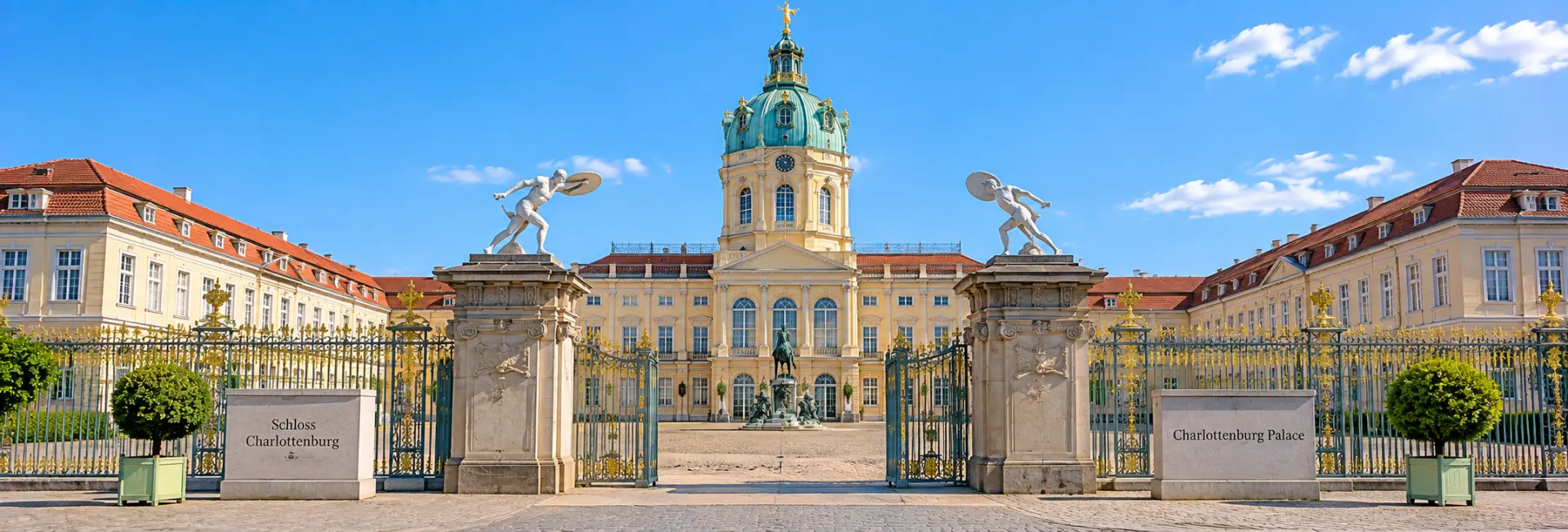
Charlottenburg Palace is the largest surviving royal palace in Berlin and the most significant remaining residence of the Hohenzollern dynasty within the city. Begun in the 1690s as a modest summer retreat, it grew over the following century into a sprawling complex of baroque and rococo state rooms set within a 55-hectare garden, reflecting the changing tastes of successive Prussian rulers.
Badly damaged during the Second World War, the palace was painstakingly restored and today functions as a museum, with its Old Palace and New Wing open to visitors alongside garden buildings including a mausoleum and a porcelain pavilion. It remains one of Berlin's leading historical sights and a rare place to experience Prussian court life at something close to its original scale.
History
A Summer Retreat for a Queen
Construction began in 1695 on what was then a small pleasure palace, commissioned by Sophie Charlotte, wife of the Elector of Brandenburg, Frederick III, and designed by architect Johann Arnold Nering. Known at the time as Lietzenburg after the surrounding village, the building was relatively modest in scale, intended as a private retreat for a queen known for her love of music and philosophy rather than as a grand seat of power.
Expansion into a Royal Residence
When Frederick was crowned the first King in Prussia in 1701, he commissioned architect Johann Friedrich Eosander, fresh from studying Versailles and other European courts, to transform the palace into a residence befitting a monarchy. Eosander added projecting side wings around a grand courtyard and crowned the central building with a dome topped by a gilded statue of the goddess Fortuna. When Sophie Charlotte died in 1705, Frederick renamed the palace and its surrounding estate in her honour.
The New Wing and Later Rulers
Work slowed under Frederick's less architecturally minded son, but resumed in earnest after Frederick the Great came to the throne in 1740. He commissioned architect Georg Wenzeslaus von Knobelsdorff to build a New Wing on the eastern side of the complex, completed in 1746, adding a suite of rococo state rooms to complement the older baroque sections. Later Hohenzollern rulers, including Frederick William II and Frederick William III with his wife Queen Louise, continued to use the palace as a residence and left their own marks on its rooms and gardens well into the nineteenth century.
Wartime Destruction and Reconstruction
The palace was severely damaged during Allied bombing raids in 1943, with large sections gutted by fire, including much of the dome and many of the state rooms that had defined the residence for over two centuries. Rather than abandon the ruin, postwar preservationists undertook a painstaking reconstruction effort, led in significant part by state palaces director Margarete Kühn, gradually restoring the exterior and many of the original interiors to something close to their prewar appearance over subsequent decades. Some rooms were rebuilt using surviving fragments and historical photographs, while others were reinterpreted where the original decoration could not be fully recovered.
Architecture & Notable Rooms
The palace's architecture spans several decades and styles, moving from the restrained baroque of its earliest sections to the lighter, more ornamental rococo of its later additions.
- The Old Palace (Altes Schloss) — the original baroque core, topped by a 48-metre dome that remains one of Berlin's recognisable silhouettes, and home to the private apartments of Frederick I and Sophie Charlotte
- The Porcelain Cabinet — a small room lined almost entirely with Chinese and Japanese porcelain, one of the finest surviving examples of this baroque decorative style
- The Chapel — the palace's ornate court chapel, largely preserved in its original baroque form
- The New Wing (Neuer Flügel) — added under Frederick the Great, containing the rococo Golden Gallery and White Hall banqueting rooms, along with the king's private apartments
- The Golden Gallery — a lavishly gilded ballroom considered one of the finest rococo interiors in Germany
- The Glass Bedchamber and Oak Gallery — earlier baroque rooms in the Old Palace, showcasing more restrained decorative styles than the later rococo additions
The palace's famous Amber Room, an entire chamber paneled in decorative amber, was originally intended for Charlottenburg but was given as a diplomatic gift to Tsar Peter the Great in 1716 before it could be permanently installed here, and was later lost during the Second World War after Nazi forces looted it from its home in Russia. Its story remains one of the most-told anecdotes connected to the palace, even though the room itself was never actually completed at Charlottenburg.
Grounds & Gardens
Behind the palace lies one of Germany's most significant historic gardens, first laid out in 1697 in the formal French baroque style and later reshaped in the nineteenth century into an English landscape park.
- A formal baroque parterre near the palace, recreated after wartime damage in a free interpretation of the original geometric design
- A larger landscaped park beyond it, with a carp pond, meandering paths, and mature woodland running down to the Spree river
- The Mausoleum, built to hold the tomb of Queen Louise after her death in 1810, later expanded to include the tombs of Kaiser Wilhelm I and other family members
- The Belvedere, a late-baroque garden pavilion built in 1788 as a lookout point, which today houses a porcelain collection from the Royal Porcelain Manufactory Berlin
- The New Pavilion, a summer retreat designed by Karl Friedrich Schinkel in the 1820s, rebuilt after wartime destruction and now used as a museum
Cultural & Royal Significance
Charlottenburg Palace stands as the most complete surviving example of Hohenzollern court life within Berlin itself, in contrast to the family's other major residences, which lie outside the city in Potsdam. Its rooms trace more than two centuries of Prussian history, from the modest tastes of a philosopher-queen through the absolutist grandeur of Frederick the Great to the more domestic royal life of the nineteenth century.
The palace also holds an important place in the history of European decorative arts, both through its surviving Porcelain Cabinet and Golden Gallery and through its lost connection to the Amber Room, whose story links Charlottenburg to the courts of both Prussia and Imperial Russia. Today it houses the most extensive collection of eighteenth-century French painting outside France, reflecting the tastes of the Prussian court at its cultural height.
Ways to Experience It
A visit can range from a quick walk through the gardens to a full day exploring several buildings across the estate.
- Tour the Old Palace to see the private royal apartments, the Porcelain Cabinet, and the chapel
- Tour the New Wing separately to see the Golden Gallery, the White Hall, and the eighteenth-century French paintings collection
- Walk the palace gardens independently, which are free to enter regardless of whether a palace ticket is purchased
- Visit the Mausoleum, generally open seasonally, to see the tombs of Queen Louise and other Hohenzollern family members
- Join a guided tour for deeper context on specific rooms and the family history behind them, offered on most days but not always on Sundays
Best Time to Visit
Because the palace combines indoor state rooms with extensive outdoor gardens, timing a visit well can shape the experience considerably.
- Spring and early summer bring the gardens into full bloom, making this the most rewarding season for combining palace and garden visits
- Weekday mornings tend to be quieter than weekend afternoons, particularly during the busy summer tourist season
- Winter visits offer a starker, quieter garden and shorter opening hours, but the interiors remain fully open and often less crowded
- Sunny afternoons are best for photographing the palace's dome and facade reflected in the garden's ponds
Visitor Tips
A few practical points are worth knowing before visiting the estate.
- The Old Palace and New Wing require separate tickets, though combination tickets covering both, along with the Mausoleum and other garden buildings, are available
- The Belvedere porcelain pavilion has been closed to visitors until further notice, so check current status before planning a visit around it
- The Mausoleum typically operates on a seasonal schedule, generally open from spring through autumn rather than year-round
- Audio guides are not always available, so joining a guided tour or researching key rooms beforehand can add useful context
- The palace gardens are free to enter and make an easy, low-cost stop even without visiting the interior
- Richard-Wagner-Platz U-Bahn station and Westend S-Bahn station are both roughly a ten-minute walk from the palace entrance
Nearby Attractions
The palace sits within Berlin's Charlottenburg district, close to several museums that make up the surrounding Museum Quarter.
- Bröhan Museum — a decorative arts museum specialising in Art Nouveau and Art Deco design, directly across from the palace
- Käthe Kollwitz Museum — dedicated to the German artist's prints and sculptures, housed in the palace's former theatre building
- Scharf-Gerstenberg Collection — a museum of Surrealist art housed in a building opposite the palace grounds
- Berggruen Museum — a collection focused on Picasso and his contemporaries, a short walk from the palace
- Kurfürstendamm — Berlin's historic shopping boulevard, a short ride away in the wider Charlottenburg district
- Olympiastadion — Berlin's 1936 Olympic stadium, reachable by public transport from the Charlottenburg district
FAQs about visiting Charlottenburg Palace
Is Charlottenburg Palace the largest palace in Berlin? +
Yes, it is the largest surviving royal palace within the city of Berlin, though the Hohenzollern family's other major residences lie outside the city in Potsdam.
Do I need separate tickets for the Old Palace and New Wing? +
Yes, they are ticketed separately, though combination tickets covering both sections along with other garden buildings are available.
Are the palace gardens free to visit? +
Yes, the surrounding gardens are open to the public free of charge, independent of any palace admission ticket.
What happened to the Amber Room? +
It was originally intended for Charlottenburg Palace but was given as a diplomatic gift to Tsar Peter the Great in 1716 before installation, and the original room was later lost during the Second World War after being looted from Russia by Nazi forces.
Is the Belvedere open to visitors? +
No, the Belvedere porcelain pavilion in the palace gardens is currently closed until further notice, so it's worth checking current status before planning a visit.
How do I get to Charlottenburg Palace? +
Richard-Wagner-Platz U-Bahn station and Westend S-Bahn station are both about a ten-minute walk from the palace entrance.
Is the Mausoleum open year-round? +
No, it typically operates on a seasonal schedule, generally open from spring through autumn rather than through the winter months.
How much time should I plan for a visit? +
A quick walk through the gardens takes under an hour, but a full visit covering both wings and the grounds can easily fill half a day.
