
Table of Contents
Overview
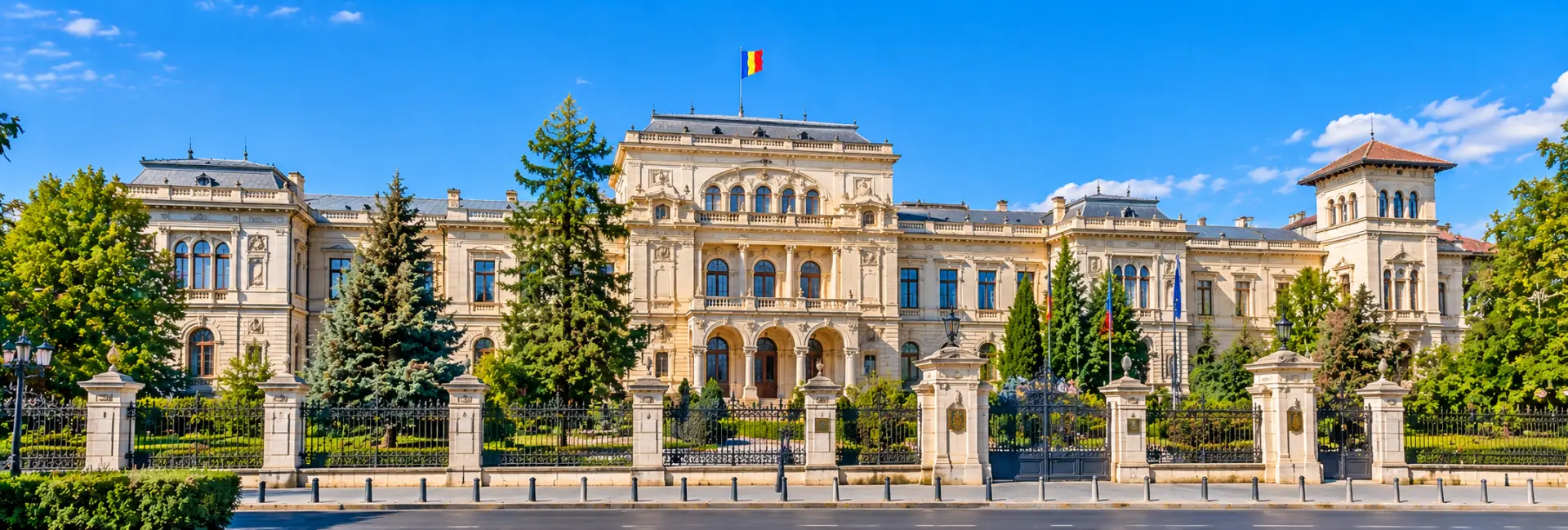
Cotroceni Palace stands on a hill in western Bucharest and combines two roles that rarely share a roof. It is the official residence of the President of Romania, and its historic royal wing is a museum that welcomes visitors. The complex grew from a 17th-century monastery into a princely court, then a royal palace and later a Communist-era children's palace before reaching its present form.
For visitors, the appeal lies in the layering. In a single visit you can walk through salons decorated for Queen Marie, descend into medieval cellars that belong to the original monastery and step out into gardens that are open on set days. Few buildings in the capital tell so many chapters of Romanian history in such a compact space.
Because part of the complex is a working government site, access works differently from an ordinary museum, so it pays to plan ahead. The visitor tips later in this guide explain the essentials.
History
From Monastery to Princely Court
The story begins in 1679, when the ruler Șerban Cantacuzino built a monastery on Cotroceni Hill in place of an older wooden hermitage. The church was completed in 1682. For two centuries the hill remained a favored residence of Wallachian rulers, who added houses and courts around the monastery. In the 1880s King Carol I took over the estate and had the old buildings demolished, planning a much larger palace for his heirs.
The Royal Palace
The new palace was built between 1893 and 1895 by the French architect Paul Gottereau, as the home of the heir Ferdinand and his English-born wife, Marie. Over the following decades the couple reshaped it. Marie requested a new north wing, central heating arrived in 1915, and the architect Grigore Cerchez added Neo-Romanian rooms between 1925 and 1929. In 1918 the palace was the setting for the signing of the Peace of Bucharest with the Central Powers.
Pioneers, Earthquake and Presidency
After King Michael I was forced to abdicate on 30 December 1947, the state took over the palace. It became the Pioneers' Palace, a center for Communist youth activities, which was inaugurated on 1 June 1950. In 1976 it passed to the State Protocol as a guest residence, and the 1977 earthquake caused serious damage. Restoration lasted nearly a decade and included a new wing by the architect Nicolae Vlădescu. Since 1991 the palace has been the seat of the presidency, while the old royal wing serves as the National Cotroceni Museum.
Architecture and Notable Rooms
A Palace of Many Styles
Cotroceni does not follow a single architectural style. Its interiors reflect the tastes of three people: Carol I, who favored German Neo-Renaissance; Ferdinand, whose hunting trophies and library fill several rooms; and Marie, who filled the palace with art and Neo-Romanian and Neo-Byzantine details. The result is a series of rooms that each feel distinct.
Rooms to Look For
- The Hall of Honor is decorated in the French style of Napoleon III, with an original Italian marble staircase and ornament inspired by the Opéra Garnier. It has been largely preserved since the 1890s.
- The German Living Room, in German Neo-Renaissance style, was the royal family's daily gathering place.
- The Hunting Room, built in 1926 under the Czech architect Karel Liman, displays some of King Ferdinand's personal trophies.
- The Flowers Room was known as the Golden Room in Queen Marie's time, when its stucco flowers were gilded.
- King Ferdinand's Library still has its original elm panelling and part of his book collection.
- The Great Hall of Receptions and the Royal Dining Room, designed by Cerchez in Neo-Romanian style, include a round Neo-Byzantine table designed by Queen Marie. The hall also hosts concerts, book launches and exhibitions.
The upper floor holds the private apartments of the royal family, including those of Ferdinand and Marie, and these rooms give the clearest sense of how the family lived.
Grounds, Gardens and Church
Gardens and Terraces
A stepped garden climbs from the lower entrance up toward the palace, passing terraces such as the Ceremony Plateau and the Baroque Plateau. On designated open days, the gardens, inner courtyards and the palace church can be explored without a museum ticket, which makes a pleasant outdoor complement to the interior tour.
Medieval Cellars and Kitchen
Beneath the royal wing, the Great Cellar and the old Kitchen survive from the Cantacuzino period. Together they form the oldest part of the visit, and a permanent exhibition in the cellar tells the story of the monastery church through art and objects. After the polished royal salons, the stone vaults feel almost like another century, which is exactly what they are.
The Palace Church
The old monastery church was demolished in 1984 under Nicolae Ceaușescu, though ruins and fragments of original frescoes were found during construction work in the 1980s. The church was later rebuilt, and it now serves as a place of worship and forms part of the visiting route.
The Museum and Its Collections
A Museum in the Royal Wing
The National Cotroceni Museum was created in 1991 in the old royal palace. It aims to give a sense of the many periods the site has seen, from medieval remains to royal interiors and Communist-era traces. The collection holds around 20,000 objects, many transferred from other institutions and others acquired or donated.
What the Collection Holds
- Romanian and international paintings, graphics and sculpture
- Painted wooden icons and other religious art, mostly from the 18th and 19th centuries
- Furniture in styles ranging from Neo-Romanian to Empire, Napoleon III and Louis XV and XVI
- Ceramics and porcelain from workshops such as Sèvres and Meissen
- Glass, textiles, carpets, Art Nouveau objects, medals and coins
Queen Marie's art collection is a highlight, together with works by members of the Artistic Youth society, a group of painters she encouraged in the early 20th century.
Historical and Political Significance
Cotroceni is one of the few places in Romania where the whole sweep of the country's modern history is visible in a single building. The monastery recalls the princely era, the palace belongs to the kingdom that took shape under Carol I, Ferdinand and Marie, and the Pioneers' period shows how the Communist regime repurposed royal spaces for its own ends.
The palace also keeps a place in national memory through the events it witnessed, such as the 1918 peace negotiations and the confiscation of the royal property in 1948. Today, as the home of the presidency, it remains a place where national decisions are made, which gives a visit an unusual sense of living history.
Ways to Visit
The Museum Tour
The museum route covers the first and second floors of the royal wing, including the main salons and private apartments. A fuller tour of around 100 minutes also takes in the medieval areas, the cellar, the church and the inner courtyard. Depending on the day, tours may be guided or self-guided, and some routes combine the museum with the ceremonial salons of the Presidential Administration.
Open Gate Days
Since 2025 the Presidential Administration has run a permanent program called Open Gates at Cotroceni Palace, which lets the public enter the gardens, the Ceremony Plateau, the Baroque Plateau, the church and the courtyards on set days, free of charge. Check the official schedule for the days that apply, since arrangements have changed more than once.
Best Time to Visit
Choosing a Season
The museum interior can be visited all year, so any season works for the royal salons. If you want to enjoy the gardens and terraces as well, late spring and early autumn offer the most comfortable weather and the best light. Summer is pleasant in the morning but can be hot on the open terraces, and winter makes the gardens quiet and bare.
Choosing a Day
Weekdays are usually calmer for the museum, while open-gate days attract more visitors to the gardens. The palace is closed on Mondays and on certain public holidays, and the complex can close for official events, so confirm the schedule before you set out.
Visitor Tips
- Carry an original identity document, since entry requires one, whether it is an ID card or a passport.
- Check the official website before your visit. Opening hours, routes, ticket prices and booking rules have changed several times since 2025.
- Know which gate to use. On open-gate days the main entrance is on Bulevardul Profesor Doctor Gheorghe Marinescu, and on other days museum visitors enter through the gate on Șoseaua Cotroceni.
- Allow around two hours for the fuller museum tour, plus extra time for the gardens.
- Wear comfortable shoes, since the garden rises in steps and the tour involves stairs and long corridors.
- Expect security checks, as this is a working presidential site.
Nearby Attractions
The palace sits in the Cotroceni district, a leafy residential and university area with several places worth adding to your day.
- The Bucharest Botanical Garden lies in the same neighborhood and offers a quieter, greener counterpart to the palace gardens.
- The Carol Davila University of Medicine and Pharmacy and other campus buildings give the area its academic character.
- The Bucharest Opera building also stands in Cotroceni.
- The Ion Minulescu Memorial House, in the district, commemorates the poet who lived nearby.
- The Palace of the Parliament lies a short distance away and is visible on the skyline from parts of the neighborhood.
FAQs about visiting Cotroceni Palace
Is Cotroceni Palace a museum or the president's residence? +
It is both. The palace is the official residence of the President of Romania, and the historic royal wing is the National Cotroceni Museum, which opened in 1991.
Can tourists visit Cotroceni Palace? +
Yes. The museum is open to visitors on set days, and the Open Gates program lets the public enter the gardens, courtyards and church on designated days. The arrangements change from time to time, so check the official website before you go.
Do I need to book in advance? +
It depends on the day and type of visit. Some routes need no booking, while guided tours may require a reservation. Confirm with the museum, which publishes a contact number and email on its website.
Do I need an ID to enter? +
Yes. An original identity document, such as a national ID card or passport, is required at the entrance.
How long does a visit take? +
A visit to the museum floors takes around one to two hours. The fuller tour with the cellars, church and courtyard lasts about 100 minutes, and the gardens add extra time.
Are the gardens free to visit? +
On open-gate days the gardens, the Ceremony and Baroque plateaus, the church and the courtyards can be visited without charge. Interior museum routes are ticketed.
What can I see inside? +
You can see royal salons such as the Hall of Honor, the German Living Room, the Hunting Room and King Ferdinand's Library, together with Queen Marie's art collection and the medieval cellars and kitchen.
Which gate should I use? +
Use the main gate on Bulevardul Profesor Doctor Gheorghe Marinescu on open-gate days, and the museum gate on Șoseaua Cotroceni on other days. Check the current rules before you go.
