
Table of Contents
Overview
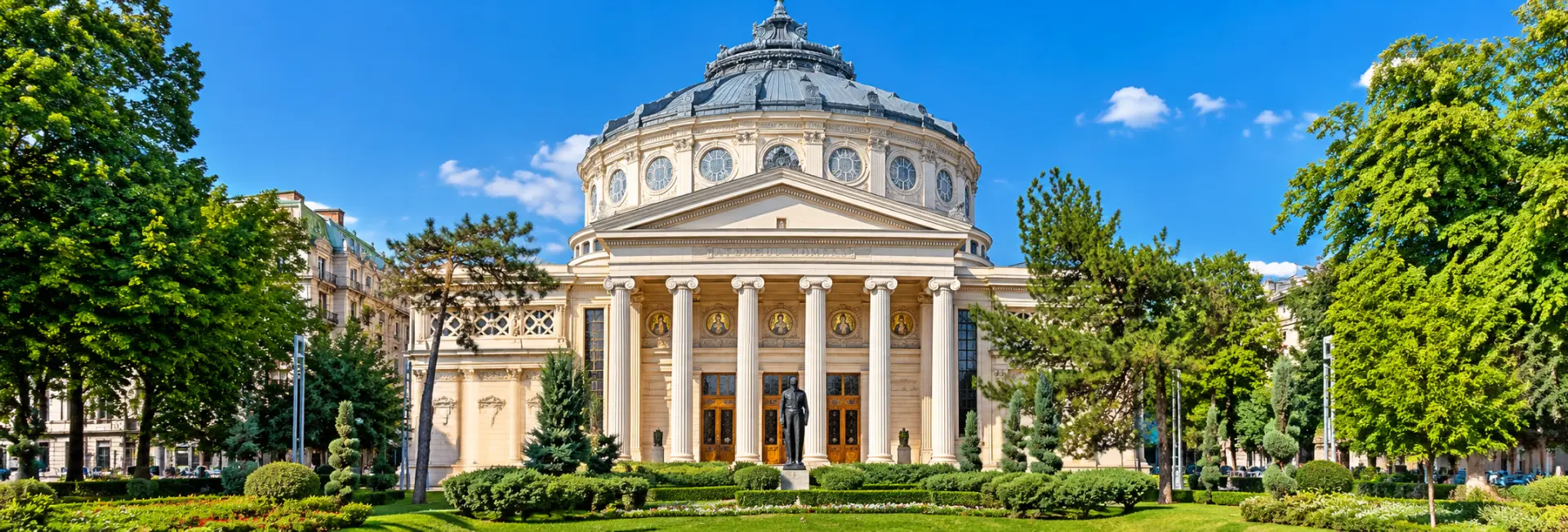
Set back behind a small park in the heart of Bucharest, the Romanian Athenaeum (Ateneul Român) looks like a Greek temple topped with a dome. Opened in 1888, it is the city's most prestigious concert hall and one of the most loved symbols of Romanian culture. Locals treat it with a kind of affection that few other buildings in the capital enjoy.
The Athenaeum is the home of the George Enescu Philharmonic and a main stage for the George Enescu Festival, one of the best known classical music events in Eastern Europe. Even if you never hear a note, the building rewards a visit for its columned portico, its marble staircases and a long painted frieze that tells the story of the country.
It is also a place where national history was made. In 1919, delegates met here to approve the union that created Greater Romania, which gives the hall a significance well beyond music.
History
A Society Dedicated to Learning
The story begins in 1865, when a group of scholars and public figures, including Constantin Esarcu, V. A. Urechia and Nicolae Kretzulescu, founded the Romanian Athenaeum Cultural Society. They wanted a home for lectures, debates, exhibitions and concerts, a building devoted to art and science in the capital.
"Give a Leu for the Athenaeum"
Money was the big obstacle. The society turned to the public, launching a fundraising campaign built around a simple slogan asking citizens to give one leu for the Athenaeum. Ordinary Bucharesters responded in large numbers, and the appeal became part of national memory. A lottery with hundreds of thousands of low-priced tickets helped raise funds, and the fundraising effort stretched across decades.
Construction and Opening
The French architect Albert Galleron drew up the plans, with Romanian architects assisting on site. The land had once belonged to the Văcărescu family and later held a riding hall started by an equestrian society. Building ran from 1886 to 1888, and the hall was inaugurated on 14 February 1888, although finishing work continued for years afterwards.
A Witness to the Twentieth Century
On 29 December 1919, politicians and public figures gathered here to ratify the union of Bessarabia, Transylvania and Bukovina with the Romanian kingdom. The Athenaeum even housed the Chamber of Deputies for a short period around that time. Later decades brought repairs after earthquakes and wartime bombing in 1944, followed by further changes in the 1960s.
By the early 1990s the structure was in serious trouble. A major restoration, funded jointly by the Romanian government and the Council of Europe Development Bank, rescued the building from the risk of collapse and returned it to its full glory.
Exterior & Architecture
A Temple of Music
The Athenaeum is mainly neoclassical, with romantic and eclectic touches that give it a softer, more decorative feel than a strict classical design. The front is dominated by a portico with six Ionic columns, which gives the entrance the look of an ancient Greek temple. Beneath it, medallions show the faces of five Romanian rulers: Neagoe Basarab, Alexandru cel Bun, Vasile Lupu, Matei Basarab and King Carol I.
The Dome
Rising behind the portico is the large dome that defines the building's silhouette. Around its base are engraved the names of important Romanian figures from culture and scholarship, a quiet reminder that the Athenaeum was conceived as a monument to the nation's learning as well as its music.
The Setting
The hall sits in a small square named for George Enescu, just off Calea Victoriei. A statue of the national poet Mihai Eminescu stands in the garden in front of it, and the open space allows you to step back and appreciate the full facade. This is one of the best photo spots in the city centre.
Inside the Hall
The Entrance Hall
The foyer sets the tone with sweeping spiral staircases that wind around columns of Carrara marble, along with rich carvings and decorative details. Even before reaching the auditorium, visitors tend to slow down and look up.
The Auditorium
The main concert hall is circular and seats roughly 800 people, with around 600 places in the stalls and the remainder in dozens of private loges. Its warm acoustics are prized by musicians and audiences alike. A large organ, installed in 1939 with support from George Enescu himself, adds to the grandeur of the space.
The Great Fresco
The most famous feature is the fresco that wraps around the inside of the dome wall. Painted by Costin Petrescu over about five years using the traditional al fresco technique, it stretches for more than 70 metres and is around three metres high. It shows 25 key scenes from Romanian history, beginning with the Roman conquest of Dacia under Emperor Trajan and ending with the creation of Greater Romania in 1918.
Take your time with it. The scenes flow into each other like a long storybook, and a good guide can point out rulers, battles and moments of union that are easy to miss on a first look.
Music at the Athenaeum
The George Enescu Philharmonic
The Athenaeum is the permanent home of the George Enescu Philharmonic, which presents symphonic and chamber programmes across the concert season. Guest conductors, soloists and visiting orchestras also appear regularly, so the calendar is varied.
The Composer Behind the Name
George Enescu, Romania's greatest composer, is closely tied to the hall and is said to have made his debut here as a young musician in 1898. His name is attached to both the orchestra and the international festival, and his music is a regular feature in the programme.
The George Enescu Festival
The festival and the related international competition bring top artists and orchestras to Bucharest, and the Athenaeum is one of its central venues. During these weeks the building is at its busiest and most atmospheric.
Recognition & Cultural Significance
- The Athenaeum was awarded the European Heritage Label in 2007, a recognition of sites that played an important role in European history and culture.
- It is widely seen as a symbol of the Romanian nation, partly because ordinary citizens helped to pay for it.
- It stands as a landmark of the city's Belle Époque era, when Bucharest was often compared with Paris.
- It hosted the 1919 assembly that endorsed the union of historic Romanian regions.
The building also appears regularly on postcards, book covers and in the logos of cultural events, which shows how closely it is tied to the country's self-image.
Ways to Experience It
Attend a Concert
The best way to experience the Athenaeum is to sit in the auditorium during a performance. The sound, the painted walls and the gilded details all work together, and tickets for many concerts are available at the box office or online without long advance planning.
Join a Guided Visit
Outside concert hours, the Philharmonic offers guided visits on selected dates, including during cultural events such as the European Museums Night, when entry has sometimes been free with a reservation. These tours usually cover the foyer, the main hall and the fresco.
Admire It from the Garden
If the doors are closed, you can still enjoy the exterior from the garden and the surrounding square. It takes only a few minutes and works well as part of a walk along Calea Victoriei.
Best Time to Visit
Concert Season
The main classical season runs from autumn to spring, when the philharmonic performs most frequently. Evening concerts offer the fullest experience, and winter programmes in the warm, decorated hall feel especially memorable.
Festival Weeks
The George Enescu Festival and competition fill the hall with international artists and larger audiences. Book earlier for popular performances and expect a livelier atmosphere around the building.
Daytime and Seasons
For photographs of the exterior, spring and early autumn bring pleasant weather and green garden scenery, while soft morning or late afternoon light shows off the facade. Summer days can be hot, but they suit a quick stop before exploring the nearby streets.
Visitor Tips
- Check the Philharmonic's official website for the current concert programme, guided visit dates and ticket sales before you travel.
- Buy tickets at the box office or online, and arrive early to explore the foyer before the performance begins.
- There is no strict dress code, but many concertgoers wear smart clothes, so shorts and flip-flops can feel out of place.
- The building has step-free access for visitors who use a wheelchair, but it is wise to confirm arrangements when you buy tickets.
- Switch off your phone during performances and follow the usual concert etiquette.
- Photography rules differ between concerts and tours, so ask the staff before taking pictures inside.
- Prices, opening arrangements and visiting schedules change, so confirm them with the official source close to your visit.
Nearby Attractions
The Athenaeum sits on the cultural spine of Bucharest, so many of the city's highlights are within a short walk. Revolution Square, a major site in the story of the 1989 revolution, is next door, and the former Royal Palace, which now houses the National Museum of Art of Romania, faces the hall across the street.
Calea Victoriei, Bucharest's historic boulevard, leads south to the elegant CEC Palace and on toward the Old Town, with its busy streets, cafes and restaurants. For a very different kind of landmark, the enormous Palace of the Parliament lies roughly two kilometres away and can be reached by taxi or a longer walk.
FAQs about visiting the Romanian Athenaeum
What is the Romanian Athenaeum? +
It is Bucharest's main concert hall, opened in 1888 and designed by French architect Albert Galleron. It is the home of the George Enescu Philharmonic and one of the best known landmarks in Romania.
Why is the Romanian Athenaeum so famous? +
It combines striking neoclassical architecture, outstanding acoustics and a large fresco showing 25 scenes from Romanian history. It is also known for being funded partly by public donations and for hosting the 1919 vote to approve the union of historic Romanian regions.
Can you visit the Athenaeum without attending a concert? +
Sometimes. The Philharmonic organises guided visits on selected dates, so check its official website for the latest schedule. You can always admire the exterior and garden for free at any time.
How do I buy tickets for a concert? +
Tickets are usually available online or at the box office, and they often go on sale shortly before each performance. Popular festival concerts can sell out sooner, so it helps to book early for those.
How long should I spend there? +
A concert usually lasts about two hours, while a guided visit or a look around the foyer and exterior takes much less. Add extra time if you want to photograph the facade and the garden.
What should I wear to a concert? +
There is no formal dress code. Smart casual clothing is common, and most visitors avoid very casual items such as shorts or flip-flops.
Is the Romanian Athenaeum accessible for wheelchair users? +
The venue is described as wheelchair accessible, but arrangements can vary by seat and event. It is sensible to contact the box office when booking so staff can prepare for your visit.
Where is the Romanian Athenaeum and how do I get there? +
It stands on Strada Benjamin Franklin in central Bucharest, close to Revolution Square and Calea Victoriei. It is easy to reach on foot from many city centre sights, or by public transport and taxi.
