
Table of Contents
Overview
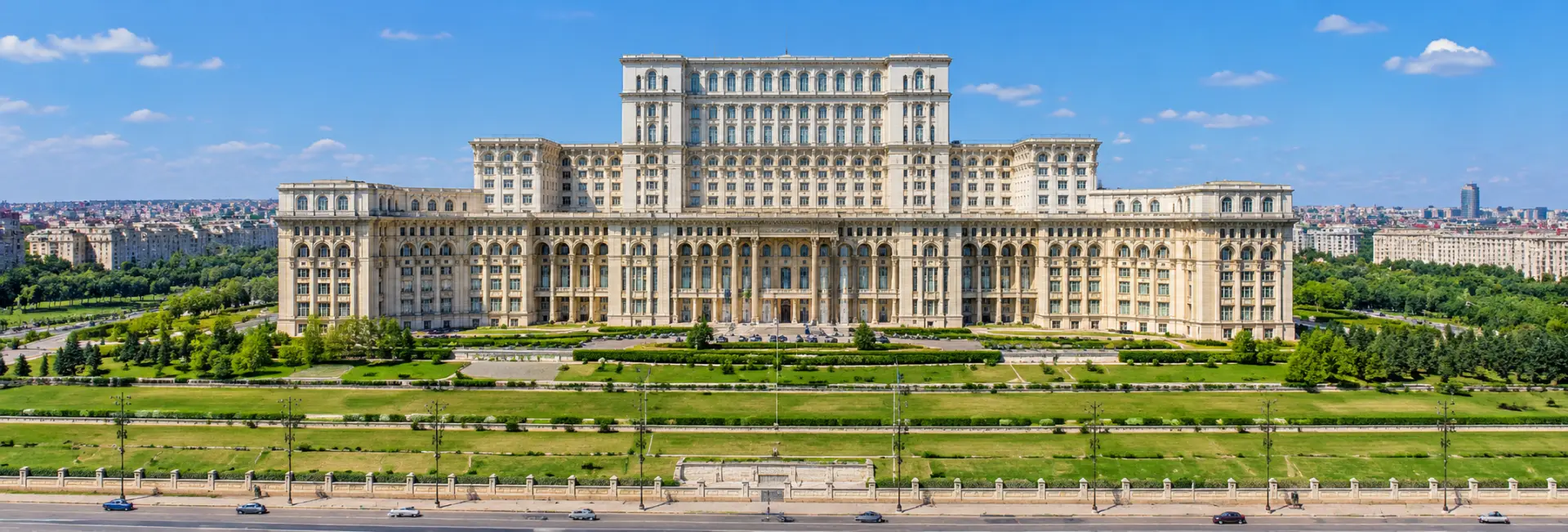
Rising from the crest of Spirea's Hill in central Bucharest, the Palace of the Parliament is a building that is difficult to take in all at once. Its pale facades stretch for hundreds of metres, and its sheer bulk dominates the skyline of the Romanian capital. Today it is the seat of the national Parliament, housing both the Chamber of Deputies and the Senate.
The palace began life as the House of the Republic, a flagship project of Communist leader Nicolae Ceaușescu. Most Romanians still call it Casa Poporului, the People's House, a name that stuck after the revolution of December 1989. Few buildings in Europe carry as much political and emotional weight.
For visitors, it offers a rare mix of spectacle and context. You can walk through grand ceremonial halls, hear how an entire district of the old city was cleared to make room for it, and then step outside to see the avenue it was designed to crown. It is as much a lesson in modern Romanian history as it is a sightseeing stop.
History
A Vision Born from Disaster and Ambition
The roots of the project lie in the 1970s. After the powerful earthquake of March 1977 damaged parts of Bucharest, Ceaușescu used the moment to push forward a sweeping plan to rebuild the city centre in a monumental socialist style. The plan, known as systematization, was inspired in part by the highly organised capitals he had seen in East Asia.
A design competition was won by Anca Petrescu, who was appointed chief architect at just 28 years old. She led a core team that supervised hundreds of other architects and engineers working on the scheme.
Clearing a Neighbourhood
To create the site, a large part of the historic Uranus and Izvor districts was demolished, and the hill itself was levelled. Churches, monasteries, a hospital, the national archives and dozens of workshops disappeared, and roughly 40,000 residents were relocated. For many Bucharest families, the loss of their homes and streets remains a vivid memory.
Construction
Work officially started on 25 June 1984. Soldiers and large numbers of volunteers laboured around the clock in shifts, and estimates of the workforce range from tens of thousands to far more. The number of people who died on site is still debated, with official figures far lower than those given by former workers.
Construction took place while Romania was living through harsh austerity as the state worked to repay its foreign debt. The regime fell in December 1989 with the building far from finished, and the work dragged on until 1997.
A New Life as a Parliament
After the revolution, the question of what to do with such an enormous structure was settled by giving it a purpose. The Chamber of Deputies moved in during 1994, and the Senate followed in 2004. An international conference centre and museums were added, and in 2008 the palace hosted a NATO summit.
Architecture & Materials
Style and Design
The palace blends neoclassical forms with the ideals of socialist realism, which is why architecture writers sometimes describe it as a kind of postmodern neoclassicism. Rows of columns, wide balconies, soaring arches and symmetrical wings create an imposing, ceremonial look from every angle. The effect is intentionally overwhelming.
The Scale in Numbers
- Height above ground: about 84 metres, with the foundations reaching roughly 92 metres below the surface
- Footprint: around 240 by 270 metres
- Floor area: about 365,000 square metres
- Levels: 12 above ground and 8 below
- Rooms: around 1,100
Romanian Materials
Almost everything used to build and furnish the palace came from within Romania. Marble was cut for floors, columns and stairways, while walnut, oak, cherry and other local woods were used for parquet and panelling. Enormous wool carpets were woven on site because they were too large to move through the doors, and crystal chandeliers, bronze fittings and heavy velvet drapes add to the richness.
Below the Surface
Beneath the visible building lie several underground levels, including a deep shelter with thick concrete walls designed to protect state leaders. Tunnels link the palace with other government sites. The sheer weight of the structure also has a measurable effect, as the ground below is slowly settling by a few millimetres each year.
Inside the Palace
The Great Halls
The interior is organised into dozens of sections, and many halls are named after important figures in Romanian history, such as Nicolae Bălcescu, Alexandru Ioan Cuza and C. A. Rosetti. Each one has its own colour scheme, ceiling treatment and style of lighting. Tours usually pass through the main staircases, long corridors and ceremonial rooms, including the grand ballroom and a number of conference halls.
Chambers of Government
Besides the two chambers of Parliament, the building houses the Constitutional Court. Some sessions and offices are off limits, but on certain tours you may see the Senate's main assembly hall, the Plenary Hall, when it is not in use.
An Unused Giant
Despite its size, only a fraction of the palace is in daily use. Large parts of the building have never been fully fitted out, which gives the visit an unusual atmosphere. You pass from polished, gilded halls to vast empty spaces that hint at how far the original ambition outran practical needs.
Museums
The west wing is home to the National Museum of Contemporary Art, which opened in 2004 and is reached through a glass-fronted annex added for that purpose. The palace also contains a museum dedicated to the building itself, which explores its design and construction.
Records & Recognition
The Palace of the Parliament holds several world records. It is listed as the heaviest building on Earth, with a weight estimated at more than four million tonnes. It is also the largest civilian administrative building anywhere, and its volume is said to exceed that of the Great Pyramid of Giza by a small margin.
It is regarded as the most expensive administrative building ever constructed, with a value put at around four billion euros in recent estimates. Running costs are also high, with heating and electricity alone amounting to millions each year.
The palace has also become a familiar screen presence. Filmmakers have used its corridors and facade for productions that include the 2018 horror film The Nun, where it stood in for the Vatican. Its sheer visual drama makes it a favourite for photographers as well.
Ways to Experience It
Standard Guided Tour
The standard tour is the most popular way to see the interior. Led by a guide, it covers a selection of the main halls, staircases and balconies, and offers context on the history, materials and politics behind them. Tours run in Romanian, English and several other languages.
Extended and Special Tours
Longer options may add the underground levels or a visit to the upper terrace, which gives a wide view over Unirii Boulevard and the city. Terrace tours are limited to small groups and cost more than the standard visit. Availability changes, so check the official visitor centre before you plan around one.
Museums and Exhibitions
Visitors who prefer to explore at their own pace can head to the National Museum of Contemporary Art, which has its own entrance and opening hours. It is a good choice if you want the scale of the building without joining a group.
Seeing It from Outside
The exterior can be enjoyed without a ticket. Walk along Unirii Boulevard for the classic view of the main facade, or stroll through Izvor Park on the northern side for a closer look at the wings and columns.
Best Time to Visit
Season
Spring and early autumn are the most comfortable seasons, with mild temperatures that suit walking around the grounds and the neighbouring parks. Summer can be very hot, though the interior stays relatively cool. Winter is cold, yet the heated halls and smaller crowds make it a good time for a quiet tour.
Day and Time
Weekday mornings tend to be calmer, while weekends can bring larger groups. Late afternoon light is flattering for exterior photographs, especially along Unirii Boulevard. Tours may not run on public holidays or when the palace is hosting an official event, so confirm your date in advance.
Visitor Tips
- Bring your original passport or national ID card, as it is checked at security and visitors without it can be refused entry.
- Book your tour ahead of time through the official visitor centre, since entry is only possible with a guided visit and slots can fill up.
- Arrive at least 15 minutes early to get through the security screening.
- Check which entrance to use. Weekday tours generally start from the northern side near Izvor Park, while weekend tours may begin on the southern side along Calea 13 Septembrie.
- Wear comfortable shoes, as the route involves long corridors and many staircases.
- Ask about photography rules at the start of the tour, since they can differ from room to room.
- Confirm opening times, prices and available tour types on the official website shortly before your visit, as these change.
Nearby Attractions
Izvor Park lies right beside the palace and makes a pleasant place to rest before or after your tour. From the main facade, Unirii Boulevard runs for several kilometres toward Unirii Square, lined with fountains and grand apartment blocks built at the same time as the palace.
A short distance away, the Palace of the Patriarchate and the Patriarchal Cathedral sit on a nearby hill and offer a very different side of Bucharest's heritage. Beyond that, the Old Town, with its lively streets, historic inns and restaurants, is within easy reach by taxi, tram or on foot, and Cișmigiu Gardens provide another green escape in the city centre.
FAQs about visiting the Palace of the Parliament
What is the Palace of the Parliament? +
It is the seat of the Romanian Parliament, built under Nicolae Ceaușescu and originally called the House of the Republic. It houses the Chamber of Deputies, the Senate, a conference centre and museums, and is known as one of the heaviest and largest administrative buildings in the world.
Can you go inside the Palace of the Parliament? +
Yes, but only on a guided tour, since the building is a working government site. Tours cover selected halls, staircases and ceremonial rooms, and you must book ahead and bring valid identification.
What do I need to bring for the tour? +
You need your original passport or national ID card, which is checked at the security entrance. It also helps to arrive about 15 minutes early so the screening does not make you late.
How long does a visit take? +
A standard guided tour lasts around an hour, and extended options with the terrace or underground areas take longer. Add some time for security and for walking around the exterior and nearby park.
How much does it cost to visit? +
Prices depend on the type of tour, with lower rates often available for students and children. Fees change, so check the official visitor centre for current prices before you book.
Is the palace still used by politicians? +
Yes, it is an active parliament building and also hosts conferences and official events. Because of that, some areas can be closed at short notice, and tours may be cancelled on certain days.
Is it worth visiting the National Museum of Contemporary Art there? +
It is a good addition if you enjoy modern art or want to see the building without a formal tour. The museum has its own entrance and schedule, so plan it separately from the guided visit.
What is the best way to get to the palace? +
It sits in the centre of Bucharest and is easy to reach by taxi or ride-hailing, and also by bus and a short walk through Izvor Park. Allow extra time on weekdays when traffic around the city centre can be heavy.
