
Table of Contents
Overview
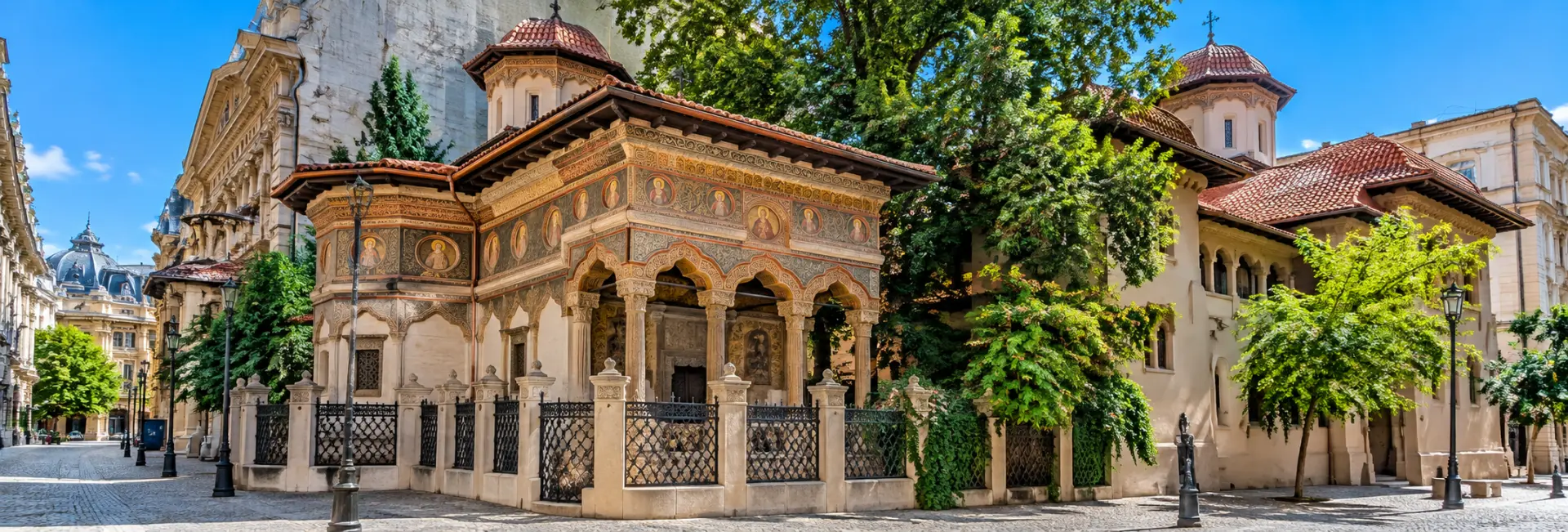
Tucked between busy streets in the middle of Bucharest's Old Town, Stavropoleos Monastery feels like a different century. The church is small, with a gracefully carved porch, painted walls and a leafy cloister courtyard that muffles the noise of the city. Many visitors stumble across it by accident and end up staying far longer than planned.
Founded in 1724, it is one of the finest examples of the Brâncovenesc style, the richly decorated Romanian architecture of the late 1600s and early 1700s. Today it works as an active Orthodox monastery for nuns, so it is not only a monument but a place of daily prayer, chanting and quiet work.
For travellers, it offers something rare in a capital city: a calm, beautiful spot that takes only a short time to see yet leaves a lasting impression.
The setting adds to its charm. The monastery sits beside the Lipscani district, which was once the heart of Bucharest's trade, and its survival through earthquakes, demolitions and decades of political upheaval gives the site a sense of resilience. Photographers, architecture lovers and music fans all find something to enjoy here, and the compact size means you can take in the main sights without feeling rushed.
History
A Monk and His Inn
The monastery was founded by Ioanichie Stratonikeas, a Greek monk from the region of Epirus who settled in Bucharest in the early 1700s. In those days, the area around the princely court was a thriving commercial district. Ioanichie set up an inn there, and the profits from it were intended to support a church and a monastery, a common arrangement at the time.
The church was completed on 30 October 1724, during the reign of Prince Nicolae Mavrocordat. In 1726, Ioanichie was named a metropolitan of Stavropolis, a Greek title that gave the monastery its name. He died in 1742 and was buried inside the church he had built.
Decline and Rescue
The inn and the monastery's outbuildings were pulled down in the late nineteenth century, and earthquakes brought down the dome. By then the church was in such a poor state that demolition was seriously considered.
It was saved when the architect Ion Mincu was commissioned to restore it between 1897 and 1912. He rebuilt the dome, repaired the decoration and designed a new cloister on the site of the old inn, with a bell tower and a building for a museum and parish use. Another architect, Alexandru Zagoritz, finished the work after Mincu's death.
Return of Monastic Life
For much of the twentieth century, the site functioned as a parish church rather than a monastery. Monastic life returned in the early 1990s under Father Iustin Marchiș, and the community now runs as a monastery for nuns.
Architecture & Design
The Brâncovenesc Style
The church is a showcase of Brâncovenesc design, named after Prince Constantin Brâncoveanu, whose reign saw a flowering of Romanian art. The style blends Byzantine, Ottoman, late Renaissance and Baroque ideas into something distinctly Wallachian, with a love for ornament and a strong sense of proportion.
Stone and Wood Carving
Though modest in size, the building has an abundance of fine detail. The entrance portal, the window frames and the porch columns are covered with carved stone patterns of vines, flowers and geometric forms. The wooden doors and interior woodwork repeat the same decorative language.
Painted Surfaces
The outer walls are decorated with colourful plant motifs, including yellow floral patterns set against a blue ground. Inside, the paintings and icons fill the small nave with deep colours, and portraits of the founder and the ruling prince recall the church's origins. A depiction of the Angelic Liturgy sits at the base of the dome, drawing the eye upward.
A Harmonious Ensemble
Mincu's cloister was designed to match the scale and style of the church, with arched galleries around a peaceful yard. The result feels like a single, unified composition rather than a historic building with a later addition.
The Courtyard, Museum & Library
The Cloister Courtyard
Step through the gate and the street noise fades quickly. The courtyard is lined with arcades and holds old gravestones, carved fragments and crosses saved from earlier phases of the monastery and from other lost churches. It is a good place to sit and absorb the atmosphere.
Collection of Icons and Church Objects
The building next to the church shelters a collection of icons and liturgical objects, including pieces from the early 1700s and fragments of wall paintings rescued from churches demolished under the communist regime. It gives a glimpse of how much sacred art Bucharest lost in the twentieth century.
A Specialist Library
The monastery library holds more than 8,000 volumes on theology, Byzantine music, art and history, many in Romanian, Greek and Church Slavonic. It includes dozens of manuscripts and hundreds of early printed works, along with donations from scholars. Its collection of Byzantine music books is the largest in the country, and the community has been digitising rare volumes so that more people can study them.
Byzantine Music & Monastic Life
The Stavropoleos Choir
Music is at the heart of the monastery. The Stavropoleos Byzantine Choir was formed in 1994 and sings in the neo-Byzantine tradition, where a single melodic line is supported by a sustained drone note. This style has become rare in Romanian churches, and hearing it here can be a moving experience even for visitors with no religious background.
Repertoire
The chants draw on the work of nineteenth-century Romanian church musicians such as Macarie the Hieromonk, Anton Pann and Nectarie the Hermit, as well as translated Greek chants and newer compositions. The choir has performed in Romania and abroad and has released recordings.
Work and Prayer
The community divides its days between worship, study and craft. Its members restore old books, icons and church vestments, continuing a tradition of careful conservation that fits the character of the place.
Cultural & Religious Significance
- It is one of the oldest surviving buildings in central Bucharest and a rare relic of the city's early eighteenth-century religious life.
- It is regarded as one of the most refined examples of Brâncovenesc art in the capital.
- It is dedicated to the Archangels Michael and Gabriel, who are the patron saints of the church.
- It preserves art and objects rescued from churches destroyed in the communist period.
- It keeps alive the Byzantine chanting tradition in Romania.
The monastery also reflects the strong Greek influence in Wallachia during the Phanariot era, when Greek clergy and merchants played a prominent role in the capital's religious and commercial life.
Ways to Experience It
Attend a Service
The most memorable way to visit is to attend a service, particularly a Sunday morning liturgy, when the choir sings in its traditional style. Even a short time in the pews gives a feel for how the church is used today.
Wander the Church and Courtyard
Outside service times, visitors can look at the carved porch, the painted interior and the cloister. A slow walk around the courtyard, with pauses to read the old inscriptions, usually takes around thirty to forty minutes.
Join a Walking Tour
The monastery is a standard stop on many guided walks through the Old Town and the historic centre. A guide can explain the symbolism of the paintings and the story behind the architecture.
Listen to the Choir Beyond Services
The monastery has occasionally hosted concerts and gatherings with Byzantine music. Check the official website for any current events, as schedules change.
Best Time to Visit
Time of Day
Mornings are generally the quietest and offer soft light in the courtyard. Late afternoons are pleasant too, when the surrounding streets fill with people but the cloister stays peaceful. Avoid service times if you only want to look around, as visitors are asked to be discreet.
Season
Spring and early autumn bring comfortable weather for strolling through the Old Town before and after your visit. In summer the shaded courtyard is a welcome retreat from the heat, and in winter the intimate church interior feels especially atmospheric. Religious holidays can draw crowds, which is both a highlight and a reason to plan carefully.
Visiting Etiquette & Tips
- Treat the monastery as a place of worship. Speak quietly and avoid disturbing people who are praying.
- Dress modestly, with shoulders and knees covered. Men are usually expected to remove hats inside the church.
- Ask before taking photographs inside, and never use flash, as rules can vary during services.
- Silence your phone, and avoid walking around during the liturgy.
- Check opening hours and any entry arrangements on the official site before your visit, since these can change and the courtyard may close during events.
- Keep your visit flexible. The monastery is small, so it combines well with other nearby sights.
- Remember that donations and purchases from the monastery's shop help support its work.
Nearby Attractions
The monastery stands at the corner of Stavropoleos Street and Poștei Street, right on the edge of the Lipscani district, Bucharest's old commercial quarter. The lanes around it are full of cafes, bars, bookshops and restaurants, so it is easy to turn a short visit into a half-day stroll.
A few minutes away you can find the CEC Palace, the National Museum of Romanian History and the ruins of the old princely court. Calea Victoriei, the city's most famous boulevard, leads north toward the Romanian Athenaeum and Revolution Square.
FAQs about visiting Stavropoleos Monastery
What is Stavropoleos Monastery? +
It is a small Orthodox monastery for nuns in the centre of Bucharest, founded in 1724. The church is a leading example of Brâncovenesc architecture and is known for its carved stone, paintings and Byzantine chanting.
Why is it called Stavropoleos? +
The name comes from Stavropolis, a Greek title linked to the founder, Ioanichie Stratonikeas, who was named a metropolitan of that see in 1726. It roughly means "city of the cross".
Is Stavropoleos Monastery worth visiting? +
Yes, especially if you enjoy architecture, history or quiet corners of a city. It is small and quick to see, but the carvings, the courtyard and the atmosphere make it one of the most memorable stops in the Old Town.
How long do I need? +
Most visitors spend between thirty minutes and an hour. If you want to attend part of a service or sit in the courtyard, allow a little longer.
Can I visit during a service? +
You can attend a service as a respectful guest, and many visitors do so to hear the choir. If you only want to look around, it is better to come outside service times so as not to disturb worshippers.
What should I wear? +
Dress modestly, covering your shoulders and knees. It is also customary for men to remove their hats inside the church.
Is photography allowed? +
Rules can differ, especially inside the church and during services. Ask a member of the community or look for signs, and avoid using flash.
How do I get to Stavropoleos Monastery? +
It is located at Strada Stavropoleos 4, in the middle of the Old Town, and is easy to reach on foot from Calea Victoriei or Lipscani. The closest approach is usually on foot, as the surrounding streets are busy and often pedestrian-friendly.
