
Table of Contents
Overview
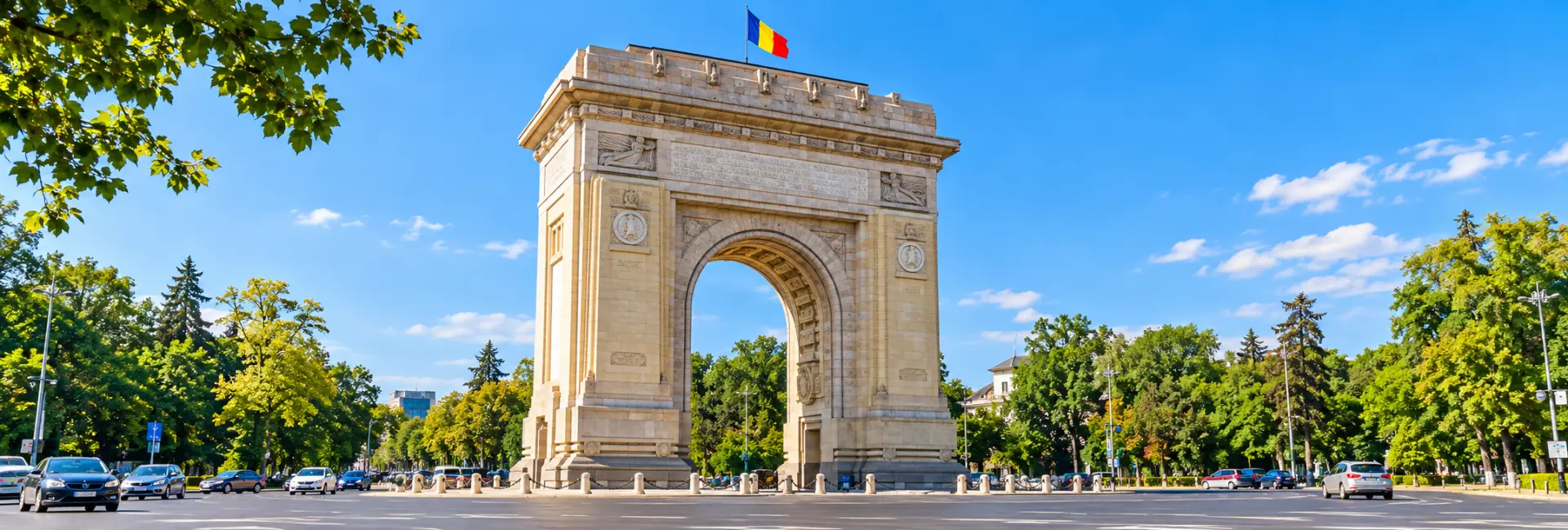
The Arcul de Triumf rises from a busy roundabout in northern Bucharest, at the point where Șoseaua Kiseleff meets several major boulevards. Standing 27 meters tall, it is one of the most recognizable symbols of the Romanian capital and a monument to the country's victory in World War I and the creation of Greater Romania.
Many visitors compare it to the Arc de Triomphe in Paris, and the resemblance is deliberate. The Bucharest arch is smaller and more restrained, but it carries a rich program of sculpture, and its position at the gateway to King Michael I Park makes it an easy anchor for a day in the north of the city.
The monument also works as a hinge between two very different parts of the city. To the south, Șoseaua Kiseleff runs toward Piața Victoriei and the government quarter, while to the north the boulevard leads to the open spaces of the park and the lake beyond.
It is more than a photo stop. Romania's National Day parade passes beneath it every year, and since 2025 the monument has been open to the public throughout the year, so you can climb inside and look out over Kiseleff Road from the terrace on top.
History
A Series of Temporary Arches
The current arch had several predecessors, each built in a hurry for a particular celebration. The first, made of wood, went up after Romania won its independence in 1878 so that returning troops could march beneath it. Later temporary arches marked the 40th anniversary of King Carol I's reign in 1906 and the return of the royal family from exile in 1918. Most were built from weak materials and decayed quickly.
After World War I, Mayor Matei Corbescu commissioned another arch in 1922, designed by the architect Petre Antonescu with a concrete frame and a plaster finish. It was still temporary in spirit, and critics were unimpressed. The composer George Enescu reportedly wrote to the mayor to ask when Bucharest would get a proper triumphal arch.
The Permanent Monument
The answer came in 1935 and 1936. The weathered plaster version was taken down and Antonescu designed a lasting replacement in stone, with ordinary citizens contributing millions of lei toward the granite. The arch was inaugurated on 1 December 1936, Romania's National Day, in the presence of King Carol II, Queen Maria and the royal family.
The date carried meaning. December 1 commemorates the union of Transylvania with the Kingdom of Romania in 1918, the event that completed the country's modern borders, so the monument's message of victory and unity was linked to the national calendar from its first day.
A National Day Tradition
Since then the arch has become the natural stage for national ceremonies. Each 1 December, military parades pass beneath it to mark Romania's National Day, and the surrounding area fills with spectators and flags.
Architecture and Design
Form and Materials
The arch is a rectangular block with a single central opening. Its footprint measures 25 by 11.5 meters, and it rises to a height of 27 meters. Architecturally it belongs to the Neoclassical tradition, with clean lines, a strong horizontal cornice and ornament concentrated in carved panels rather than spread over every surface.
The structure combines reinforced concrete with a facing of Deva granite, while the reliefs and decorative figures were carved from Rușchița marble and other stone. Skilled stone carvers from Italy worked alongside Romanian sculptors to execute the marble work.
Setting and Proportions
The arch is a freestanding monument in the middle of a large traffic circle, which means it is seen from every direction. Its blocky, parallelepiped shape reads clearly from a distance, and the deep central opening frames the road beyond. The proportions are broad rather than tall, giving the monument a calm, ceremonial presence that suits the formal avenue it terminates.
The Paris Connection
Petre Antonescu took the Arc de Triomphe in Paris as his model, a choice that reflected the close cultural ties between Romania and France at the time. The Bucharest arch is about half the height of its Parisian counterpart, which stands around 50 meters tall. Antonescu was best known for his Neo-Romanian buildings, so the sober classical language here is a notable departure from his usual style.
Sculpture and Symbolism
A Monument Carved with a Story
The decoration is the arch's most distinctive feature. A team of leading Romanian sculptors produced the reliefs, medallions and figures, and the program tells a national story of war, sacrifice and unification. The arch honors the heroes of the War of Independence as well as those of World War I.
- The northern facade carries medallions symbolizing Virility, by Ion Jalea, and Faith, by Constantin Baraschi.
- Figures of Victory by Cornel Medrea and Dimitrie Onofrei complete the northern composition.
- The southern facade presents portraits of the first sovereigns of Greater Romania.
- The arch's underside shows decisive battles fought by the Romanian army in World War I.
- The sides record the proclamations issued by King Ferdinand in 1916 and 1922.
Other sculptors who contributed include Alexandru Călinescu, Mac Constantinescu, Dimitrie Paciurea and Costin Petrescu. Looking closely at the panels is the best way to appreciate how much narrative the monument holds.
Status and Restoration
A Listed Historic Monument
The Arcul de Triumf is on the list of historic monuments in Romania and is managed today as a cultural site by the Brâncovenești Palaces cultural center. Its status reflects both its architecture and its role in national memory.
Strengthening the Arch
Decades of weather and age left the monument in need of serious work. A major program of consolidation, restoration and conservation began in 2014, financed by the city with European co-funding, and the arch reopened on 28 November 2016. As part of the work, dozens of seismic isolators and dampers were installed in the structure, so the monument is much better prepared for the earthquakes that Bucharest is known to face.
Inside the Arch
The Climb
Inside each of the two legs of the arch is a staircase, and together they lead up to the terrace on top. The climb is 164 steps with no elevator, so it takes a little effort, but the pace is manageable for most people who are comfortable with stairs.
Exhibitions and Terrace
Along the way, the interior levels host small thematic exhibitions about the history of the arch and the events it commemorates. At the top, the terrace opens onto a wide view of Kiseleff Road and the greenery of King Michael I Park, with the skyline of northern Bucharest stretching beyond. On clear days the view straight down the boulevard toward the House of the Free Press is especially striking.
The cultural center that runs the arch also stages occasional recitals and commemorative events there, so it is worth checking the official program in advance.
Ways to Experience It
From the Outside
Viewing the arch from the pavement is free and takes only a few minutes. Walk around the roundabout to see the north and south facades and photograph the sculptural details in different light.
From the Top
Climbing to the terrace is the fullest way to visit. Allow around 30 to 60 minutes for the ascent, the exhibitions and the view. Guided visits are offered in Romanian and English and add useful context about the sculptors and symbolism.
As Part of a Longer Walk
Many visitors combine the arch with a stroll through King Michael I Park or a walk along Șoseaua Kiseleff, which makes a pleasant half-day itinerary.
Best Time to Visit
By Season
- Spring and early autumn offer mild weather and clear air, which suit both the climb and the photography.
- Summer brings long daylight hours, but midday heat can make the stairs tiring, so aim for morning or late afternoon.
- Winter is cold and the days are short, though the arch looks dramatic against a clear sky and the monument is open all year.
Special Dates
On 1 December, public access around the arch is usually restricted during the National Day ceremonies, so plan your visit for another day unless the parade itself is your goal. Check the official channels for any unscheduled closures.
Visitor Tips
- Opening hours change between the summer and winter seasons, and the arch is closed on Mondays, so confirm the schedule with the operator before you set out.
- Entry to the interior and terrace requires a ticket, while looking at the monument from outside costs nothing.
- The monument is not wheelchair accessible because of the 164 steps, although the exterior is easy to see.
- Cross the roundabout only at the signalized pedestrian crossings, since traffic around the arch is heavy.
- Safety rules apply on the terrace, including limits on large bags and a ban on leaning over the parapet.
- Bring a camera for the terrace, and pick a clear day for the best long-distance views.
Nearby Attractions
The arch sits at the start of one of Bucharest's most pleasant areas for walking, with parks, museums and grand villas close at hand.
- King Michael I Park, better known as Herăstrău Park, begins a short walk away and offers a large lake, gardens and the open-air Village Museum.
- Șoseaua Kiseleff, the tree-lined boulevard that links the arch with Piața Victoriei, is lined with museums, including the Romanian Peasant Museum and the Grigore Antipa Natural History Museum.
- The House of the Free Press stands at the northern end of the boulevard and is visible from the arch.
- Piața Victoriei, the seat of the Romanian government, lies at the southern end of Kiseleff Road.
FAQs about visiting the Arcul de Triumf
Is the Arcul de Triumf the same as the Arc de Triomphe in Paris? +
No, but it was modeled on it. The Bucharest arch was designed by Petre Antonescu, stands 27 meters tall and uses a more restrained Neoclassical style. The Paris monument is roughly twice as high.
Can you go up the Arcul de Triumf? +
Yes. The interior staircases lead to a rooftop terrace with views over Kiseleff Road and the park. The monument has been open to visitors throughout the year since March 2025, with seasonal hours and closures on Mondays.
How many steps are there? +
There are 164 steps and no elevator. Anyone who is comfortable with stairs should manage the climb without difficulty, but it is not suitable for wheelchair users.
Do I need a ticket? +
A ticket is required to enter the arch and reach the terrace, with reduced prices for some groups and free entry for others. Viewing the monument from outside is free.
How long does a visit take? +
Plan about 30 to 60 minutes if you climb to the terrace and see the exhibitions. A quick look from the street needs only 10 to 15 minutes.
How do I get there? +
Take metro line M2 to Aviatorilor station and walk for roughly 10 minutes, or use one of the buses that stop at Arcul de Triumf. The arch is on a roundabout, so use the pedestrian crossings.
What is the best time to visit? +
Clear mornings and late afternoons in spring or autumn give the best light and the most comfortable climb. Weekdays are generally quieter than weekends.
What happens at the arch on 1 December? +
Romania's National Day is marked by a military parade that passes beneath the arch. Access to the area is usually restricted that day, so visit on another date if you want to climb.
