
Table of Contents
Overview
Revolution Square, or Piața Revoluției, is the open heart of central Bucharest and one of the most important public spaces in Romania. It lies on Calea Victoriei, where the avenue widens into a plaza framed by a former royal palace, a university library, a concert hall and the old headquarters of the Communist Party.
The square is best known for the events of December 1989, when a staged rally for Nicolae Ceaușescu turned into the moment that his regime lost control. Today it is a place of remembrance as well as a busy crossroads, where tourists, office workers and students pass memorials, museums and cafes in the space of a few minutes.
Entry is free and there are no gates or tickets, so you can simply arrive and take your time. A visit works as a short stop of half an hour or as the starting point for a much longer walk through the city's historic centre.
History
Palace Square
Before 1989, the square was known as Palace Square, or Piața Palatului, because it stood in front of the royal residence. Over the nineteenth century, a modest house on this spot was enlarged into a princely palace and later into the Royal Palace, and the area around it grew into a showcase for the capital's institutions.
A Cultural Centre
Around the palace, other important buildings appeared. The Romanian Athenaeum opened just to the north in 1888, and the Central University Library, the Kretzulescu Church and the grand Athénée Palace hotel all became part of the same civic and cultural cluster. This concentration of important buildings explains why the square later became such a powerful stage for political events.
The Communist Period
In the communist era, one side of the square was occupied by the headquarters of the Central Committee of the Romanian Communist Party. The former Royal Palace was taken over for use as a national art museum, and the whole area became a setting for official ceremonies and organised rallies.
A New Name
After the revolution, the plaza was renamed Revolution Square, a title that reflects its role in the fall of the old regime. In 1990, the former party headquarters became the seat of the Senate, and from 2006 it has housed a government ministry.
The 1989 Revolution
The Final Speech
On 21 December 1989, a crowd of well over 100,000 people was brought to the square to show support for Ceaușescu after unrest in the western city of Timișoara. Instead, the gathering turned hostile. Jeering and shouting interrupted the leader from the balcony of the Central Committee building, and the scene was seen by viewers across the country on live television.
Chaos and Fighting
The situation quickly spiralled out of control. Security forces moved against demonstrators, and fighting broke out in and around the square and nearby streets. Many people were killed or injured over the following hours and days.
Escape by Helicopter
The next morning, on 22 December, Ceaușescu tried to address the crowd again but was unable to regain control. He fled by helicopter from the roof of the Central Committee building around midday. He was later captured, tried and executed, and the revolution ended the communist regime in Romania.
These events are central to how Romanians remember the late twentieth century, and the square remains the best place in the capital to reflect on them.
Memorials & Monuments
The Memorial of Rebirth
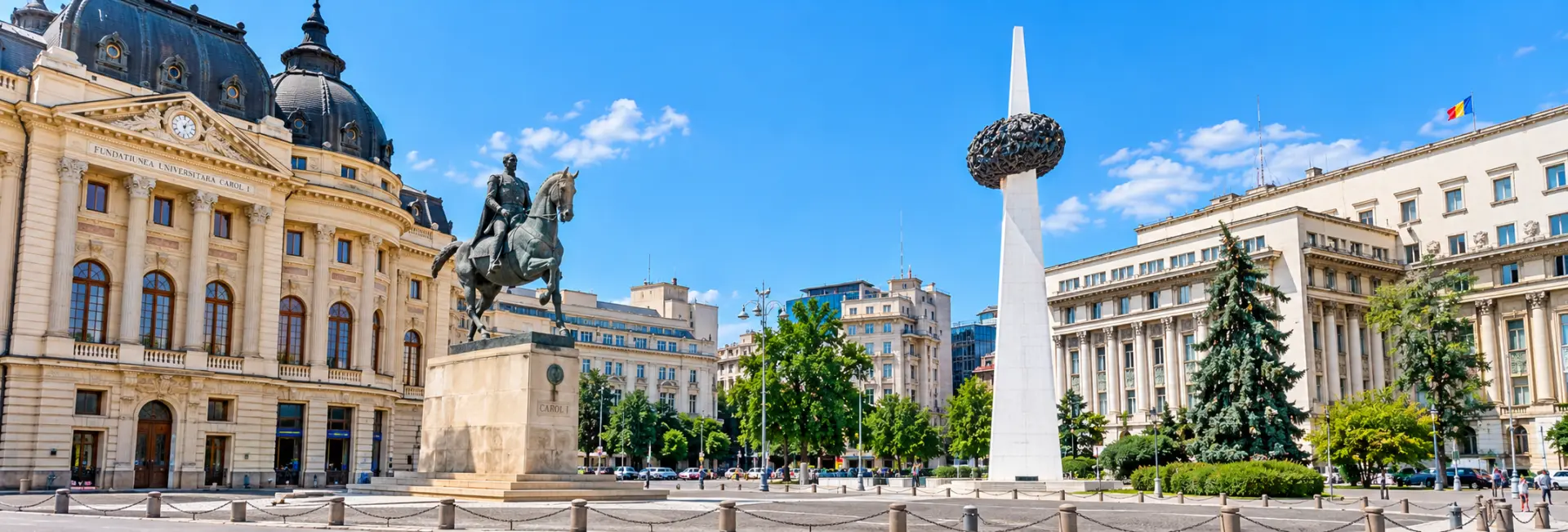
The most visible monument is the Memorial of Rebirth, a slender white marble spire about 25 metres tall that appears to pierce a metal ring near its top. It was designed by Alexandru Ghilduș, built between late 2004 and August 2005, and dedicated to the victims of the 1989 revolution. Its design divides opinion, and many locals have given it playful nicknames, but it remains the visual centrepiece of the square.
The Wall of Remembrance
Part of the memorial complex is a wall engraved with the names of those who died during the revolution, more than a thousand in all. Reading the names is a quiet and moving moment that brings the human cost of the events into focus.
The Marble Triangle
In front of the former party headquarters stands a low white marble memorial bearing an inscription that honours the martyrs of the revolution. Its pointed shape directs the eye toward the balcony from which Ceaușescu made his last public address.
Statue of Iuliu Maniu
A seated bronze statue honours Iuliu Maniu, a former prime minister who opposed the communists and died in prison in 1953. It adds a reminder of earlier resistance to the regime that fell in 1989.
Notable Landmarks
- Former Central Committee building: the imposing building with a columned entrance and the balcony from which Ceaușescu spoke, now home to a government ministry.
- National Museum of Art of Romania: housed in the former Royal Palace, with Romanian and European collections.
- Central University Library: a handsome building on the northern edge of the square, damaged in 1989 and later restored.
- Kretzulescu Church: a small eighteenth-century church with warm brickwork beside the former palace.
- Romanian Athenaeum: the domed concert hall just to the north, often called the finest building in the city.
- Athénée Palace Hilton: a historic hotel with a long role in the capital's social life.
Together these buildings make the square one of the best places in Bucharest to see several centuries of history in a single view.
Cultural Significance
Revolution Square holds a special place in Romanian public memory. It is where the country's communist era effectively ended, and it has since been used for commemorations, protests and celebrations. Each December, people gather to mark the anniversary, and civic groups have organised installations and exhibitions that bring the events of 1989 to life.
In December 2025, for example, a two-day commemorative event called the Garden of Memories took over the area around the Memorial of Rebirth. It combined an audio installation of authentic recordings made in the square in December 1989 with an open-air photo exhibition of documentary images, giving visitors a direct and sobering sense of what happened there.
The square is also a place of ongoing debate. Residents and architects have discussed how best to reorganise the space, which is partly used for car parking and traffic, so that it can serve as a more welcoming central plaza. Proposals include reducing traffic and expanding pedestrian areas, particularly at weekends when parts of Calea Victoriei are closed to cars.
For visitors, this means the square is not frozen in the past. It is a living public space whose meaning is still being discussed and shaped.
Ways to Experience It
Walk and Reflect
The simplest approach is to walk slowly around the square, starting at the Memorial of Rebirth and then moving to the marble triangle, the wall of names and the balcony. Reading the inscriptions and looking across the plaza helps you picture the crowd of 1989.
Visit the Museum
The National Museum of Art of Romania is right on the square and makes an excellent addition to the visit. Its galleries cover Romanian and European art, and the building itself is part of the story.
Attend a Concert
Just to the north, the Romanian Athenaeum hosts concerts throughout the year. An evening performance gives the area a very different, more festive atmosphere.
Join a Walking Tour
Many guided tours of Bucharest include the square as a key stop, with guides who explain the events of 1989 in detail and point out places that are easy to overlook, such as bullet-scarred facades on nearby buildings.
Best Time to Visit
Time of Day
Mornings are quiet and good for photographs, while late afternoon brings warm light on the facades and a lively mix of people. Evenings bring a different atmosphere, with people crossing the square on their way to concerts and restaurants.
Season and Dates
Spring and early autumn are the most comfortable seasons for walking. Around the anniversary of the revolution in late December, the square can host commemorations and special events, which make it a particularly meaningful time to visit, though it will also be colder and busier.
Visitor Tips
- Treat the memorials with respect. This is a place of remembrance for people who died, so keep noise and photography sensitive near the wall of names.
- Take care when crossing, as the square is surrounded by busy roads and traffic runs through it.
- Be mindful around the ministry building, which is an active government site, and follow any instructions from security staff.
- Check opening hours and ticket details for the museum, library and concert hall before you go, since these change and some venues close on certain days.
- Combine the visit with a longer walk on Calea Victoriei and allow extra time if you want to enter a museum.
- Keep an eye on your belongings in busy central areas, as you would in any major city.
Nearby Attractions
The square sits in the middle of Calea Victoriei, so many of Bucharest's best sights are within a short walk. To the north, the Romanian Athenaeum and the Cantacuzino Palace offer music and history, while to the south you reach the Telephone Palace, the CEC Palace and the National Museum of Romanian History.
A short distance away, the Cișmigiu Gardens provide a green retreat, and the Old Town with its lively streets and the small Stavropoleos Monastery lies beyond the southern end of the avenue. The Universitate and Piața Romană metro stations are the closest underground connections.
FAQs about visiting Revolution Square
What is Revolution Square known for? +
It is the place where Nicolae Ceaușescu gave his final speech in December 1989, which led to the fall of the communist regime in Romania. Today it holds memorials to the victims and is surrounded by important cultural buildings.
Why is it called Revolution Square? +
It was known as Palace Square until 1989. After the revolution, it was renamed to honour the uprising that began there and in other parts of the city.
What is the tall monument in the middle of the square? +
It is the Memorial of Rebirth, a marble spire about 25 metres high that was inaugurated in 2005. It is dedicated to the victims of the 1989 revolution and has long been the subject of debate about its design.
Is it free to visit? +
Yes, the square is a public space and there is no charge to walk around it. Museums and concerts nearby have their own ticketing, so check their current details.
Can you see the balcony where Ceaușescu spoke? +
You can see the balcony from the square, but the building is now used by a government ministry and is not open to the public. The nearby marble memorial points toward it.
How long should I spend at the square? +
Around thirty minutes to an hour is enough to see the memorials and take photographs. If you add the museum or a concert, plan for more time.
What else is nearby? +
The Romanian Athenaeum, the National Museum of Art of Romania, the Central University Library and Calea Victoriei with its many sights are all very close. The Old Town and Cișmigiu Gardens are a short walk away.
How do I get there? +
It is in the centre of Bucharest, on Calea Victoriei. The Universitate and Piața Romană metro stations are nearby, and taxis and buses also serve the area. Many visitors simply walk from other central sights.
