
Table of Contents
Overview
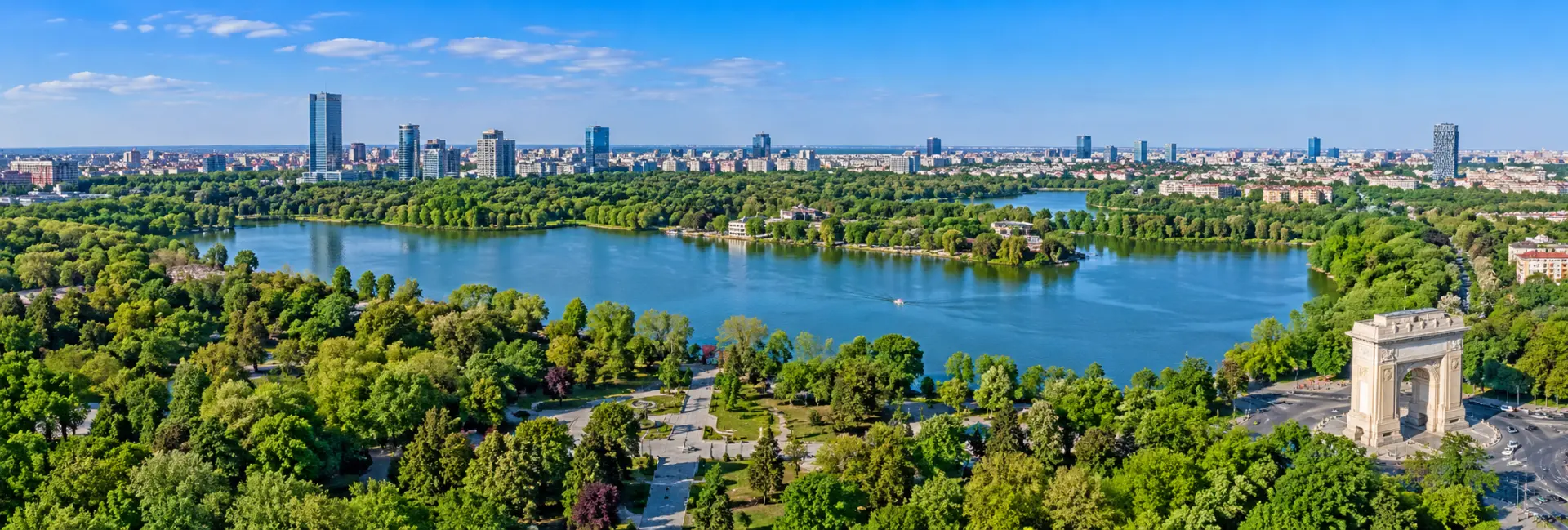
Herăstrău Park, officially renamed King Michael I Park in 2017, is the largest park in Bucharest and the city's favorite escape from traffic and concrete. It covers about 187 hectares in the north of the capital, and roughly 74 of those hectares are water: Lake Herăstrău, one of the lakes strung along the Colentina River.
The park is really several landscapes in one. Formal flowerbeds and shaded promenades sit beside a calm, almost rural zone built around the Village Museum, while the opposite shore is given over to playgrounds, sports grounds, cafes and restaurants. Locals still say Herăstrău far more often than the newer name, so expect to hear both.
It works equally well as a full day out or a short walk between meetings. You can rent a boat, cycle the lakeside paths, stroll through a Japanese garden or step into an open-air museum of traditional Romanian villages without ever leaving the park. The whole area is also protected as a historic monument.
History and Names
From Marshland to Promenade
The park takes its name from the lake, and the lake's name comes from a regional variant of the Romanian word for "saw", a nod to the water-powered sawmills that once worked along the Colentina. For a long time the shoreline was damp, marshy ground, though history records an Ottoman-style pavilion built on the bank by Alexander Ypsilantis. By the middle of the 19th century the area had become a favored walking spot for Bucharest's elite.
A Park Built in the 1930s
The park you see today dates to the reign of Carol II. After the marshland was drained in the early 1930s, work on a new National Park began in 1936. Several dozen run-down houses and an industrial plant were cleared to make room for it. The project was entrusted to Ernest Pinard and the German landscape architect Friedrich Rebhuhn, whose planting scheme gave the park its varied vegetation. It opened to the public in May 1939 as the largest park in the city.
Many Names, One Park
The park's names mirror the country's politics. It began as the National Park, then carried King Carol II's name, and after World War II became I. V. Stalin Park, with a statue of Stalin at its entrance. That statue was pulled down in 1956 during de-Stalinization, and the park became Herăstrău. On 19 December 2017, two weeks after the death of King Michael I, Bucharest's city council renamed it in his honor.
Design and Layout
Two Zones
The park is organized into a quiet zone and an active zone. The quiet side, devoted to rest and culture, holds the Village Museum, the Elisabeta Palace and an open-air summer theatre. The active side, across the lake, is where people head for sports courts, restaurants, children's play areas and a fun park.
Entrances, Axes and Flowers
The most elegant entrance faces Piața Charles de Gaulle, where the Alley of the Caryatids (Aleea Cariatidelor) greets visitors. Created by the sculptor Constantin Baraschi and inaugurated in 1939, it translates a classical Greek idea into a Romanian setting. From there, paths fan out toward the lake and the gardens beyond.
The Expoflora area, roughly 15 hectares of seasonal floral displays, includes Rose Island and ties the formal gardens together. The park is bordered by Aviatorilor and Constantin Prezan boulevards, Șoseaua Kiseleff, Șoseaua București-Ploiești and Șoseaua Nordului, which explains why entrances are scattered around its edges.
Lake Herăstrău
On the Water
The lake is the heart of the park and the reason it feels so open. In warm weather you can hire pedal boats and rowboats, and a yacht club on the shore keeps sailing and other water sports part of the scene. Recreational fishing is also practiced here. The surface covers about 74 hectares, so even on a busy weekend there is room to drift away from the crowds.
Around the Shore
A continuous path follows much of the shoreline, passing flowerbeds, fountains, statues and long stretches of mature shade. The views shift with every bend, from open lawns and reeds to boats gliding past the waterfront cafes. Toward the northern end, the lake looks across to the House of the Free Press, the large landmark building that dominates the skyline at Piața Presei Libere.
Gardens, Monuments and Highlights
The Japanese Garden
Laid out in 1998 with the support of the Embassy of Japan in Romania, this small garden in the southwest of the park is one of its calmest corners. Its compact, carefully tended design makes a deliberate contrast with the busier lakeside paths, and spring brings cherry blossom.
Rose Island
Rose Island is a landscaped island linked to the rest of the park by two bridges. Its rose beds are at their best in early summer, and ornamental birds such as peacocks and swans have been kept here. Nearby, a row of twelve bronze busts honors political figures associated with the founding of the European Union.
Sculpture Along the Paths
- The Alley of the Caryatids, at the Charles de Gaulle entrance, is a formal, statue-lined approach that sets the tone for the rest of the visit.
- Hercules Fighting the Centaur is a 1925 work by the Romanian sculptor Ion Jalea.
- Prometheus is a sculpture by the Belgian artist Joseph Lambeaux, placed in the park in the mid-20th century.
The Village Museum and Elisabeta Palace
Dimitrie Gusti National Village Museum
The Village Museum is one of the park's most popular attractions and one of the best-known museums in Romania. It was founded in the 1930s on the initiative of the sociologist Dimitrie Gusti, who wanted to show rural life as it was actually lived. Houses, churches, mills and workshops were taken apart piece by piece in villages across the country, carried to Bucharest by train, cart or boat and rebuilt here.
Today the open-air collection includes hundreds of buildings, many of them furnished with authentic tools, textiles and household objects. The layout lets you cross from one region of Romania to another in a few minutes, and the site is large enough to fill half a day if you take your time.
The Elisabeta Palace
Inside the museum area, close to the Arcul de Triumf, stands the Elisabeta Palace, the current residence of the Romanian Royal Family. It is a private home and is not open to visitors, although its facade can be admired from the outside. Its presence gives the park a quiet royal connection that fits well with its newer name.
Ways to Experience the Park
On Foot or by Bike
Walking the lakeside paths is the classic way to see the park, and the route is flat and easy for most visitors. Bicycle rental points near the main entrance make cycling a popular alternative, which is a good way to cover more ground in a limited time.
On the Water
Pedal boats and rowboats are available in the warmer months, usually from landing points along the shore. Spending an hour on the lake gives you a completely different view of the park and the city skyline beyond it.
Culture, Food and Play
- Catch an open-air performance at the summer theatre during the season, when Bucharest theatre companies stage shows there.
- Spend a few hours at the Village Museum, ideally with a separate half-day set aside for it.
- Stop for a meal or a coffee at one of the lakeside restaurants and cafes on the active side of the park.
- Bring children to the playgrounds and the fun park, or use the sports grounds, including tennis and football courts.
Best Time to Visit
By Season
- Spring brings cherry blossom in the Japanese Garden, fresh flowerbeds and comfortable walking weather.
- Summer is peak season for boating, shade and lakeside dining, and also the busiest, especially on Sunday afternoons.
- Autumn is arguably the most photogenic season, with colorful foliage along the shoreline and thinner crowds.
- Winter is quiet and cold. Boating is generally off the menu, but the bare trees and empty paths suit a peaceful walk.
By Time of Day
Weekday mornings are the calmest hours and the best for photography and cycling. Late afternoon and early evening bring soft light over the water and a livelier atmosphere around the cafes. Weekends from late spring to early autumn are the busiest, so arrive early if you want quiet paths.
Visitor Tips
- The park is a public space and open all year, but the Village Museum has its own admission and opening hours, so check them before you go.
- Wear comfortable shoes. A full walk around the lake takes a while, and the park is much larger than it first appears.
- Share the paths politely. Cyclists, joggers, families and pedestrians all use the same routes, especially on weekends.
- Boat and bike rentals depend on the weather and the season. Some rental schemes ask for an ID, so carry one.
- Choose your entrance deliberately. The Piața Charles de Gaulle gate is the most scenic and sits beside the metro, while the Kiseleff side is handy for the Village Museum.
- Bring water and sun protection in summer, since shade is plentiful but not continuous.
Nearby Attractions
Herăstrău sits at the start of one of Bucharest's grandest stretches of city, so it is easy to combine with other sights on foot or by a short ride.
- The Arcul de Triumf stands a few hundred meters west of Piața Charles de Gaulle and marks the entrance to Șoseaua Kiseleff.
- Șoseaua Kiseleff is a broad boulevard lined with museums, mansions and the smaller Kiseleff Park, and it leads south toward Piața Victoriei.
- The House of the Free Press stands at the northern end of the boulevard and is visible across the lake.
- Piața Victoriei, home to the seat of the Romanian government, lies at the southern end of Aviatorilor Boulevard.
FAQs about visiting Herăstrău Park (King Michael I Park)
Is Herăstrău Park the same as King Michael I Park? +
Yes. The park was officially renamed after King Michael I in December 2017, but most people in Bucharest still call it Herăstrău, and both names appear on maps and signs.
How big is the park? +
It covers about 187 hectares, of which roughly 74 hectares are the lake. That makes it the largest park in Bucharest.
Is it free to enter? +
The park itself is a public space open all year. Separate attractions inside it, such as the Village Museum, have their own tickets and hours, so check the official sources before your visit.
How do I get there? +
The easiest route is the metro. Aviatorilor station on line M2 sits directly beneath Piața Charles de Gaulle, right next to the main entrance. Other gates open from Șoseaua Kiseleff and surrounding roads, and some have limited parking.
How much time should I allow? +
Plan two to three hours for the lakeside walk, gardens and a boat ride. If you also want to visit the Village Museum properly, add another two to three hours.
Can I rent boats and bikes? +
Yes, pedal boats and rowboats are available in the warmer months, and bicycle rental points operate near the main entrance. Availability and prices change with the season and weather.
Is the park good for children? +
Very much so. There are playgrounds, a fun park, open lawns and flat paths that suit strollers, plus the Village Museum, which many children enjoy exploring.
Can I visit the Elisabeta Palace? +
No. It is the private residence of the Romanian Royal Family and is not open to visitors, although you can see it from the outside.
