
Table of Contents
Overview
Phaselis is an ancient port city set on a narrow, pine-covered peninsula about 15 kilometres south of Kemer, on Antalya's western coast. Founded by colonists from Rhodes around 690 BC, it grew wealthy as a trading hub thanks to an unusual advantage: three separate natural harbors on a single small isthmus, which let ships load and unload no matter which way the Mediterranean winds were blowing.
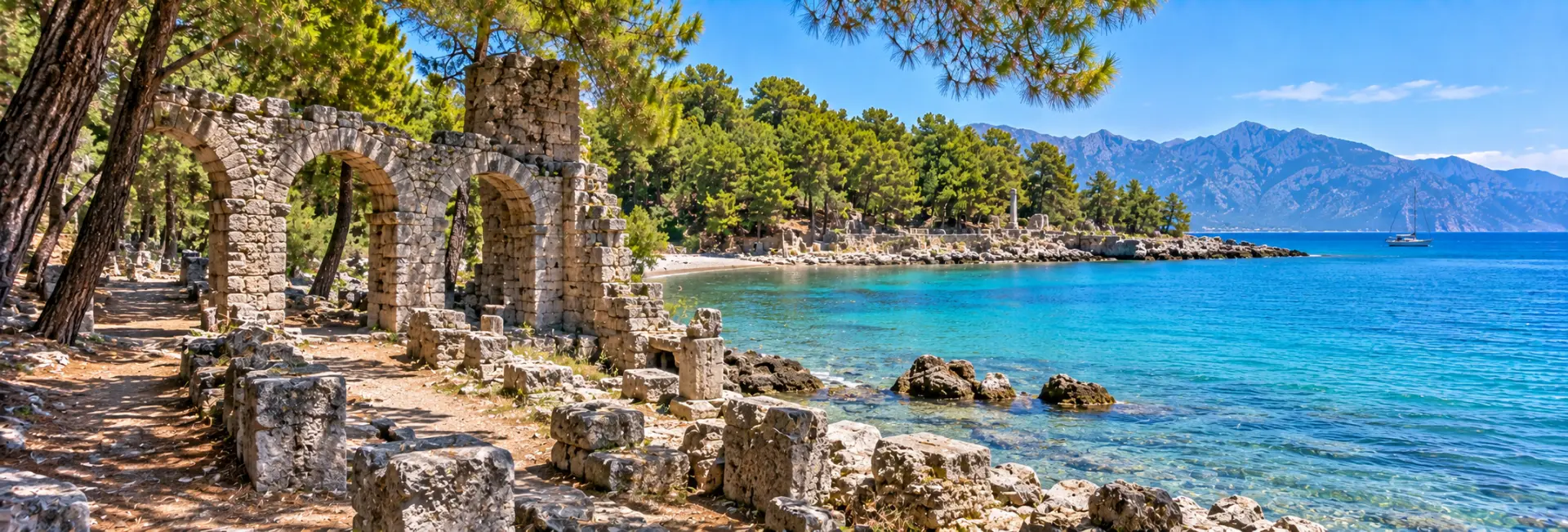
What makes a visit to Phaselis distinctive today is how closely its Roman-era streets, gate, and theatre sit alongside calm, swimmable bays, all shaded by tall pines within a protected national park. Many visitors treat it as much a beach outing as a historical one, splitting their time between walking the ancient main street and swimming off one of its three small harbors. That mix of ruins and coastline is part of why Phaselis is often recommended as a lighter, more relaxed alternative to some of the larger, more heavily visited ancient sites elsewhere on the Antalya coast.
History
A Rhodian Trading Colony
Phaselis was established by settlers from Rhodes at the end of the 7th century BC, on a site that already commanded a strategic position between the forested Bey Mountains and the sea. Its three harbors quickly made it one of the most important trading ports on the Lycian coast, linking Greece, Egypt, and Syria, and the city built its wealth on exports of timber and the rose and lily oils produced in the surrounding countryside.
Persians, Alexander, and Hellenistic Rule
Phaselis came under Persian control after the conquest of Asia Minor, and its fortunes shifted repeatedly over the following centuries as regional powers rose and fell. In 333 BC, during his campaign against the Persian Empire, Alexander the Great arrived at Phaselis and was welcomed peacefully by its citizens, reportedly spending the winter there with his fleet rather than having to take the city by force. After Alexander's death, control of Phaselis passed between Ptolemaic Egypt, Seleucid Syria, and the island of Rhodes before the city was eventually absorbed into the Lycian confederacy under Roman oversight around the mid-2nd century BC.
Pirates, Rome, and Hadrian's Visit
Like nearby Olympos, Phaselis suffered under the pirate leader Zeniketes in the 1st century BC, before Rome intervened and restored order to the coast. The centuries that followed under Roman rule brought Phaselis its greatest period of prosperity, culminating in a visit from Emperor Hadrian in AD 129, an event the city commemorated by building a monumental gateway and reworking part of its harborside agora in his honor. Statues were reportedly raised throughout the city to mark the occasion, underscoring how significant an imperial visit was for a provincial trading port of this size. Much of what visitors see on site today, including its best-preserved buildings, dates from this Roman and early Byzantine period of renewed wealth.
Decline and Abandonment
Phaselis's fortunes faded in later centuries, worn down by repeated Arab raids in the 7th and 8th centuries and by outbreaks of malaria that historians link to the city's low-lying, marshy setting near its harbors. Earthquakes in the medieval period further damaged the city, and Phaselis was largely abandoned by the 13th century as trade and population shifted toward growing centers like Antalya and Alanya.
The Three Harbors
Phaselis's defining feature was always its geography: a narrow isthmus flanked by three separate bays, each useful in different wind conditions, which let the city function as a reliable stop for merchant ships year-round. The central harbor, sometimes called the war harbor, is the best preserved today and is still used by small tour boats and pleasure craft, while the northern and southern harbors are quieter, framed by ruins and pine trees running almost to the waterline.
This triple-harbor layout is part of why ancient geographers singled out Phaselis as an unusually well-equipped trading city for its size, and it remains the site's most immediately recognizable feature, since visitors can walk between all three bays in well under an hour.
Exploring the Ruins
The Main Street and Hadrian's Gate
A wide paved avenue, roughly ten metres across, runs through the heart of Phaselis and once connected the northern and southern harbors, lined on either side by the remains of shops and public buildings. Near its southern end stands the single-arched gate built in AD 131 to commemorate Hadrian's visit two years earlier, one of the clearest surviving markers of the city's Roman-era prosperity.
Agoras, Theatre, and Baths
Phaselis had several agoras built at different periods, including one associated with Emperor Domitian and a later one added near the harbor closer to Hadrian's time, reflecting the city's continued investment in its civic core well into the Roman period. On the western side of the main street, a 2nd-century theatre built into the base of the acropolis hill once held around 1,500 to 2,000 spectators, while the remains of a bathhouse, a nymphaeum, and a small circular temple lie scattered nearby among the pines.
The Aqueduct
One of the first structures visitors see on entering the site is the Roman aqueduct, widely considered the best-preserved of the city's ruins. It carried water roughly 450 metres from a spring on the hill behind the northern harbor down to the agora and surrounding streets, supplementing the wells and cisterns the city had relied on in earlier periods. A gentle, carefully engineered gradient along its length let water flow steadily downhill without pumps, a detail that still impresses visitors who stop to look closely at the surviving piers and channel sections.
- A paved main street around 10 metres wide, connecting the northern and southern harbors
- Hadrian's Gate, built in AD 131 to mark the emperor's visit
- A 2nd-century theatre seating roughly 1,500 to 2,000 people
- A Roman aqueduct carrying water from a hillside spring to the city center
Beaches and Natural Setting
Because Phaselis sits inside a protected national park rather than an open town, its three small beaches have kept a quiet, undeveloped feel that's increasingly rare on this stretch of coast. Swimming and snorkeling are popular in all three harbors, and parts of the submerged ruins near the shoreline add an extra point of interest for anyone swimming with a mask and snorkel.
The dense pine forest surrounding the ruins provides welcome shade for walking between sites in summer, and the park's rules against picnicking and open fires help keep the area clean, though a small café and shop near the entrance sell drinks and snacks for visitors who don't want to pack their own.
Ways to Experience It
Most visitors plan for two to three hours at Phaselis, enough time to walk the main street, see the theatre and aqueduct, and swim at one or more of the harbors. Excursion boats and private yachts frequently anchor at the central harbor for a few hours, combining a stop at the ruins with lunch and a swim as part of a longer coastal cruise from Kemer or Antalya.
- Walk the full main street between the northern and southern harbors at an easy pace
- Bring swimwear and a towel to combine the ruins with time in the water
- Join a boat excursion from Kemer if you'd rather arrive by sea than by road
- Allow extra time if you plan to snorkel around the submerged sections near the shore
Best Time to Visit
Late spring through early autumn offers the most reliable weather for combining sightseeing with a swim, since the sheltered harbors stay calm and the pine forest keeps much of the site shaded even at midday. Early morning visits in peak summer help avoid both the heat and the larger tour groups that tend to arrive from Kemer and Antalya later in the day.
Outside the main swimming season, the site is quieter and cooler, which suits visitors more interested in the ruins themselves than in beach time, though the water will be too cold for a comfortable swim in winter months.
Visitor Tips
- Bring swimwear even if you're mainly there for the history, since a swim in one of the harbors is part of the standard Phaselis experience
- Wear comfortable shoes for walking the main street and surrounding paths, which are paved but uneven in places
- Picnicking is prohibited inside the park, so plan to buy food at the small café near the entrance or eat before or after your visit
- Pack out any trash you bring in, since bins are limited across the site
- Consider arriving by boat excursion from Kemer for a different perspective on the three harbors
- Check current opening hours before visiting, since these can shift slightly by season
Nearby Attractions
- Kemer - a coastal resort town about 15 kilometres north, with marinas, shopping, and nightlife
- Olympos Ancient City and Çıralı - another Lycian ruin and beach village further south, near the Chimaera flames
- Tahtalı Dağı (Mount Olympos) cable car - reachable from Tekirova, offering panoramic views over the coastline
- Antalya's old town (Kaleiçi) - a historic harbor quarter back toward the provincial capital
FAQs about visiting Phaselis Ancient City
Why did Phaselis have three harbors? +
Its position on a narrow isthmus allowed the city to build three separate bays, each useful under different wind conditions, which made it an unusually reliable stop for merchant ships trading along the Lycian coast.
Did Alexander the Great capture Phaselis by force? +
No, the city welcomed him peacefully in 333 BC, and he reportedly spent the winter there with his fleet rather than laying siege to it.
Can I swim at Phaselis? +
Yes, swimming and snorkeling are popular in all three harbors, and many visitors combine a walk through the ruins with time in the water as part of the same visit.
How long should I plan for a visit? +
Most people spend two to three hours exploring the main street, theatre, and aqueduct, plus extra time if they plan to swim or snorkel at the harbors.
How do I get to Phaselis from Kemer or Antalya? +
It's accessible by rental car, taxi, minibus toward Tekirova, or by excursion boat from Kemer, with the ruins about 15 kilometres south of Kemer and roughly 55 to 60 kilometres from Antalya.
Is food available on site? +
There's a small café and shop near the entrance selling drinks and snacks, but picnicking is not allowed elsewhere in the park.
What's the best-preserved structure at Phaselis? +
The Roman aqueduct, which once carried water from a hillside spring to the city center, is generally considered the site's best-preserved ancient structure.
Is Phaselis suitable for a family day trip? +
Yes, the combination of walkable ruins, shaded pine forest, and calm swimming harbors makes it a popular option for families visiting the Antalya coast.
