
Table of Contents
Overview
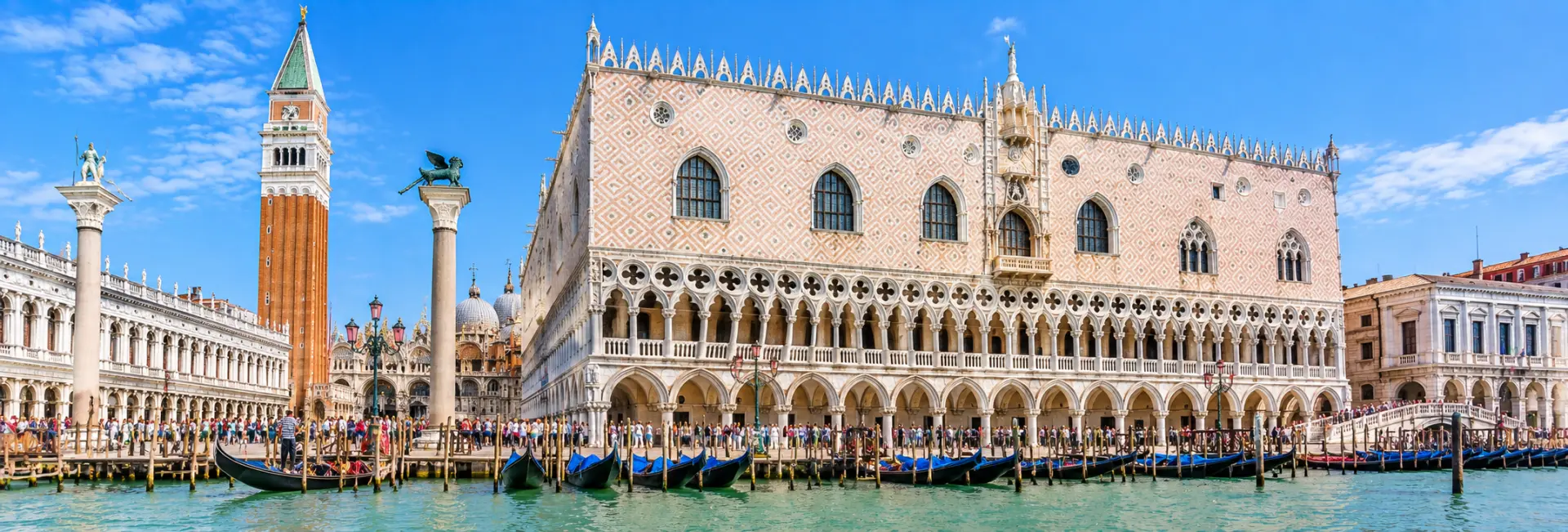
The Doge's Palace, or Palazzo Ducale, stands on the waterfront edge of Piazza San Marco, its lace-like Gothic facade facing the lagoon it once governed. For nearly nine hundred years, this was the political, judicial and ceremonial heart of the Venetian Republic: the residence of the doge, the meeting place of its councils, and the seat from which one of history's most durable maritime powers ran its affairs.
Despite the name, only a small portion of the building ever served as the doge's private apartments. Most of the palace was institutional space, built to house the Senate, the Great Council, the Council of Ten and the courts that gave Venice its reputation for order and secrecy in equal measure.
What makes a visit worthwhile today is the sheer density of what survives inside: room after room decorated by Tintoretto, Veronese and Titian, culminating in the largest oil painting in the world, and a direct physical link, the Bridge of Sighs, to the prison cells where the Republic's justice was carried out.
History
Origins and early rebuilding
A fortified residence for Venice's rulers stood on this site as far back as the ninth century, though nothing of that original structure survives above ground. The palace was rebuilt and expanded repeatedly over the following centuries as Venetian power and wealth grew, with each generation adding to or replacing what came before.
The Gothic palace takes shape
The building recognisable today is largely the product of construction carried out between 1309 and 1442, the period that gave the palace its distinctive Venetian Gothic character. Fires in the following centuries damaged sections of the interior, prompting further rebuilding and redecoration, which is why so much of what visitors see inside dates from the sixteenth century even though the shell of the building is older.
Government of the Republic
For most of its working life, the palace held the machinery of Venetian government: the Great Council, made up of over a thousand noble members, the smaller and more powerful Senate, and the secretive Council of Ten, which oversaw state security. The doge himself, elected for life, occupied only a modest set of private rooms within a building otherwise built for collective rule rather than personal luxury.
The end of the Republic and after
Venetian independence ended in 1797, when Napoleon's forces conquered the city and the last doge, Ludovico Manin, was deposed without resistance, bringing eleven centuries of the Republic to a close. The palace passed through various administrative uses in the years that followed and was formally opened to the public as a museum in 1923.
Architecture & Exterior
The Doge's Palace is considered one of the finest examples of Venetian Gothic architecture anywhere in the world. Its facade is built in three registers: an arcade of pointed arches at ground level, a loggia of delicate quatrefoil tracery above it, and a solid upper wall faced in a diamond pattern of pink and white marble that seems to hover rather than bear weight, an effect that was deliberately calculated by its builders.
Two features of the exterior stand out on approach:
- The Porta della Carta, an ornately carved Gothic gateway on the side facing the Piazzetta, which served as the ceremonial entrance to the palace and remains one of the finest examples of Venetian Gothic stone carving.
- The Scala dei Giganti, the grand exterior marble staircase inside the courtyard, flanked by Sansovino's monumental sculptures of Mars and Neptune, where newly elected doges were traditionally crowned.
The overall design intentionally inverts what visitors might expect of a fortress of state power: rather than heavy walls at ground level and lightness above, the palace is airiest and most open at the bottom, with the solid mass held aloft on slender arcades, a piece of architectural theatre that has unsettled and delighted observers for centuries.
Inside the Palace
Passing through the Porta della Carta leads into the internal courtyard and, from there, up toward the palace's institutional heart. The Golden Staircase, or Scala d'Oro, is the grand internal approach to the upper chambers, its stuccoed ceiling covered in gold leaf and reserved historically for the doge and his most honoured guests.
The rooms beyond are where Venetian government actually happened, and each carries its own character:
- The Doge's private apartments, comparatively restrained given the grandeur elsewhere, reflecting the largely ceremonial and collective nature of Venetian rule.
- The Sala del Senato, the Senate Chamber, decorated with gilded woodwork and ceiling frescoes by Veronese, where the Republic's smaller governing body debated law and policy.
- The Sala del Consiglio dei Dieci, the chamber of the Council of Ten, the body most associated with Venetian state security and secret proceedings.
- The Sala del Maggior Consiglio, the Hall of the Great Council, the largest room in the palace and one of the largest rooms in Europe, where the city's noble families once gathered by the hundreds to elect leaders and decide the Republic's fate.
Every surface across these rooms, walls and ceilings alike, is worked with paintings, gilding and carved wood, deliberately assembled over generations to project the wealth and permanence of the state to the foreign envoys who were regularly received here.
Tintoretto's Paradise and Other Masterworks
The single most famous object inside the palace hangs in the Hall of the Great Council: Tintoretto's Paradise, an enormous canvas roughly 24.5 metres wide and 9.9 metres high, generally cited as the largest oil painting in the world. It depicts a heavenly scene crowded with several hundred figures and occupies an entire wall behind where the doge's throne once stood.
Paradise is only the largest of many major works distributed through the palace's chambers. Veronese, Titian and other leading Venetian painters contributed ceiling panels, frescoes and monumental canvases throughout the council rooms, most commissioned specifically to celebrate Venetian power, virtue and history rather than as independent works of art.
Sculpture plays a role too, from the carved reliefs of the Porta della Carta to Sansovino's giants on the Scala dei Giganti, meaning the palace functions as a survey of Venetian art across several centuries as much as a historic seat of government.
The Bridge of Sighs and the Prisons
A fully enclosed stone bridge, built in the early seventeenth century, connects the palace to the New Prisons across a narrow canal. Known as the Bridge of Sighs, or Ponte dei Sospiri, its name comes from the small windows through which condemned prisoners caught their final glimpse of Venice on the way to their cells, said to have drawn an audible sigh from those crossing it.
The palace's most famous inmate was Giacomo Casanova, held here in the 1750s before making a celebrated escape through the building's roof in 1756, an episode he later wrote about at length and which has become part of Venetian folklore.
Standard palace tickets include a walk across the bridge into the older prison cells. The Secret Itineraries tour, a separate guided route, goes further, taking visitors through hidden passages, interrogation rooms and additional cells not seen on the standard circuit, offering a more detailed look at how Venetian justice actually operated behind the ceremonial rooms upstairs.
Ways to Experience It
The Doge's Palace supports several different visit formats, and the right one depends on how much time and depth you want.
- Standard admission: covers the state rooms, the Great Council Chamber, the armoury and a walk across the Bridge of Sighs into the older prison cells.
- Combined ticket with Museo Correr: the palace is generally sold as part of the Museum Pass covering several San Marco museums together, which is worth it for anyone planning to see more than one.
- Secret Itineraries tour: a separate, pre-booked guided route through hidden rooms, torture chambers and additional prison cells not included in standard admission.
- Audio guides: available in multiple languages, useful given how little on-site labelling explains the political function of each room.
- Fast-track or skip-the-line tickets: sold by the museum and various operators, worth considering in peak season when queues at the entrance can be long.
A standard self-guided visit typically takes around ninety minutes to two hours; the Secret Itineraries tour adds roughly another hour and must be booked in advance, as places are limited.
Best Time to Visit
Time of day
Arriving at opening time gives the clearest run through the state rooms before tour groups converge from the square outside. Late afternoon, in the final two hours before closing, is a workable second option once the day's cruise and coach groups have moved on.
Season
Spring and autumn bring more comfortable crowd levels than summer, when the palace, like the rest of Piazza San Marco, sees its heaviest volume of visitors. Winter is quieter inside, though acqua alta can occasionally affect access to the surrounding square and the palace's own ground-floor approach.
Booking tickets online in advance, with a specific entry time, is worth doing in any season, since it avoids the ticket-office queue that forms at the entrance even when the interior itself is not overcrowded.
Visitor Tips
- Book the Secret Itineraries tour well ahead if you want it, since spaces are limited and it sells out during busy periods.
- A combined museum ticket covering the Doge's Palace and Museo Correr, and often the Marciana Library and Archaeological Museum, is usually better value than single admission if you plan to see more than one.
- Large bags and backpacks are restricted inside; plan to travel light or use a bag drop nearby.
- The palace involves significant walking and several staircases; lifts serve part of the route but not every room, so mobility needs are worth checking with the museum in advance.
- Photography without flash is generally permitted in the state rooms, though rules can vary by area, so check posted signage.
- Combine the visit with the Bridge of Sighs viewed from outside, on the Ponte della Paglia over the adjacent canal, for the classic photograph of the bridge itself.
- Allow a full morning or afternoon if adding the Secret Itineraries tour to the standard visit.
Nearby Attractions
Standing at the edge of Piazza San Marco, the palace is within easy walking distance of nearly everything else in this part of Venice.
- Piazza San Marco: the square the palace fronts, ringed by arcaded buildings and historic cafés.
- St. Mark's Basilica: directly adjoining the palace, Venice's Byzantine cathedral and former ducal chapel.
- Bridge of Sighs: best photographed from the Ponte della Paglia, a short walk along the waterfront from the palace's southern side.
- Museo Correr: a museum of Venetian art and history facing the Basilica from across the square, often included with palace admission.
- Campanile di San Marco: the bell tower beside the Basilica, with a lift to a rooftop observation level.
- Riva degli Schiavoni: the broad lagoon-front promenade extending east from the palace, lined with hotels and views back across the water.
A natural route is to visit the palace and Basilica together, given their shared ticketing and adjoining location, then walk the Riva degli Schiavoni or continue toward the Rialto Bridge afterward.
FAQs about visiting the Doge's Palace
What was the Doge's Palace used for? +
It was the seat of government for the Venetian Republic for nearly nine hundred years, housing the doge's residence alongside the chambers of the Senate, the Great Council and the Council of Ten. Only a small part of the building was ever the doge's private living space.
What is the most famous artwork inside? +
Tintoretto's Paradise, hanging in the Hall of the Great Council. At roughly 24.5 by 9.9 metres, it is generally considered the largest oil painting in the world.
What is the Bridge of Sighs? +
An enclosed stone bridge connecting the palace to the New Prisons, named for the sighs said to have escaped condemned prisoners glimpsing Venice for the last time through its small windows. It is included on the standard palace visit.
Is it true Casanova was imprisoned here? +
Yes. Giacomo Casanova was held in the palace's prison cells in the 1750s and famously escaped through the roof in 1756, an episode central to his own later writings.
How long does a visit take? +
A standard self-guided visit runs roughly ninety minutes to two hours. Adding the Secret Itineraries tour extends that by about another hour.
Do I need to book in advance? +
It is not strictly required for standard admission, but booking a timed ticket online is strongly advisable in peak season, and the Secret Itineraries tour must be pre-booked since spaces are limited.
Is the palace combined with other museums on one ticket? +
Yes, standard admission is generally sold as part of a combined pass covering the Museo Correr and often the Marciana Library and Archaeological Museum as well.
When did the Venetian Republic end? +
In 1797, when Napoleon's forces conquered Venice and the last doge, Ludovico Manin, was deposed, ending eleven centuries of independent Venetian government.
Is the Doge's Palace accessible for wheelchair users? +
Some routes are step-free with lift access, but not every room in the palace is reachable this way, so it is worth checking specific accessibility needs with the museum before visiting.
What is the Golden Staircase? +
The Scala d'Oro, an ornately gilded internal staircase that historically only the doge and his most honoured guests were permitted to use, leading up to the main state rooms.
