
Table of Contents
Overview
Teatro La Fenice is Venice's principal opera house and one of the most storied theatres in Europe, its name, "The Phoenix," chosen because the very first company to build here had already lost one theatre to fire before this one opened. That name has proven prophetic: La Fenice has burned down and been rebuilt not once but twice more since, most recently after a devastating arson attack in 1996.
Tucked into a quiet campo a short walk from Piazza San Marco, the theatre has hosted premieres by Rossini, Bellini, Donizetti and Verdi, and performances by figures ranging from Maria Callas to Igor Stravinsky. Its gilded, neoclassical interior, painstakingly recreated after the last fire using historical records, remains one of the most opulent theatre spaces in Italy.
Visitors can see the theatre either by attending a performance during the opera season or by taking a self-guided daytime tour with an audio guide, which is often the only way to see the auditorium up close outside performance nights.
History
Born from an earlier fire
La Fenice takes its name, meaning "The Phoenix," from the circumstances of its own founding. In 1790, a group of Venetian noble families commissioned a new theatre after the city's leading opera house of the time had burned down in 1774 and was not successfully rebuilt. Naming the new venue after the mythical bird that rises from its own ashes was, from the start, an act of defiant optimism.
Opening night, 1792
Designed by the architect Gianantonio Selva in a neoclassical style prized for its acoustics as much as its elegance, the theatre opened on 16 May 1792 with a performance of Giovanni Paisiello's I giochi di Agrigento, staged during the Festa della Sensa, one of Venice's major civic festivals. It quickly became the cultural centre of Venetian society and one of the leading opera houses in Europe.
The nineteenth century
Through the following decades, La Fenice became a fixture of the bel canto era, staging works by Rossini, Bellini and Donizetti, and later a string of premieres by Giuseppe Verdi, including Ernani, Attila, Rigoletto and La Traviata. The theatre's boxes, filled with Venice's political and cultural elite, also became a quiet meeting ground for the nationalist sentiment of the Risorgimento in the years leading up to Italian unification.
Twentieth-century prestige
La Fenice maintained its international standing well into the twentieth century, hosting performers and composers including Maria Callas, Luciano Pavarotti, Igor Stravinsky, Sergei Prokofiev and Herbert von Karajan, and remaining a fixture of the global opera calendar even as the building itself endured further setbacks.
The Fires and the "Com'era, Dov'era" Rebuild
The 1836 fire
Disaster struck for the first time under its current name on 13 December 1836, when fire destroyed the theatre. True to its phoenix reputation, La Fenice was rebuilt within about a year, reopening on 26 December 1837 to a design by the architect-engineer brothers Tommaso and Giovanni Battista Meduna, who gave the interior its late-Empire style of gilded stucco and lavish decoration still recognisable today.
The 1996 arson fire
On 29 January 1996, arson destroyed La Fenice almost completely, leaving only the exterior walls standing. Two electricians, reportedly behind schedule on repair work and facing contractual penalties, were later found guilty of starting the blaze. The fire shocked Venice and the wider opera world, and for several years the theatre's future felt genuinely uncertain.
Rebuilding "as it was, where it was"
The city and national government settled on a guiding principle for reconstruction: com'era, dov'era, "as it was, where it was," meaning the theatre would be rebuilt to match its pre-fire appearance in painstaking detail rather than replaced with a modern design. Reconstruction began in 2001 under the architect Aldo Rossi, drawing on photographs and historical documentation to recreate the auditorium's decoration, while incorporating modern fire safety standards and flame-resistant materials behind the scenes. La Fenice reopened on 14 December 2003, once again rising, as its name promised, from the ashes.
Architecture & Interior
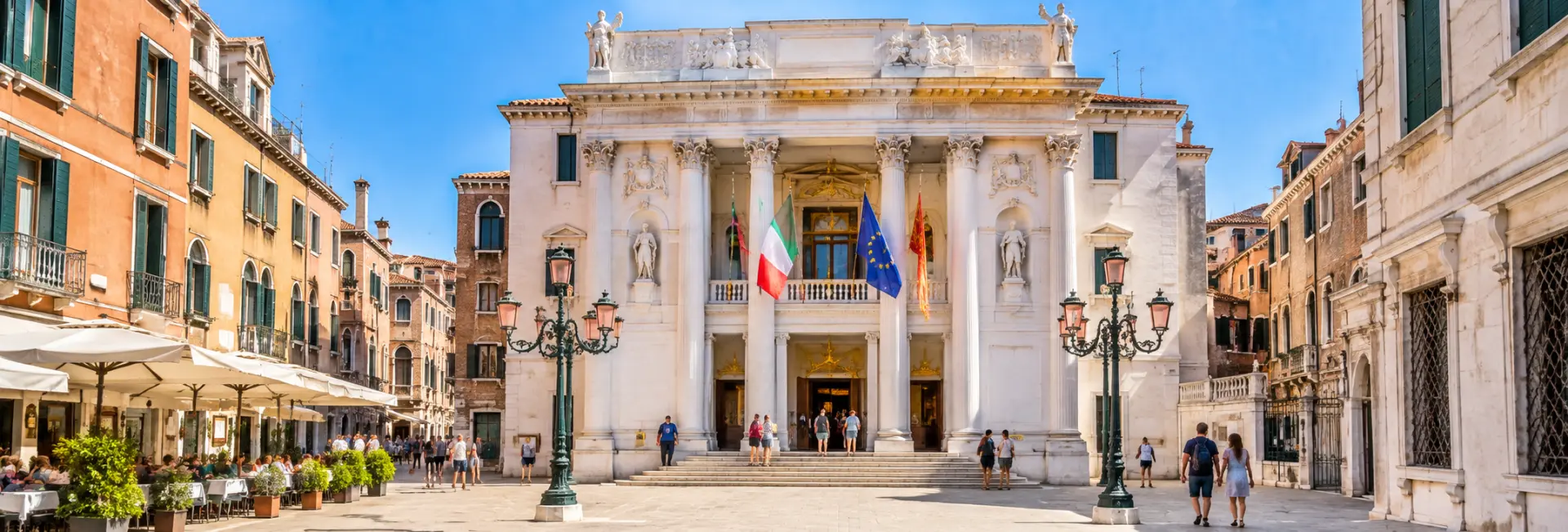
The exterior remains close to Selva's original 1792 neoclassical design, its facade restrained compared to the richness inside. Passing through the entrance leads into a foyer and staircase before opening into the horseshoe-shaped auditorium, arranged over several tiers of boxes in the traditional Italian opera house layout.
The interior decoration, recreated after the 1996 fire to match its nineteenth-century appearance, is dense with gilding, stucco work and painted ornament. The ceiling, repainted by Mauro Carosi and Silvano Mattei during the reconstruction, depicts allegorical figures including Aurora, the Three Graces, and personifications of Music and Dance, following the composition of the ceiling lost in the fire.
The overall effect, both before and after the reconstruction, is one of concentrated opulence typical of nineteenth-century Italian theatre design: a relatively compact space made to feel far grander through gilt, colour and layered ornament rather than sheer size.
Famous Premieres and Performers
La Fenice's reputation rests heavily on the operas that premiered within its walls, several of which are now considered among the most important works in the repertoire.
- Rossini staged Tancredi here in 1813 and Semiramide in 1823, two of his most significant productions.
- Bellini's I Capuleti e i Montecchi premiered in 1830, followed by Beatrice di Tenda in 1833.
- Donizetti returned to Venice with Belisario in 1836 after years of triumphs elsewhere in Italy.
- Verdi premiered Ernani, Attila, Rigoletto, La Traviata and Simon Boccanegra here across the mid-nineteenth century.
La Traviata's premiere on 6 March 1853 is one of opera's most famous cautionary tales about first impressions: the audience booed it on opening night, and it is now regarded as one of the greatest operas ever written. In the twentieth century, the theatre continued to draw major figures, including Maria Callas, Luciano Pavarotti, Igor Stravinsky and Herbert von Karajan, cementing its place as one of Europe's most important opera houses well beyond its nineteenth-century golden age.
Ways to Experience It
There are two distinct ways to experience La Fenice, and they suit different kinds of visit.
- Attending a performance: the opera season runs roughly from January to July and September to October, and seeing the theatre in use, with its acoustics and atmosphere in full effect, is the fullest way to experience it.
- A self-guided daytime tour: on non-performance days, the theatre is generally open to visitors with an audio guide, allowing a close look at the auditorium, boxes and decoration outside of showtimes.
- Guided tours: some operators offer guided visits combining the theatre with the surrounding San Marco district's musical and theatrical history.
- Concerts and recitals: beyond full opera productions, the theatre also hosts orchestral concerts and smaller recitals throughout the year, often a more accessible way to see a live performance.
Booking ahead is advisable for both opera performances and the daytime tour, particularly in peak tourist season, since visiting hours can be limited around rehearsals and performance schedules.
Best Time to Visit
Time of day and season
For a daytime visit, mornings tend to be quieter, before the audio-guide tour groups build through the day. The theatre is generally not open for daytime visits during the height of the opera season on performance days, so checking the current schedule before planning a stop is worthwhile.
The opera season itself runs roughly January to July and September to October, with a gap over the summer months. Attending a performance in the cooler months, when the season is in full swing, gives the fullest experience of the theatre in use, while a daytime visit works at almost any time of year the theatre is open to the public.
Because access depends heavily on the performance calendar rather than typical tourist opening hours, checking the current schedule directly with the theatre before visiting is more important here than at most Venice sights.
Visitor Tips
- Check the daytime visiting schedule in advance, since the theatre closes to tourism around rehearsals and performances, and hours vary through the season.
- Book opera tickets well ahead for popular productions, particularly during the main autumn to spring season.
- The audio guide included with daytime admission is worth using, as it covers the theatre's fires and reconstruction in more depth than the signage alone.
- Dress for a performance leans smart-casual to formal, though there is no strict enforced dress code for most shows.
- The theatre sits in a quiet campo away from the main tourist routes, so allow a few extra minutes to find it if arriving on foot from a busy area like the Rialto or San Marco.
- Photography is generally restricted during performances but often permitted during the daytime self-guided tour; check current signage.
- Combine a visit with the surrounding Campo San Fantin and the nearby church of San Fantin, both part of the same quiet corner of San Marco.
Nearby Attractions
Tucked into a quiet part of the San Marco district, the theatre sits within easy walking distance of several major Venice sights.
- Piazza San Marco: Venice's main square, a walk of around five to ten minutes.
- Rialto Bridge: a similarly short walk in the opposite direction, through the streets of San Marco.
- Campo San Fantin: the small square the theatre fronts, with its own historic church.
- Museo Fortuny: a museum dedicated to the designer Mariano Fortuny, housed in a Gothic palace a short walk away.
- Grand Canal: reachable at several points nearby, with vaporetto stops a few minutes' walk from the theatre.
- Teatro Goldoni: another historic Venetian theatre, a short walk toward the Rialto side of San Marco.
A natural way to combine a visit is to see the theatre by day, then continue on foot to either Piazza San Marco or the Rialto Bridge, both close enough to fold into the same outing.
FAQs about visiting Teatro La Fenice
Why is it called La Fenice? +
The name means "The Phoenix" in Italian, chosen in 1790 because the noble families who commissioned the theatre had lost an earlier venue to fire. The name proved fitting: the theatre has since burned down and been rebuilt twice more.
How many times has La Fenice burned down? +
Counting the earlier theatre that inspired its name, three times in total: the predecessor venue in 1774, La Fenice itself in 1836, and again in a 1996 arson fire.
What does "com'era, dov'era" mean? +
"As it was, where it was," the guiding principle behind the theatre's reconstruction after the 1996 fire, which aimed to recreate its pre-fire appearance in exact detail using historical records and photographs.
When did it reopen after the 1996 fire? +
On 14 December 2003, following reconstruction led by the architect Aldo Rossi.
What famous operas premiered here? +
Verdi's La Traviata, Rigoletto and Ernani, along with major works by Rossini, Bellini and Donizetti, including Rossini's Tancredi and Semiramide and Bellini's I Capuleti e i Montecchi.
Can I visit without attending a performance? +
Yes. On non-performance days, the theatre is generally open for self-guided visits with an audio guide, though hours vary with the performance schedule, so checking in advance is recommended.
When is the opera season? +
Roughly January to July and September to October, with a break over the summer months.
Is La Traviata's premiere really that famous? +
Yes. Its 1853 premiere at La Fenice was booed by the audience, a striking contrast to its later status as one of the most performed and beloved operas ever written.
How do I get there? +
On foot through the San Marco district; the theatre sits in the quiet Campo San Fantin, a short walk from both Piazza San Marco and the Rialto Bridge.
Is there a dress code for performances? +
There is no strictly enforced dress code, though smart-casual to formal attire is customary for opera performances here.
