
Table of Contents
Overview
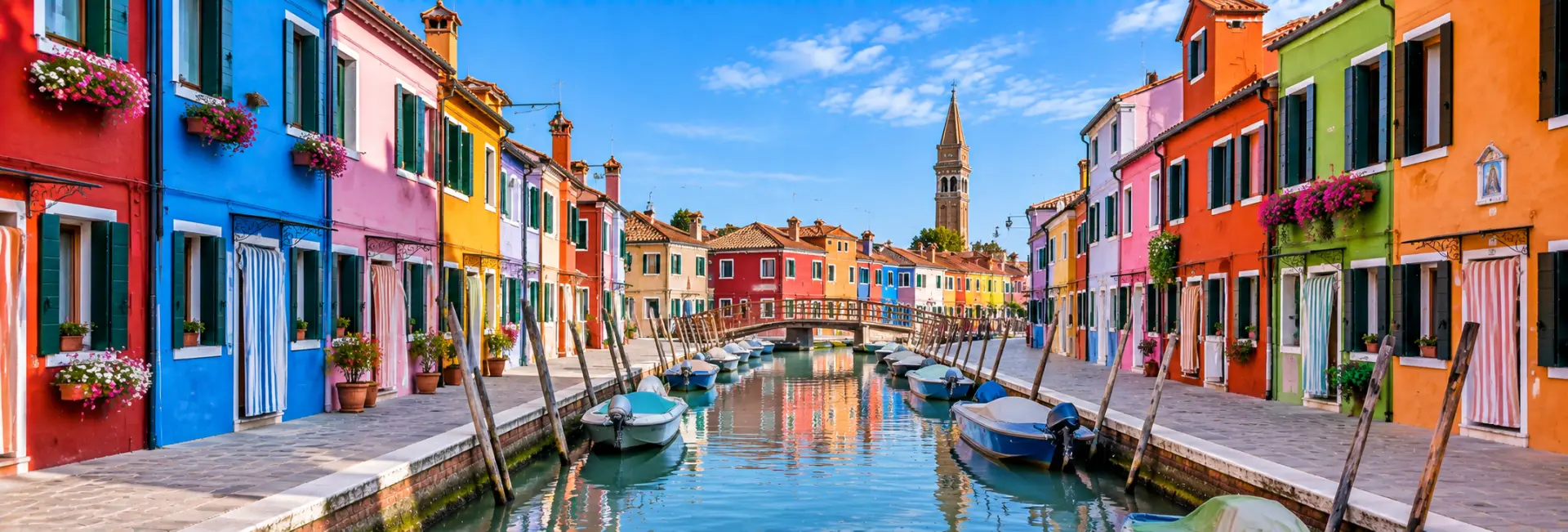
Burano is a small island in the northern Venetian Lagoon, roughly a forty-five minute vaporetto ride from Venice's Piazza San Marco. It is instantly recognizable from the water: rows of small houses painted in vivid reds, yellows, blues, and greens line its canals, packed together along narrow streets built for foot traffic rather than cars. Where Murano is known for glass, Burano built its reputation on needle lace, a craft so fine that it once numbered among the most prized textiles in Europe.
The island is compact enough to explore on foot in a couple of hours, yet its color and quiet canal life make it one of the most photographed spots in the entire lagoon. Locals still fish for a living, lace makers still work in doorways and shop windows, and the leaning bell tower of the parish church rises over it all like a smaller, more crooked cousin of Pisa's famous tower.
History
Early Settlement
Burano's origins are traditionally linked to refugees from the mainland town of Altino, who are said to have fled to the lagoon islands in the 5th century to escape Attila's invasions. Like much of the lagoon, the island's earliest structures were built from reeds and mud before giving way to brick and stone as the settlement grew, and it eventually came under the authority of the Republic of Venice.
Fishing and the Lace Trade
For most of its history, Burano's economy rested on two pillars: fishing, which remains active today, and lace-making, which took root in the 16th century. Venetian needle lace, and Burano's version of it in particular, became prized across European courts for its intricate, all-needle technique, worked without any backing fabric. Demand grew so high that the craft supported a large share of the island's households at its peak, a period often remembered locally as Burano's golden age.
Decline and Revival
The lace trade collapsed in the late 18th century as fashions shifted and cheaper machine-made alternatives spread across Europe, and the industry nearly disappeared on the island. It was revived in 1872, when a lace-making school was founded on Burano specifically to preserve the craft and give local women a trade during a period of hardship. That school trained generations of lace makers before closing in 1970, and its former premises now house the island's Lace Museum.
The Colorful Houses
Burano's painted houses are its most recognizable feature, and their origin is part practical tradition, part local legend. The most commonly told story is that fishermen painted their homes in bold, distinct colors so they could recognize their own house from out on the water, particularly in fog. A more grounded explanation ties the colors to property boundaries, since a distinct shade helped mark where one small plot ended and the next began.
Whatever the original reason, the practice is now formalized. Homeowners who want to repaint a house must apply to the local authorities, who assign an approved color for that specific plot based on its historical scheme, which is why the island's palette has stayed so consistent for generations rather than drifting toward whatever color a new owner might prefer.
Burano Lace
Burano lace, known in Italian as merletto, is made entirely by needle rather than bobbin, with a design built up stitch by stitch without any woven backing to guide it. The result is an openwork fabric fine enough that a single piece can represent months, sometimes years, of work, and historically the most accomplished lace makers spent decades mastering the technique's most difficult stitches.
Genuine hand-made Burano lace has become rare and expensive, and much of what is sold in shops around the island today is machine-made or imported. The Lace Museum, set in the former lace school's building on Piazza Galuppi, displays historical pieces alongside tools and examples of the different stitches, and it remains the clearest place to understand what sets true needle lace apart from the printed or machine-made versions sold nearby.
A handful of stitches define the tradition, each named for the pattern it produces and the level of skill it demands. Punto in aria, meaning "stitch in air," is considered the most distinctly Buranese technique, since it is built up entirely with a needle and thread with no fabric base at all, allowing lace makers to create motifs that seem to float within the open mesh. Learning even a single stitch to a professional standard traditionally took years of practice under an experienced teacher, which is part of why so few working lace makers remain on the island today compared with the craft's peak.
Key Areas and Landmarks
Via and Piazza Baldassare Galuppi
Named after the island's most famous native son, the 18th-century composer Baldassare Galuppi, this street and square form Burano's main artery, connecting the vaporetto landing to the central square where the church and Lace Museum both sit. It is lined with lace shops, restaurants, and the brightly painted facades the island is known for.
San Martino Church and Its Leaning Bell Tower
Burano's parish church dates to the 16th century and holds a Crucifixion attributed to Giambattista Tiepolo, but it is the church's campanile that catches the eye first. Visibly tilted, the bell tower has leaned for centuries due to unstable lagoon-bed foundations, and it serves as a landmark visible from the water long before the rest of the island comes into view.
Lace Museum
Housed in the former Palazzo del Podestà di Torcello on Piazza Galuppi, the Lace Museum traces the history of Burano needle lace from its 16th-century origins through the founding of the island's lace school in 1872. Its collection includes historical garments and lace pieces alongside displays explaining the stitches used to make them.
Casa di Bepi
One of the most photographed houses on the island, this small home was decorated by a former resident in a bold, geometric pattern of primary colors rather than a single flat shade, and it has since become an informal landmark that visitors seek out while walking the back canals.
Ways to Experience It
Burano is reached by vaporetto, usually via line 12 from Venice's Fondamenta Nove stop, a trip that takes around forty-five minutes across open lagoon water. The same line often continues to or from Murano and Torcello, making it easy to combine islands in a single outing. Because the island has no cars, everything is seen on foot, and its layout is small enough that getting lost rarely costs more than a few extra minutes.
- Wander the back canals: away from the main square, quieter streets reveal painted houses with fewer crowds and better light for photos, especially in the early morning
- Visit the Lace Museum: a focused stop that explains the craft's history and shows genuine hand-made pieces alongside the tools used to create them
- Watch a lace demonstration: a handful of shops still have lace makers working by hand near the entrance, offering a glimpse of the stitching process in person
- Climb the church tower area: while the leaning campanile itself is usually not open for climbing, the square around San Martino church offers good views of the tilt up close
- Sample local seafood: Burano is known for dishes built around lagoon fish, particularly a risotto made with goby, served in the island's small trattorias
Best Time to Visit
Burano draws large numbers of day-trippers, and the crowds tend to peak around midday, when boats from Venice and cruise excursions converge on the main square at the same time. Arriving in the early morning or staying into the late afternoon, after most tour groups have moved on, gives a much quieter view of the canals and better conditions for photography.
Spring and early autumn offer the most comfortable weather for walking the island, with fewer visitors than the height of summer. Winter is quiet and atmospheric, though some shops and the Lace Museum may keep shorter hours, and the open lagoon crossing can feel cold and exposed on the vaporetto during rough weather.
Visitor Tips
- Buy lace from shops that can show genuine hand-made pieces or explain their origin, since much of the lace sold on the island is machine-made or imported
- Visit the Lace Museum before shopping, since it makes the difference between hand-made and machine-made lace much easier to spot afterward
- Photograph the back canals rather than only the main square, since side streets tend to be quieter and just as colorful
- Bring cash for smaller shops and trattorias, since some don't accept cards for lower-value purchases
- Check the vaporetto schedule before your visit, since return boats to Venice can get crowded in the late afternoon
- Combine Burano with Torcello or Murano in one day, since the same vaporetto lines connect all three islands
Nearby Attractions
Burano sits close to several other lagoon islands, each offering a different character than its own fishing-village atmosphere.
- Mazzorbo: connected to Burano by a wooden footbridge, home to vineyards and a quieter, more rural stretch of the lagoon
- Torcello: a short additional boat ride away, with one of the lagoon's oldest cathedrals and far fewer visitors than Burano itself
- Murano: reachable on the same vaporetto network, known for centuries of glassmaking and its own canal-side workshops
- Venice's Cannaregio district: the mainland neighborhood closest to the Fondamenta Nove stop used to reach Burano
FAQs about visiting Burano Island
What is Burano Island famous for? +
Burano is famous for its brightly painted houses and for centuries-old needle lace, a craft that once made the island one of Europe's most prized sources of fine textiles.
How do you get to Burano from Venice? +
The main route is vaporetto line 12 from the Fondamenta Nove stop in Venice, with the crossing taking about forty-five minutes across open lagoon water.
How long do you need to visit Burano? +
Two to three hours is enough to see the main square, walk the colorful back canals, and visit the Lace Museum, though a full day allows time to combine it with Torcello or Murano.
Why are the houses on Burano so colorful? +
The most common explanation is that fishermen painted their homes in bold colors to spot them from the water in fog, though a house's color is also historically tied to its property boundary and must now follow an approved local scheme.
Is Burano free to visit, or do you need tickets? +
Walking around the island is free, but the Lace Museum charges separate admission, and some churches request a small donation.
Is real Burano lace expensive? +
Yes, genuine hand-made needle lace can take months to complete and is priced accordingly, while cheaper, machine-made or imported lace is widely sold alongside it, so it helps to ask shops directly about a piece's origin.
Is Burano suitable for children and older visitors? +
Burano is flat and easy to walk, with no major hills or difficult terrain, making it comfortable for most ages, though the main square can get crowded around midday.
What should I combine a Burano visit with? +
Torcello and Murano are the most common pairings, since all three sit on similar vaporetto routes from Fondamenta Nove and can be visited together in a single day trip.
