
Table of Contents
Overview
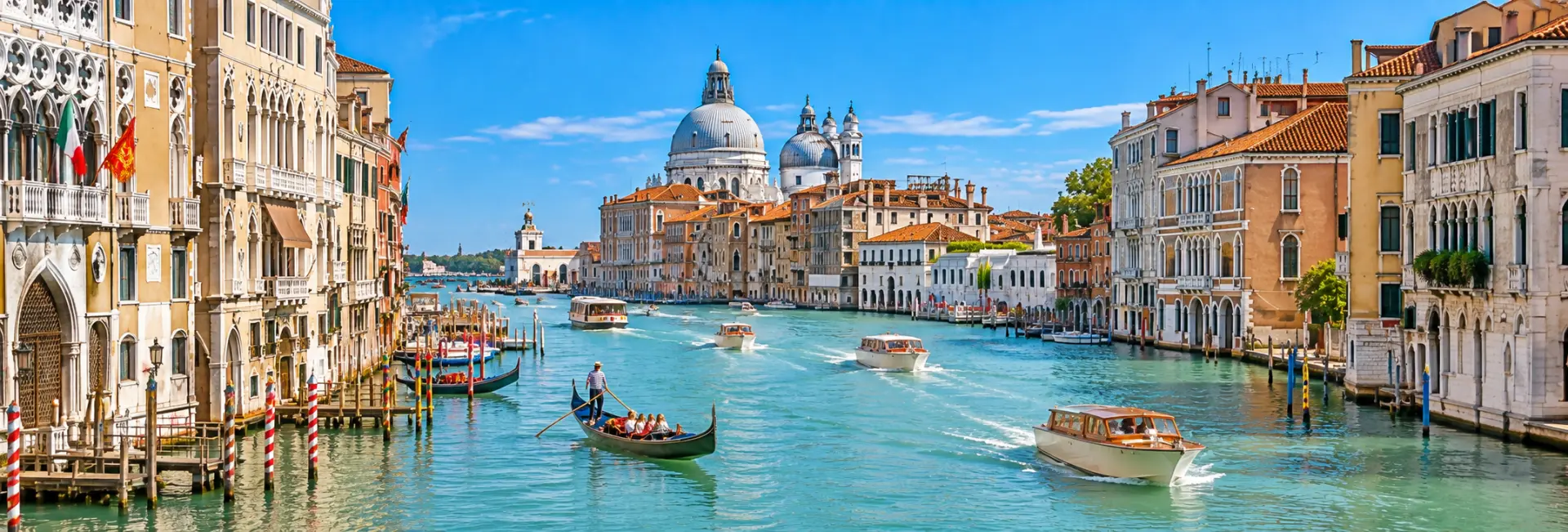
The Grand Canal is Venice's main thoroughfare and the closest thing the city has to a high street, except that it is entirely water. It winds through the historic centre in a broad reverse-S shape, dividing the city roughly in two and carrying the bulk of its public transport, deliveries and daily life along a single curving channel.
Rather than a single attraction to visit, the canal is the setting for many of Venice's most famous sights, its banks lined with more than 170 palaces, churches and grand houses built between the thirteenth and eighteenth centuries. Travelling its length by boat, whether by public vaporetto, private water taxi or hired gondola, is one of the essential Venice experiences, offering a continuously changing view of the city's architecture from the one vantage point it was designed to be seen from.
There is no admission fee to see the canal itself; the only cost is whatever form of transport you choose to travel it by.
History
An ancient riverbed
Historians believe the Grand Canal follows the course of an ancient river, possibly a branch of the Brenta, that once flowed into the lagoon before Venice existed as a city. Long before the canal took its current commercial role, communities of Adriatic Veneti are thought to have lived on stilt houses along its banks, relying on fishing and small-scale trade in salt.
Rise as a trading artery
By the tenth century, the canal had become one of the central arteries of Venetian life, the route by which ships from across the Mediterranean and beyond brought goods into the heart of the city. Many of the merchant families who grew wealthy from this trade built their homes directly on the water, conducting business from their own front doors and using the canal as both address and marketplace.
Centuries of palace-building
As Venetian wealth and power grew through the medieval and Renaissance periods, the buildings lining the canal evolved through successive architectural styles, from Byzantine-influenced facades with elongated arches in the twelfth and thirteenth centuries, through Venetian Gothic, to the Renaissance and Baroque palaces that still dominate long stretches of the waterway. The result is a continuous, mostly unplanned architectural timeline that visitors can travel through simply by moving along the water.
Geography & Layout
The canal runs for roughly 3.8 kilometres through the centre of Venice, tracing a broad reverse-S curve from the area near Santa Lucia railway station in the northwest to the Bacino di San Marco, the basin in front of St. Mark's Square, in the southeast. Its width varies considerably along its length, narrowing to around 30 metres in places and widening to as much as 90 metres elsewhere, with an average depth of about 5 metres.
Because the canal effectively splits historic Venice into two halves, most cross-city journeys on foot involve either a detour to one of its bridges or a short ferry hop across on a traghetto, a standing gondola-ferry used for exactly this purpose. This layout is part of why so much everyday movement in Venice, not just sightseeing, happens on the water rather than the narrow streets.
The canal is tidal, rising and falling twice daily in step with the Adriatic, a rhythm that also governs the acqua alta flooding that periodically affects low-lying parts of the city closest to its banks.
Palaces Along the Canal
The buildings lining the Grand Canal are, collectively, one of the largest and best-preserved concentrations of historic domestic architecture anywhere in Europe. A handful stand out on almost every visitor's itinerary:
- Ca' d'Oro: a Venetian Gothic palace known for its intricately carved marble facade, once gilded, that gives the building its name, "House of Gold."
- Palazzo Barbaro: a Gothic palace in Dorsoduro with a history of hosting American and European artists and writers, including the art patron Isabella Stewart Gardner.
- Ca' Rezzonico: a grand Baroque palace, now a museum of eighteenth-century Venetian life, with an especially ornate ballroom and painted ceilings.
- Basilica di Santa Maria della Salute: the great domed church marking the canal's southern end, built as a votive offering after a seventeenth-century plague and visible from much of the lower canal.
- Palazzo Dario: a small but distinctive Renaissance palace known for its colourful marble inlay and, among Venetians, a long-standing reputation for bad luck among its owners.
Most of these buildings remain privately owned or serve as museums, hotels and consulates, meaning the canal functions as a living street rather than a preserved historical set piece.
The Bridges
For more than six centuries, the Grand Canal had only a single fixed crossing. Today there are four, spaced along its length:
- Ponte di Rialto: the oldest and most famous, a single stone arch completed in 1591, and the sole bridge across the canal until the nineteenth century.
- Ponte dell'Accademia: a wooden bridge near the Accademia Gallery, first built in 1854 and rebuilt in its current form in the 1930s.
- Ponte degli Scalzi: a stone bridge near Santa Lucia railway station, built in the late nineteenth century to serve arriving rail passengers.
- Ponte della Costituzione: the newest crossing, a modern glass-and-steel bridge designed by Santiago Calatrava, opened in 2008 near the Scalzi Bridge and still debated locally for its design and practicality.
Away from these four fixed crossings, traghetto stations at several points along the canal allow pedestrians to cross by boat, a cheaper and faster option than walking to the nearest bridge, and one still used daily by residents rather than only visitors.
Ways to Experience It
There is no single correct way to see the Grand Canal, and most visitors end up combining more than one of the following over a stay in Venice.
- Vaporetto line 1: the classic budget option, travelling the full length of the canal with around fifteen stops and taking roughly forty-five minutes end to end, giving a slow, comprehensive view of the palaces along the way.
- Vaporetto line 2: a faster express service covering a similar route with fewer stops, useful when time is tighter.
- Private water taxi: quicker and considerably more expensive, but flexible for a direct point-to-point transfer with an open view.
- Gondola ride: the traditional and most expensive way to travel the canal, typically covering a shorter stretch or a loop into the side canals rather than the full length.
- Traghetto crossing: a brief, functional crossing by standing gondola-ferry, useful for getting from one bank to the other without walking to a bridge.
- Walking the banks: only parts of the canal have a continuous walkable promenade, so this works best combined with detours inland and back.
For a first visit, riding vaporetto line 1 end to end is widely considered the single best orientation to the city, since it passes almost every major landmark along the water.
Best Time to Visit
Time of day
Early morning offers the calmest water and the softest light on the palace facades, along with noticeably quieter vaporetti before the day's tourist traffic builds. Sunset is the other standout time, when the light turns warm against the marble and stone, though boats and the waterside promenades near the Rialto and San Marco get busy at this hour too.
Season
Spring and autumn bring comfortable temperatures and generally smaller crowds on the vaporetti than midsummer, when both the boats and the canal-side walkways can feel genuinely crowded. Winter is quiet on the water, though shorter days limit the golden-hour window, and acqua alta is more likely between autumn and early spring, occasionally affecting low banks and landing stages.
Because a canal journey has no opening hours to plan around, timing a visit is mostly about choosing calmer water and better light rather than working around a schedule.
Visitor Tips
- Buy a vaporetto ticket or travel pass before boarding; fares are considerably higher if purchased on board, and inspections do happen.
- Sit or stand at the front or rear of the vaporetto for the clearest, most open views along the water.
- Gondola prices are fixed by the city per half-hour rather than negotiated per ride, though rates rise after dark, so confirm the current rate before boarding.
- A traghetto crossing costs a small fixed fare and is a much faster way across the canal than walking to the nearest bridge.
- Waterside promenades exist only in patches; plan a route that alternates between the canal edge and the streets behind it rather than expecting a continuous towpath.
- Getting oriented is easier with a landmark in mind, since Venice's street numbering can be confusing; the Rialto Bridge and St. Mark's Basin are the two most useful reference points.
- For photographs of the classic canal view, the area around the Rialto Bridge and the mouth of the canal near the Salute church are the two most reliably rewarding spots.
Nearby Attractions
Because the canal runs through the centre of Venice, nearly every major sight in the historic core sits directly on it or a short walk from its banks.
- Rialto Bridge: the oldest crossing of the canal and one of Venice's most photographed landmarks.
- Piazza San Marco and St. Mark's Basilica: at the canal's southeastern mouth, opening onto the Bacino di San Marco.
- Doge's Palace: adjoining St. Mark's Basilica, facing the water where the canal meets the lagoon.
- Ca' d'Oro: one of the finest Gothic palace facades on the canal, now a museum, with its own vaporetto stop.
- Accademia Gallery: Venice's leading collection of pre-nineteenth-century art, beside the bridge of the same name.
- Santa Lucia railway station: at the canal's northwestern end, the arrival point for most rail travellers into Venice.
A natural way to see the canal and its surroundings is to ride vaporetto line 1 from Santa Lucia to San Marco, then explore the square, the Basilica and the Doge's Palace on foot before returning by a different route.
FAQs about visiting the Grand Canal
What is the Grand Canal? +
Venice's main waterway, a roughly 3.8-kilometre channel that winds through the historic centre in a reverse-S shape, lined with more than 170 historic palaces and crossed by four bridges.
Is there a fee to see the Grand Canal? +
No, the canal itself is free to view from its banks or bridges. Costs only apply to transport, such as a vaporetto ticket, water taxi fare or gondola ride.
What is the best way to see it? +
Riding vaporetto line 1 from one end to the other is widely considered the best introduction, since it stops close to almost every major landmark along the water at an affordable price.
How long is the Grand Canal? +
About 3.8 kilometres, running from near Santa Lucia railway station to the Bacino di San Marco, with widths varying between roughly 30 and 90 metres.
How many bridges cross it? +
Four: the Rialto Bridge, the Accademia Bridge, the Scalzi Bridge and the modern Ponte della Costituzione. For more than six centuries, the Rialto Bridge was the only one.
What is a traghetto? +
A standing gondola-ferry that carries pedestrians directly across the canal for a small fixed fare, faster than walking to the nearest bridge and still used daily by Venetians.
Is a gondola ride worth it? +
It is the most traditional and most expensive way to experience the canal, typically covering a shorter stretch or a loop through quieter side canals rather than the full length. Prices are fixed by the city per half-hour.
When is the best time to see it? +
Early morning for calm water and soft light, or around sunset for warm colour on the palace facades. Both times also tend to be less crowded than the middle of the day.
What are the most famous buildings along it? +
Ca' d'Oro, Ca' Rezzonico, Palazzo Barbaro, Palazzo Dario and the Basilica di Santa Maria della Salute are among the most recognisable, alongside the Doge's Palace near its southern mouth.
Does the Grand Canal flood? +
It is tidal and rises and falls daily, and during acqua alta, the periodic high tides that affect Venice, low-lying banks and landing stages near the canal can be affected, particularly between autumn and early spring.
