
Table of Contents
Overview
Piazza San Marco, known in English as St. Mark's Square, is the only space in Venice formally called a piazza. Every other open space in the city is a campo, a field, which gives some sense of how much this one square has always stood apart. It is the ceremonial, religious and political heart of Venice, and has been for the better part of a thousand years.
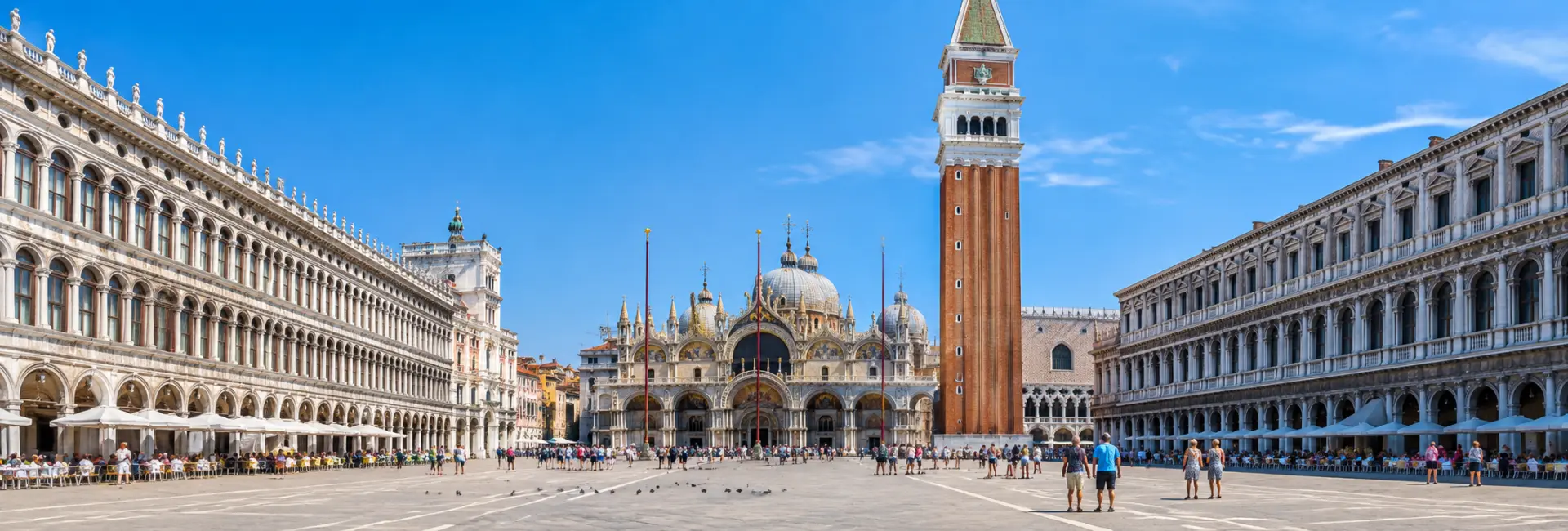
The square is often attributed to Napoleon as "the drawing room of Europe," a line historians cannot actually trace to him with certainty, though it has stuck because it captures the place so well: an enclosed, elegant public room open to the sky, ringed by arcaded buildings on three sides and dominated by the great church at the fourth.
Visiting costs nothing beyond your time, but almost everything of note here, the Basilica's inner treasures, the Campanile's lift, the Doge's Palace, carries a separate ticket. The square itself is simply the stage; the individual sights are what fill it.
History
From marshy garden to civic centre
The original St. Mark's Basilica was built at the start of the ninth century, and the open ground in front of it was then little more than a modest grassy patch, reportedly no longer than about sixty metres. As Venice's wealth and naval power grew through the medieval centuries, the square expanded to match its ambitions.
Taking its present shape
The piazza reached roughly its current size and outline in the late twelfth century, when a canal running through the area was filled in and a church standing at the western end was relocated further back to make room. It was paved not long after, and by then had become the fixed setting for state ceremony, religious processions and public life in the Republic.
Renaissance building and Napoleonic changes
The three-storey arcaded buildings framing the square to the north and south were built and rebuilt through the sixteenth century, and the freestanding bell tower took its familiar form in 1514. The final major change came under Napoleon, who after conquering Venice in 1797 had the four bronze horses on the Basilica's facade removed and shipped to Paris, and in 1810 ordered the demolition of the church at the western end to make way for what is now called the Napoleonic Wing, closing the square into the form it has today.
Architecture & Layout
The piazza measures roughly 175 metres in length and about 80 metres across at its widest point, narrowing slightly toward the Basilica. Three long arcaded ranges enclose it: the Procuratie Vecchie along the north side, the Procuratie Nuove along the south, and the Napoleonic Wing closing the western end, all faced with continuous ground-floor colonnades that have sheltered shops and cafés for centuries.
The eastern end is held entirely by St. Mark's Basilica, its ornate multi-domed facade the visual anchor of the whole space. Because the square is enclosed on three sides and open only through narrow approaches, arriving in it after threading Venice's tight streets and bridges produces a genuine sense of release, a design effect that was almost certainly intentional.
Notably, the piazza sits at the lowest point in Venice. During acqua alta, the periodic high tides that affect the lagoon city, it is typically the first place to flood, and raised wooden walkways are set out for pedestrians when this happens. It is a detail that shapes practical planning for anyone visiting outside the drier months.
Key Landmarks Around the Square
Nearly every major sight in Venice's historic core touches this one square, which is part of why it draws such volume of visitors.
- St. Mark's Basilica: the domed cathedral dominating the eastern end, its facade decorated with Byzantine mosaics and topped by copies of the four ancient bronze horses, the originals now displayed inside.
- Campanile di San Marco: the freestanding bell tower standing nearly 99 metres tall, rebuilt in the early twentieth century after its sudden collapse in 1902, with a lift to an observation level offering the best rooftop view in the city.
- Torre dell'Orologio: the ornate Renaissance clock tower at the square's northern edge, where two bronze figures known as the Moors strike the hour, and where during Ascension week and Epiphany mechanical figures of the Three Wise Men process past a figure of the Madonna.
- Museo Correr: a museum of Venetian art and history occupying part of the Napoleonic Wing and the Procuratie Nuove, facing the Basilica from across the square.
- Caffè Florian: opened in 1720 beneath the arcades on the square's southern side, generally regarded as one of the oldest continuously operating cafés in the world, historically favoured by Venetians over its rival Caffè Quadri during the period of Austrian rule.
The Piazzetta
South of the main square, opening toward the lagoon, is a smaller connected space known as the Piazzetta San Marco. Though officially distinct, it functions as an extension of the piazza and is generally described together with it.
Two tall granite columns, raised near the water's edge in the twelfth century, mark its entrance from the lagoon: one topped by the winged lion of St. Mark, the city's enduring symbol, the other by a statue of St. Theodore, Venice's original patron saint before Mark's relics were brought to the city. During the eighteenth century, public executions were carried out in the space between these two columns, a grim history at odds with the elegance of the setting today.
The Piazzetta is flanked by the Doge's Palace, the seat of Venetian government for centuries and now a museum, and by the Biblioteca Marciana, one of Italy's most important historic libraries, whose Renaissance facade closes the western side.
Ways to Experience It
The square supports several different kinds of visit, and most people end up combining more than one over the course of a stay in Venice.
- Simply walking through: the square is free and open at all hours, and passing through at different times of day changes its character completely.
- Individual monument tickets: the Basilica, Campanile, Doge's Palace and Museo Correr are each ticketed separately, though combined passes covering several of them are widely available.
- A coffee at Florian or Quadri: expensive by any ordinary measure, but the arcaded seating and live orchestra are part of what the square has offered visitors for three centuries.
- Guided walking tours: many Venice history tours are built around the square, tracing the Republic's political and religious life through its buildings.
- Watching the clock tower: timed to the hour, when the bronze figures strike the bell, and worth planning around during the Ascension and Epiphany processions.
Because the individual sights each keep their own hours and sell out at busy times, booking Basilica or Campanile tickets in advance is worth doing before travelling, particularly in high season.
Best Time to Visit
Time of day
Early morning, before the cruise ship crowds and day-trip groups arrive, is by far the best time to see the square with any sense of space. Evening is the other strong option, when the day-trip crowds have thinned and the arcades are lit, though the café orchestras and lingering tour groups keep a level of activity going well into the night.
Season and tide
Spring and autumn bring the most comfortable weather and somewhat smaller crowds than summer, though Venice rarely feels quiet anywhere near this square. Acqua alta is a real seasonal factor, most likely between autumn and early spring, and can close or partially flood the square with little warning; checking a tide forecast the day before is sensible if flooding is a concern. Summer brings the heaviest crowds and heat with very little shade across the open square.
Whatever the season, arriving at opening time for the Basilica and Campanile makes the single biggest difference to how the visit feels.
Visitor Tips
- Dress modestly for the Basilica: shoulders and knees covered are required for entry, and this is enforced.
- Watch for pickpockets and the pigeon-feed sellers who target visitors near the columns; keep bags closed and in front of you in the busiest stretches.
- Café prices under the arcades include a cover charge for the seating and orchestra, which is standard practice here and not a mistake on the bill.
- If acqua alta is forecast, wooden walkways are laid out through the square; check the tide schedule and pack waterproof footwear if visiting between autumn and early spring.
- The square and its surrounding arcades are step-free, but the interiors of the Basilica and Campanile have more limited accessibility, so check ahead for specific needs.
- Getting there is on foot or by water: the Vaporetto stop San Marco-Vallaresso and San Zaccaria both serve the square directly, and it is a walkable, if winding, route from the Rialto Bridge.
- Feeding pigeons in the square is discouraged and has been actively restricted by the city; it is best avoided.
Nearby Attractions
The square sits at the centre of Venice's most concentrated cluster of major sights, nearly all reachable on foot within minutes.
- Doge's Palace: the Gothic seat of Venetian government, directly beside the Piazzetta, with state rooms and the Bridge of Sighs.
- Bridge of Sighs: the enclosed bridge linking the Doge's Palace to the old prisons, visible from the Riva degli Schiavoni waterfront just beyond the Piazzetta.
- Rialto Bridge: Venice's most famous bridge over the Grand Canal, a walk of roughly ten to fifteen minutes through the San Marco district.
- Grand Canal: reachable at several points nearby, with vaporetto and gondola departures close to the Piazzetta.
- Teatro La Fenice: Venice's historic opera house, a short walk through the streets north-west of the square.
- Riva degli Schiavoni: the broad lagoon-front promenade extending east from the Piazzetta, lined with hotels and views back toward the square.
A natural route is to see the square and Basilica first thing in the morning, continue into the Doge's Palace, then walk the Riva degli Schiavoni or head toward the Rialto Bridge as the day goes on.
FAQs about visiting St. Mark's Square
What is St. Mark's Square known for? +
It is Venice's principal public square and historic civic centre, ringed by the Basilica, the Campanile bell tower, the Doge's Palace and centuries-old arcaded buildings, and often called "the drawing room of Europe."
Is it free to visit? +
Yes, the square itself is free and open at all times. The Basilica, Campanile, Doge's Palace and Museo Correr each require separate tickets.
Why does the square flood? +
It sits at the lowest point in Venice, so during acqua alta, the periodic high tides that affect the lagoon, it is typically the first area to flood. This happens most often between autumn and early spring, and the city puts out raised walkways when it occurs.
How long should I spend there? +
Walking the square itself takes only minutes, but seeing the Basilica, climbing the Campanile and visiting the Doge's Palace can easily fill half a day or more.
What is the Piazzetta? +
A smaller connected square opening from St. Mark's Square toward the lagoon, marked by two tall columns and flanked by the Doge's Palace and the Biblioteca Marciana. It is generally considered part of the same overall space.
Is the square crowded? +
Very much so, especially from late morning through the afternoon when cruise and day-trip groups arrive. Early morning and evening are noticeably calmer.
How do I get there? +
On foot through Venice's streets, or by vaporetto to the San Marco-Vallaresso or San Zaccaria stops, both a short walk from the square.
Can I feed the pigeons? +
It is discouraged and has been restricted by the city in recent years, so it is best avoided.
What should I wear to visit the Basilica? +
Modest dress is required: shoulders and knees should be covered, and this is enforced at the entrance.
Is the square accessible for wheelchair users? +
The open square and arcades are step-free, though the Basilica and Campanile have more limited accessibility inside, so it is worth checking specific requirements in advance.
