
Table of Contents
Overview
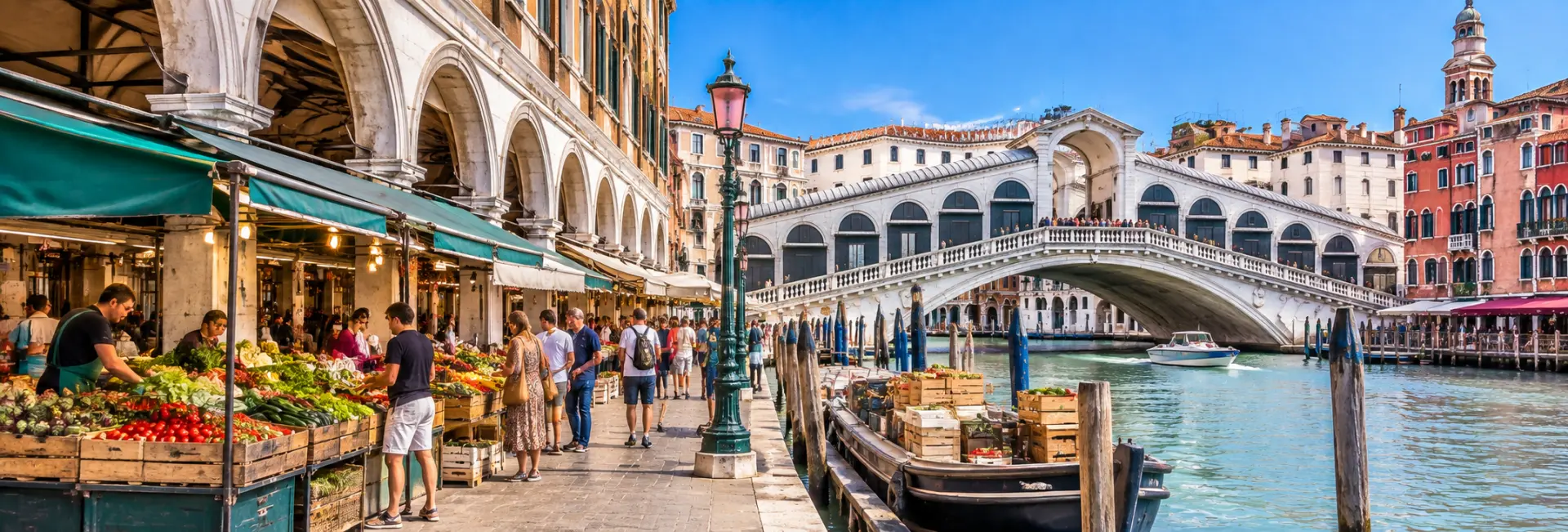
The Rialto Market is Venice's oldest working marketplace, spreading out along the Grand Canal a short walk from the Rialto Bridge in the San Polo district. It has supplied the city with fresh produce and seafood since the eleventh century, and it remains a genuine, functioning market rather than a recreated tourist attraction, a rare thing in this part of Venice.
The market splits into two connected sections: the Erberia, an open-air run of fruit, vegetable and flower stalls, and the Pescheria, a covered fish market housed under a Renaissance-style loggia directly on the canal. Together they form one of the few places in central Venice where residents still do their everyday shopping alongside the steady flow of visitors.
There is no admission fee and no fixed itinerary here; the market rewards simply wandering through, watching the trade, and picking up something to eat later. It is at its liveliest and most photogenic first thing in the morning, and largely finished by early afternoon.
History
Venice's original commercial centre
The Rialto area was the first part of Venice to be developed, and the city's principal market moved here at the end of the eleventh century, traditionally dated to around 1097. For centuries afterward, this was where Venetians and visiting merchants bought and sold goods freshly unloaded from ships arriving from across the Mediterranean and beyond, making the market a working expression of Venice's role as a trading power.
Rebuilt after fire
A destructive fire in the sixteenth century led to the construction of a new complex of squares and porticoes to the west of the Rialto Bridge, organised into distinct zones for different goods. Those historic divisions survive today in the names of the surrounding lanes and squares: Erberia for fruit and vegetables, Naranzeria for oranges, Speziali for spices, and Pescaria for fish.
The fish market's Renaissance-style loggia
The Pescheria, the covered fish market on the water's edge, stands in a neo-Gothic loggia built in 1907 by the architects Domenico Rupolo and Cesare Laurenti, replacing earlier structures on the same spot. Marble plaques set into its walls still record the strict fish-sizing regulations enforced under the old Venetian Republic, a small surviving trace of the market's centuries as a tightly governed civic institution rather than an informal bazaar.
Layout: Erberia and Pescheria
Walking west from the foot of the Rialto Bridge, the market unfolds in stages. Stalls selling produce, flowers and souvenirs line Ruga degli Orefici and fill Campo San Giacomo di Rialto, the small square anchored by the church of the same name, one of the oldest in Venice.
Continuing further, past a dogleg in the path, leads to the Erberia proper, the open fruit and vegetable market sitting directly on the Grand Canal, where farmers bring produce grown on the lagoon islands and the surrounding Veneto countryside. Just beyond it is the Pescheria, the covered fish market beneath its Renaissance-style loggia, where the day's catch from the Adriatic and the lagoon is laid out each morning.
The two sections work on different rhythms: the produce stalls tend to stay open longer into the day, while the fish market is a strictly morning affair, largely packed up well before lunchtime.
What to See and Buy
Even for visitors with no intention of cooking, the market is worth a slow walk simply for the display: piles of seasonal vegetables, crates of fish still glistening from the lagoon, and vendors calling out in Venetian dialect much as their predecessors would have centuries ago.
Produce is generally labelled with its place of origin, and much of it comes from Sant'Erasmo, the lagoon island known as Venice's vegetable garden. Look out for:
- Castraure, the small, prized artichokes from Sant'Erasmo, in season from late April into May
- Radicchio di Treviso, the bitter-sweet red chicory associated with the wider Veneto region
- White asparagus, another spring speciality from the mainland around Bassano
- Moeche, soft-shell lagoon crabs, sold live in seawater tanks in spring and autumn
- Schie, small lagoon shrimp typically served in summer, a classic Venetian bar snack
Several small food shops and wine bars sit around the edges of the market, selling regional oils, pasta, cheese and wine, and a handful of bacari, Venice's traditional small bars, serve simple seafood dishes and cicchetti made with whatever the market has just delivered.
Ways to Experience It
The Rialto Market suits a few different kinds of visit, depending on how much time and appetite you bring.
- A morning walk-through: the simplest option, taking in the stalls, the loggia and the general atmosphere without buying anything.
- Shopping for a picnic: buying fruit, cheese and bread here to eat elsewhere in the city, a cheaper alternative to restaurant meals.
- Food and market tours: several operators run guided walks through the market that continue into nearby bacari for tastings, useful for context on ingredients and Venetian cuisine.
- A seafood lunch nearby: a handful of restaurants around the Pescheria serve dishes made from the morning's catch, popular with both locals and visitors.
- Photography: the Pescheria's loggia on the Grand Canal and the colourful produce stalls are among the most photogenic working scenes in Venice.
Because the market is a genuine commercial operation rather than a display, buying something, even a small amount of fruit or a coffee nearby, is generally appreciated by the vendors who depend on it for their livelihood.
Best Time to Visit
Time of day
Early morning, from around seven to nine o'clock, is when the market is at its fullest and most authentic, with chefs, locals and the freshest produce all arriving together. By late morning, the fish stalls are largely packed up, though the fruit and vegetable side generally stays active a while longer.
Day of the week
The market runs Monday to Saturday, with the fish market typically closed on Mondays and both sections closed on Sundays. Saturday mornings tend to be the busiest, combining the usual trade with weekend shoppers.
Season
Spring is a particularly good time to visit, when the Sant'Erasmo artichoke season and the arrival of moeche soft-shell crabs bring some of the market's most distinctive produce to the stalls. Any season shows the market's everyday rhythm well, though winter mornings can be cold and damp given the market's exposed, canal-side setting.
Visitor Tips
- Go early. By late morning much of the fish market has packed up, and the produce stalls thin out as the day goes on.
- Check the day: the market is closed on Sundays, and the fish section is typically also closed on Mondays.
- Buy something if you can. The market depends on genuine trade, and Venice's shrinking resident population has put real pressure on vendors here in recent years.
- The stone floors, especially in the Pescheria, are often wet underfoot; sturdy, non-slip shoes are worth wearing.
- Prices at the surrounding souvenir stalls near the bridge are higher than a few steps further into the market proper.
- Getting there is easiest by vaporetto to the Rialto Mercato stop, a short walk along the canal from the Rialto Bridge stop.
- Pair a visit with a stop at a nearby bacaro for cicchetti, the small Venetian snacks often made with ingredients bought that same morning.
Nearby Attractions
Sitting right beside the Grand Canal in San Polo, the market is within easy walking distance of several of Venice's central sights.
- Rialto Bridge: a short walk east along the canal, the market's traditional starting point.
- Campo San Giacomo di Rialto: a small square at the market's edge, home to one of the oldest churches in Venice.
- Grand Canal: running alongside the Pescheria, with vaporetto stops close to the market.
- Campo San Polo: one of the largest squares in Venice, a short walk inland from the market.
- Ca' d'Oro: an ornate Gothic palace on the canal's opposite bank, reachable by vaporetto or on foot.
- Frari Basilica: a major Gothic church in San Polo with important Titian works, a walk of roughly ten minutes.
A natural route is to visit the market first thing in the morning, cross the Rialto Bridge afterward, and continue into Piazza San Marco or explore further into San Polo toward the Frari.
FAQs about visiting the Rialto Market
What is the Rialto Market? +
Venice's oldest working market, a cluster of fruit, vegetable and fish stalls beside the Grand Canal in the San Polo district, trading on this spot since around 1097.
What are the Erberia and Pescheria? +
The Erberia is the open-air fruit, vegetable and flower market, and the Pescheria is the covered fish market housed in a Renaissance-style loggia directly on the canal. Together they make up the Rialto Market.
When is the market open? +
Monday to Saturday in the mornings, with the fish market typically closed on Mondays. Both sections are closed on Sundays, and trade winds down through the late morning.
Is there an entrance fee? +
No, the market is free to walk through at any time it is open.
What should I try or buy there? +
Seasonal highlights include Sant'Erasmo artichokes in spring, white asparagus, moeche soft-shell crabs, and schie lagoon shrimp, alongside the everyday produce and fish sold year-round.
How do I get there? +
By vaporetto to the Rialto Mercato stop, or on foot from the Rialto Bridge, a walk of just a few minutes along the canal.
Is it worth visiting if I'm not buying anything? +
Yes. The market is one of the few genuinely working scenes left in central Venice, and simply walking through the stalls and the historic loggia is worthwhile on its own.
Why is it closing early compared to other attractions? +
It is a real commercial market serving chefs and residents, so trade is heaviest in the early morning and largely finished by early afternoon, unlike ticketed sights with fixed all-day hours.
Is the market struggling? +
Reports suggest it has faced pressure in recent years from a shrinking resident population and the growth of short-term rentals in the area, making genuine local trade there more important than ever.
What else is nearby? +
The Rialto Bridge, Campo San Polo, the Frari Basilica and several Grand Canal palaces are all within easy walking distance of the market.
