
Table of Contents
Overview
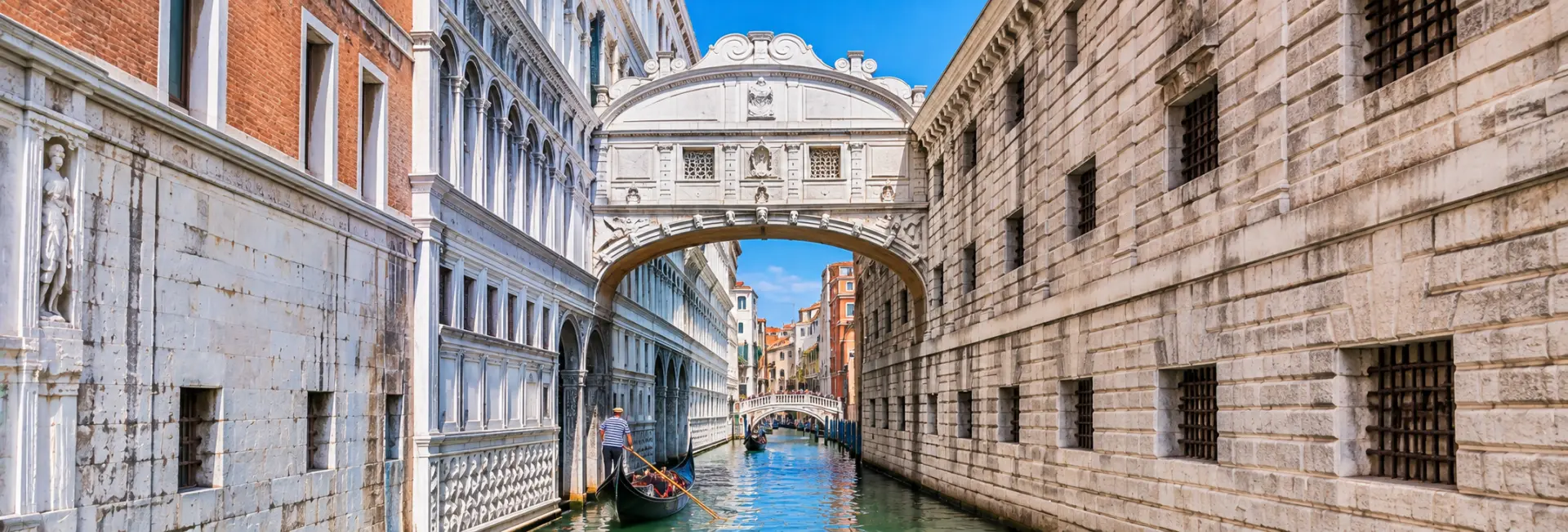
The Bridge of Sighs is a small, fully enclosed bridge arching over a narrow canal beside the Doge's Palace, linking the palace's interrogation rooms to the old prison building across the water. It is barely eleven metres long, but it carries a reputation out of all proportion to its size, thanks to a story about sighing prisoners that has made it one of the most photographed structures in Venice.
Unlike Venice's open, arched bridges, this one is fully covered, with only two small barred windows looking out on either side. That enclosure is precisely what gives it its atmosphere: a passage built for a grim purpose, dressed in Baroque stonework fine enough to make it look almost celebratory.
Today the bridge can be seen from outside for free, viewed from a neighbouring bridge over the same canal, or walked across as part of a ticketed visit to the Doge's Palace, which is the only way to experience it from the inside.
History
A problem of moving prisoners
By 1600, Venice's authorities needed to move prisoners held in cells on the ground floor of the Doge's Palace to a newly built prison, the Prigioni Nuove, standing just across a narrow canal from the palace. Doge Marino Grimani commissioned a connecting bridge to solve the practical problem of transferring prisoners, who had often just been interrogated in the palace, to their cells on the other side of the water.
Contino's design
The commission went to Antonio Contino, nephew of Antonio da Ponte, the architect who had designed the Rialto Bridge a decade earlier. Construction ran from around 1600 to 1603, producing a small enclosed span of white Istrian limestone in the Baroque style, decorated with carved reliefs and, at its centre, the coat of arms of the Grimani family who had commissioned it.
Function over the following centuries
For as long as the palace's judicial functions continued, the bridge served its intended purpose, moving prisoners between interrogation and confinement over the Rio di Palazzo below. Its most famous occupant, the adventurer and writer Giacomo Casanova, was held in the prison across the bridge in the 1750s before staging his celebrated escape in 1756, an episode that later folded into the structure's growing legend.
Architecture & Design
The bridge is built almost entirely of white Istrian limestone, a material used throughout Venice for its durability against the lagoon's damp air. Its enclosed form, unusual among Venice's otherwise open bridges, was a practical response to its function: sealing prisoners inside a single narrow corridor as they crossed, rather than exposing them on an open span.
Two small windows, one on each side, are fitted with thick stone bars and offer only a narrow, filtered view of the water and buildings outside. Inside, the passage is divided into two separate corridors by a dividing wall, so that prisoners moving in one direction could not encounter those moving in the other, a small but telling detail of how deliberately the space was controlled.
Decoratively, the bridge carries more ornament than its grim function might suggest: carved stone reliefs and the Grimani coat of arms mark it as a piece of civic architecture as much as a functional prison corridor, in keeping with the way Venice tended to dress even its most utilitarian structures in some degree of formal style.
The Legend of the Name
The bridge's evocative English name, Bridge of Sighs, is generally credited to the English poet Lord Byron, who used the phrase in the early nineteenth century as a translation of the Italian Ponte dei Sospiri. Byron's own famous line, "I stood in Venice, on the Bridge of Sighs, a palace and a prison on each hand," helped cement the name and the romantic legend behind it among the Romantic-era travellers who followed him to Venice on their own Grand Tours.
The popular story holds that condemned prisoners, crossing the bridge on their way to the cells, would sigh at their last glimpse of the city and the lagoon through the small barred windows before being shut away. It's a poetic image, though by the time the bridge was actually built, Venice's era of the Inquisition and summary executions had largely passed, and the cells beyond mostly held minor offenders rather than the doomed political prisoners the legend implies; the barred windows, in any case, allowed only a very limited view out.
A separate, more modern piece of local folklore holds that couples who kiss in a gondola beneath the bridge at sunset, as the bells of the Campanile toll, will be granted eternal love, a tradition that has made the bridge as much a romantic landmark as a historical one.
Ways to Experience It
Most visitors encounter the Bridge of Sighs in one of a few ways, and each gives a different sense of the structure.
- Viewing from outside: the classic view is from the neighbouring Ponte della Paglia, a public bridge over the same canal, which frames the Bridge of Sighs from a short distance and is free to visit at any time.
- Walking across it: only possible as part of a paid ticket to the Doge's Palace, which includes crossing the bridge into the old prison cells on the standard visitor route.
- By gondola: gondola rides along the Rio di Palazzo pass directly beneath the bridge, giving the view up through its arch from the water, the same route featured in the local kissing tradition.
- The Secret Itineraries tour: a separate, pre-booked guided route through the Doge's Palace that goes further into the prison's hidden rooms and additional cells connected to the bridge.
Since the bridge itself is not a standalone ticketed site, seeing it up close on foot always means visiting the Doge's Palace as a whole.
Best Time to Visit
Time of day
Early morning offers the clearest view from the Ponte della Paglia, before the waterfront promenade fills with visitors and the canal below fills with gondola traffic. Late afternoon light is also favoured for photographs, when the sun catches the pale limestone at an angle.
Season
Spring and autumn bring smaller crowds to the surrounding waterfront than the height of summer, when the narrow viewing spot on the Ponte della Paglia can be genuinely packed. Winter is quieter, though shorter days limit good photography light, and acqua alta can occasionally affect the immediate waterfront.
Because the bridge itself has no opening hours, the best time to view it from outside is really about crowd levels on the neighbouring bridge and promenade rather than the site itself.
Visitor Tips
- To photograph the bridge, stand on the Ponte della Paglia, the public bridge just to its south, which gives the best and most commonly used vantage point.
- Crossing the bridge in person requires a Doge's Palace ticket; there is no separate admission for the bridge alone.
- The viewing spot on the Ponte della Paglia is narrow and gets crowded quickly, so patience is often needed for an unobstructed photograph in peak season.
- A gondola ride along the Rio di Palazzo is one of the only ways to see the bridge from directly underneath, though it typically needs to be booked as part of a wider gondola route.
- The interior corridors, seen only when crossing as part of the Doge's Palace visit, are narrow and involve stairs, so mobility needs should be checked with the museum in advance.
- Combine a visit with the Doge's Palace and St. Mark's Basilica next door, both an easy walk from the bridge itself.
Nearby Attractions
The bridge sits at the edge of Venice's most concentrated cluster of major sights, all within a few minutes' walk.
- Doge's Palace: the building the bridge connects to, and the only way to walk across the bridge itself.
- Ponte della Paglia: the neighbouring public bridge offering the classic photograph of the Bridge of Sighs.
- Piazza San Marco: Venice's main square, a short walk from the palace's main entrance.
- St. Mark's Basilica: adjoining the Doge's Palace, Venice's Byzantine cathedral.
- Riva degli Schiavoni: the broad lagoon-front promenade running east from the bridge, popular for its views back across the water.
- Museo Correr: a museum of Venetian art and history facing the Basilica from across the square.
A natural way to see it is to view the bridge from the Ponte della Paglia first, then continue into the Doge's Palace to cross it in person as part of a full palace visit.
FAQs about visiting the Bridge of Sighs
What is the Bridge of Sighs? +
An enclosed limestone bridge in Venice, built in the early seventeenth century to connect the Doge's Palace to the old prison across a narrow canal, and named for the legend of prisoners sighing at their last view of the city.
Who built it, and when? +
The architect Antonio Contino, nephew of the Rialto Bridge's designer Antonio da Ponte, built it between around 1600 and 1603 for Doge Marino Grimani.
Where does the name come from? +
It is generally credited to the English poet Lord Byron, who used the phrase in the early nineteenth century as a translation of the Italian Ponte dei Sospiri, popularising the romantic legend behind it.
Is the sighing prisoner story true? +
It is more legend than documented fact. By the time the bridge was built, the era of summary executions had passed, and its barred windows in any case allowed only a very limited view out.
Can I walk across the Bridge of Sighs? +
Yes, but only as part of a paid visit to the Doge's Palace, which includes crossing the bridge into the old prison cells on the standard route. There is no separate ticket for the bridge alone.
Where is the best place to photograph it from outside? +
The Ponte della Paglia, a public bridge over the same canal just to its south, offers the classic view for free at any time.
Is there a romantic tradition connected to the bridge? +
Yes. Local folklore holds that couples who kiss in a gondola beneath the bridge at sunset, as the Campanile bells toll, will be granted eternal love.
Who was imprisoned here? +
The writer and adventurer Giacomo Casanova was held in the prison connected by the bridge in the 1750s, before famously escaping in 1756.
How long is the bridge? +
About eleven metres, spanning the narrow Rio di Palazzo between the Doge's Palace and the old prison building.
Is it accessible for wheelchair users? +
The interior crossing, reached only as part of the Doge's Palace visit, involves stairs and narrow corridors, so it is not step-free. Viewing the bridge from the Ponte della Paglia outside requires no special access.
