
Table of Contents
Overview
The Rialto Bridge is the oldest of the bridges spanning the Grand Canal and, for more than two and a half centuries, was the only one. It connects the San Marco and San Polo districts at the canal's narrowest point, a crossing that has mattered to the city since well before the current stone structure existed.
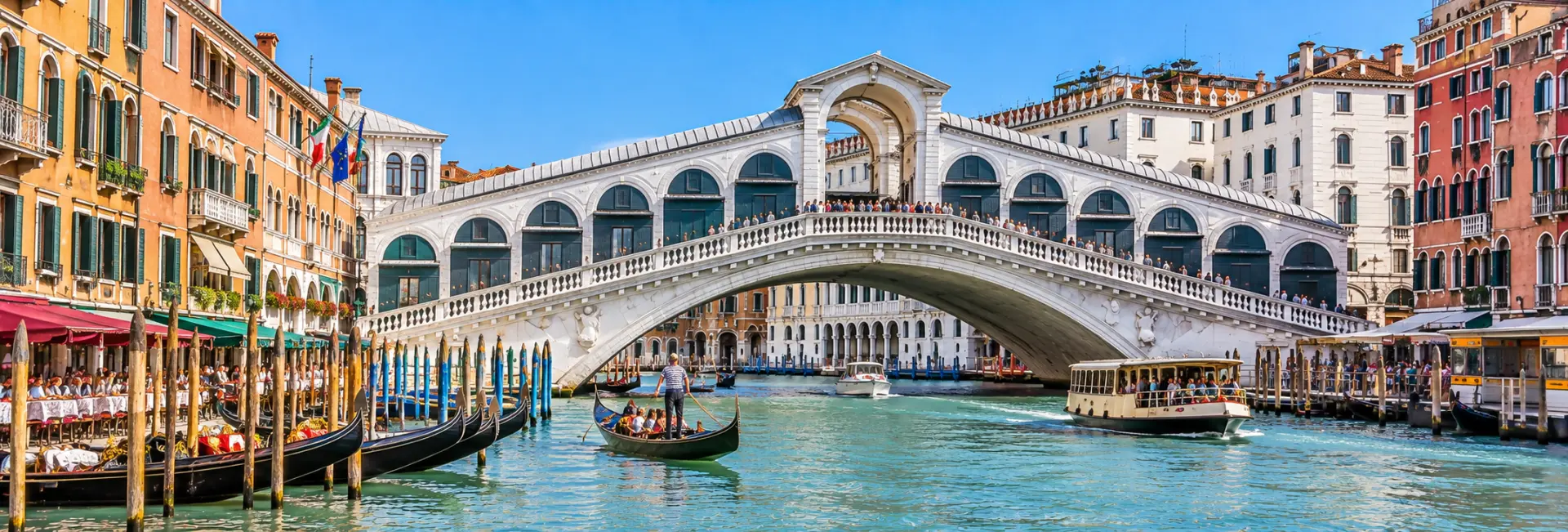
What visitors see today is a single broad stone arch, lined on both sides with small shops and topped by a covered walkway, a design that was considered close to reckless when it was built and has since become one of the most photographed structures in Italy. Boats pass beneath it constantly, and the view from its central span, up and down the Grand Canal in both directions, is one of the defining images of Venice.
Unlike many of the city's paid attractions, the bridge itself costs nothing to cross. Its appeal lies entirely in standing on it, walking its shop-lined length, and watching the water traffic move below.
History
Centuries of wooden crossings
A crossing at this point on the Grand Canal dates back to at least the twelfth century, when a pontoon bridge of boats was first proposed in the 1170s. Wooden bridges followed over the succeeding centuries, each replacing the last after damage, fire or collapse. A 1444 version was the first to include shops along its length, interrupted by a drawbridge at the centre to let tall-masted ships pass through.
A competition among Renaissance masters
By the mid-sixteenth century, Venice's authorities had decided a permanent stone bridge was needed, and in 1551 they invited proposals from some of the era's most celebrated architects, including Jacopo Sansovino, Andrea Palladio and Vignola, with Michelangelo also considered for the commission. Every classical scheme submitted called for multiple arches, which would have obstructed the busy boat traffic passing beneath, and all were ultimately rejected as unworkable for a canal this important.
Da Ponte's winning design
The commission finally went to Antonio da Ponte, a Venetian government architect whose surname, fittingly, translates as "of the bridge." His design, chosen in a competition held in 1587, called for a single vast stone arch rather than the multiple spans his rivals had proposed, a solution judged bold enough that critics, including fellow architect Vincenzo Scamozzi, predicted it would eventually collapse. Construction ran from 1588 to 1591, with da Ponte assisted by his nephew Antonio Contino, who later went on to design the Bridge of Sighs.
Standing the test of time
The bridge has proven far sturdier than its early critics expected, remaining in continuous use for more than four centuries. It stayed the only fixed crossing of the Grand Canal until the Accademia Bridge was built in 1854, followed a few years later by the Scalzi Bridge near the train station.
Architecture & Design
Da Ponte's bridge rests on roughly 12,000 wooden pilings driven into the canal bed, a foundation technique typical of Venetian construction that has kept the structure stable for over four hundred years. The single stone arch above spans close to 28 metres and rises around 7.5 metres above the water, a clearance calculated specifically to let the galleys and trading vessels of the day pass beneath it without lowering their masts.
The bridge deck is organised into three parallel walkways: a wide central ramp flanked by two narrower passages, each rising in shallow steps toward the crown of the arch. Two rows of small shops run along both sides of the central passage, their arched fronts meeting at the top under a shared portico, so that crossing the bridge means walking through a covered, shop-lined arcade rather than an open span.
The audacity of the single-arch design was very much the point. Multiple-arch proposals from da Ponte's rivals would have been structurally safer by contemporary standards but would have narrowed the navigable channel considerably. Da Ponte's gamble on a wider single arch is precisely what has allowed the bridge to remain functional for modern boat traffic centuries later, famously including the barge-borne sections of the Calatrava Bridge, which had to pass beneath it during that bridge's construction in the mid-2000s.
The Shops and Market Quarter
The shops lining the bridge have been part of its identity since long before the current stone version was built, continuing a commercial tradition from the wooden bridges that preceded it. Today they sell mostly jewellery, glasswork, leather goods and souvenirs aimed squarely at visitors, and prices here run well above what the same items cost a short walk away.
The bridge's location is no accident. It sits at the edge of the Rialto district, which was Venice's principal commercial and financial centre for centuries, home to its markets, banking houses and the offices that once managed trade across the Mediterranean. The San Polo side of the bridge still opens directly onto the Rialto Market, where fresh produce and seafood have been sold for hundreds of years, giving the area around the bridge a working, transactional energy that the more ceremonial Piazza San Marco does not have.
Ways to Experience It
Crossing the bridge is free and unticketed, and most visits are simple: walk across, pause at the crown of the arch, take in the view, continue on to whichever side you're headed. A few variations are worth knowing about.
- Walking across at street level: the standard way to experience it, ideally slowly enough to look both ways along the Grand Canal from the top.
- Viewing from the water: gondola rides and vaporetto routes along the Grand Canal pass directly beneath the bridge, giving the view from underneath that most pedestrians never see.
- Viewing from the banks: the canal-side promenades on both the San Marco and San Polo sides offer classic photograph angles of the bridge's full arch, especially from a small distance back.
- Dining nearby: several restaurants and bacari, Venice's traditional small bars, sit close to the bridge on both banks, offering waterside views over an aperitivo or a meal.
- Exploring the Rialto Market: a short walk from the San Polo side, worth combining with a bridge crossing for a sense of the working district around it.
Best Time to Visit
Time of day
Early morning is by a wide margin the best time to see the bridge without being packed shoulder to shoulder, since it sits on one of the most heavily trafficked routes in the city and fills quickly once the day gets going. Sunset and shortly after are also rewarding, when the light along the canal turns warm and the crowds thin slightly compared to the middle of the day.
Season
Spring and autumn bring more comfortable crowd levels than the height of summer, when the bridge and its approaches can be genuinely difficult to move through at midday. Winter is the quietest season by far, though foggy days along the canal, while atmospheric, can obscure the wider views the bridge is known for.
Because there is no ticket or opening hour to plan around, timing a visit is entirely about avoiding crowds and catching good light, which makes early morning the most reliable choice in any season.
Visitor Tips
- The bridge itself has no barriers to entry and no set hours; it is open and crossable at all times.
- The central and side walkways get extremely congested at peak times, so keep to one side and expect a slow shuffle rather than a brisk walk during the busiest hours.
- Shops on the bridge are priced for tourists; better value for similar souvenirs is usually found a few streets away in either direction.
- Watch your footing on the steps, which are shallow but numerous, and can be slippery when wet.
- Pickpocketing is a known risk in dense crowds on and around the bridge, so keep bags secured and in view.
- Getting there is easiest by vaporetto to the Rialto stop on either bank, or on foot from Piazza San Marco, roughly a ten to fifteen minute walk through the San Marco district.
- For photographs of the bridge itself rather than the view from it, stand on the canal-side promenade a short distance back on either bank.
Nearby Attractions
The bridge sits at the heart of one of Venice's busiest and most historic districts, with several notable sights within a short walk.
- Rialto Market: Venice's historic produce and seafood market, a few minutes' walk on the San Polo side.
- Grand Canal: the bridge's main reason for being, with vaporetto stops and gondola departures on both banks.
- Piazza San Marco: Venice's main square, a walk of roughly ten to fifteen minutes through the narrow streets of San Marco.
- Ca' d'Oro: an ornate Gothic palace on the Grand Canal's opposite bank, reachable by vaporetto or on foot via Cannaregio.
- Campo San Polo: one of the largest squares in Venice, a short walk inland from the market side of the bridge.
- Ca' Rezzonico: a grand Baroque palace museum on the Grand Canal, a scenic vaporetto ride from the bridge.
A natural route is to cross the bridge, browse the Rialto Market on the San Polo side, then continue on foot into Campo San Polo or back toward Piazza San Marco.
FAQs about visiting the Rialto Bridge
Why is the Rialto Bridge famous? +
It is the oldest bridge across the Grand Canal and was, for over two and a half centuries, the only one. Its bold single-arch design, built between 1588 and 1591, was considered structurally risky at the time but has held for more than four hundred years.
Is there an entrance fee? +
No. The bridge is a public crossing with free, unrestricted access at all times.
Who designed it? +
Antonio da Ponte, a Venetian government architect, won a design competition in 1587 against proposals from Michelangelo, Palladio and other leading architects of the day. His nephew, Antonio Contino, assisted him and later designed the Bridge of Sighs.
What is on the bridge? +
Two rows of small shops line the central walkway, selling mostly jewellery, glasswork, leather goods and souvenirs, with a covered arcade running along its length.
How long does it take to cross? +
Just a few minutes on foot, though most visitors pause at the top to take in the view along the Grand Canal in both directions.
What is the best time to visit? +
Early morning, before the crowds build, gives the clearest views and easiest walking. Sunset is the next best option for light and atmosphere, with somewhat smaller crowds than midday.
How do I get there? +
By vaporetto to the Rialto stop on either bank of the Grand Canal, or on foot from Piazza San Marco, about a ten to fifteen minute walk.
Is it crowded? +
Yes, especially in the middle of the day during high season, when the walkways can be genuinely congested. Early mornings and evenings are noticeably calmer.
What else is nearby? +
The Rialto Market sits just off the bridge on the San Polo side, with Campo San Polo, Piazza San Marco and several Grand Canal palaces all within easy walking or vaporetto distance.
Can boats still pass under it? +
Yes. The single wide arch was specifically designed to let large vessels pass beneath without lowering their masts, a clearance that still accommodates the boat traffic on the Grand Canal today.
