
Table of Contents
Overview
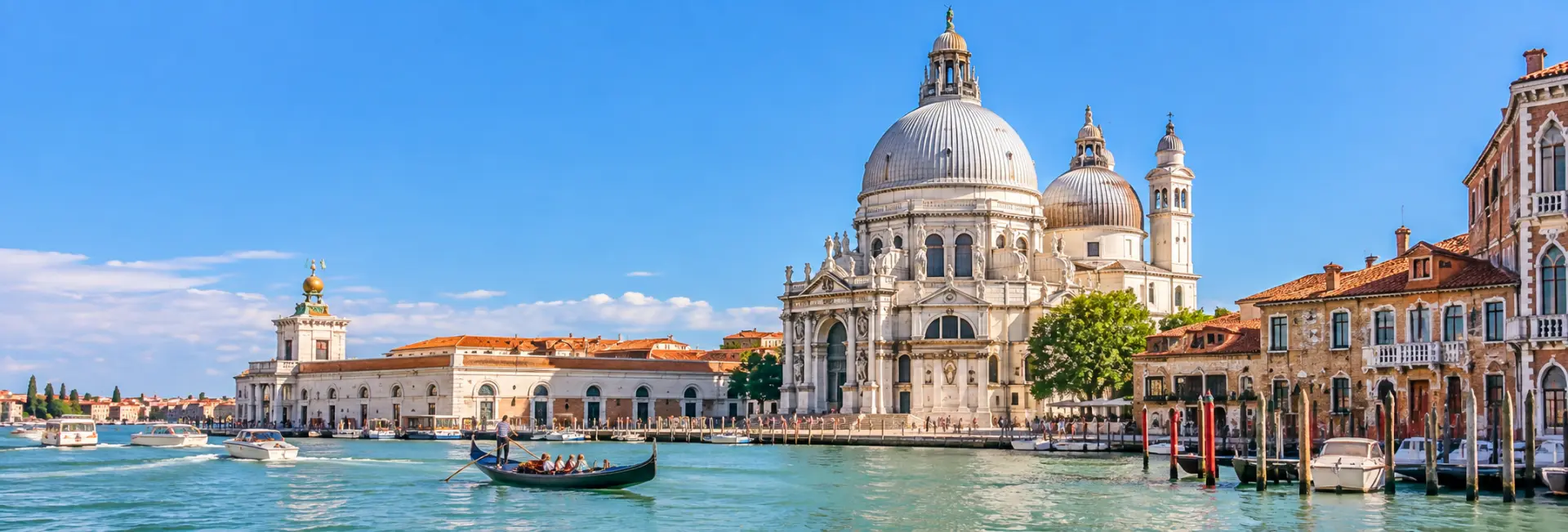
Santa Maria della Salute stands at the point where the Grand Canal opens into the Bacino di San Marco, its great white dome one of the defining silhouettes of the Venice skyline. Painted by Canaletto, Turner and Monet among many others, it is the building most visitors picture when they imagine the view across the water from Piazza San Marco.
The church was built as a votive offering, a promise made to the Virgin Mary in exchange for deliverance from a plague that killed roughly a third of the city's population in 1630 and 1631. That origin still shapes how the building is used today: once a year, the city holds a dedicated festival here to give thanks for the plague's end, a tradition that has continued for centuries.
Entry to the main body of the church is free, with a small fee to see the sacristy, where several of the basilica's finest paintings, including work by Titian, are kept.
History
A plague and a vow
In 1630, a severe outbreak of bubonic plague swept through Venice, killing an estimated 46,000 people in the city and close to 94,000 more across the wider lagoon, roughly a third of the population. As the epidemic dragged on, the Venetian Senate made a public vow: if the Virgin Mary would end the plague, the Republic would build a great church in her honour.
A competition won by an unknown architect
The plague subsided in 1631, and true to its word, the Senate held a design competition for the promised church. It was won, against ten other competitors, by Baldassare Longhena, then in his late twenties or early thirties and largely unknown at the time. It would become the defining project of his career, occupying him for the rest of his working life.
Fifty years in the building
Construction began in 1631 on the Punta della Dogana, a challenging site of waterlogged, unstable ground at the mouth of the Grand Canal. The engineering required to support the building's weight was immense, involving well over a million wooden piles driven into the lagoon floor as a foundation. The church took more than fifty years to complete and was finally consecrated in 1687, a year after Longhena's death, meaning he never saw his masterpiece finished.
Architecture & the Dome
Longhena's design broke sharply from convention. Rather than the elongated basilica plans typical of the period, he gave the church an octagonal floor plan, said to have been inspired by the shape of a crown, an offering fit for the Virgin Mary in her role as Queen of Heaven.
The building rises in two unequal domes: a large central dome, shaped as a near-perfect hemisphere, sitting atop a drum ringed with tall arched windows, and a smaller secondary dome over the sanctuary at the rear, flanked by twin bell towers. Around the base of the main dome, a ring of large stone scrolls, or volutes, curls outward like a collar, an inventive structural and decorative solution that has become one of the building's most recognisable features.
The church is built of brick faced with Istrian stone and marmorino, a marble-dust plaster that gives the exterior its bright, almost luminous white finish. More than 125 statues decorate the facade and roofline, and the central entrance is shaped to evoke a Roman triumphal arch, a deliberate symbol of Venice's victory over the plague rather than a purely devotional gesture.
Inside the Basilica
The interior carries through the octagonal plan of the exterior, opening into a spacious central hall ringed by columns and arches that rise into the drum of the great dome, flooding the space with light from the high windows above. Six side chapels open off the main space, five dedicated to the Virgin Mary and one to St. Anthony, along with the high altar at the rear.
The high altar itself, also designed by Longhena, is a dramatic Baroque set piece. Its sculptural group, carved by the Flemish sculptor Josse de Corte in 1670, depicts the Queen of Heaven expelling the plague, a literal staging of the church's founding story in stone. Beside it sits a Byzantine icon of the Madonna, dating from the twelfth or thirteenth century, brought to Venice from Crete by the future doge Francesco Morosini after the fall of Heraklion to the Ottomans in 1669.
Compared to the exuberance of the exterior, the interior is relatively restrained, its white marble surfaces and clean geometry letting the architecture itself, rather than dense decoration, carry the effect.
The Sacristy Paintings
The basilica's most significant paintings are kept in the sacristy, reached via a narrow passageway near the church's Titian altarpiece, and viewable for a small entrance fee. It is a worthwhile stop for anyone with an interest in Venetian painting, since the works here rank among the finest by two of the city's greatest masters.
Highlights include:
- Titian's Descent of the Holy Spirit, a mid-sixteenth-century altarpiece
- A ceiling painting of David and Goliath by Titian, one of several biblical scenes he contributed to the sacristy ceiling
- Tintoretto's Marriage at Cana, notable for its luminous treatment of the figures and setting
- Additional works by Luca Giordano, found among the church's side chapels
Because several of the basilica's finest paintings sit behind the altar or within the sacristy rather than in the main body of the church, visitors who skip the small entrance fee miss a significant part of what the building holds.
The Festa della Salute
Every year on 21 November, Venice marks the Festa della Salute, a citywide day of thanksgiving for the end of the 1630-31 plague, and one of the most heartfelt celebrations on the Venetian calendar. Special Masses are held throughout the day, and a temporary votive bridge of boats is built across the Grand Canal specifically for the occasion, allowing pilgrims and residents to walk directly to the church from the San Marco side rather than travel by regular bridge or boat.
The festival draws large numbers of Venetians rather than only tourists, many of whom light candles inside the church as an act of continuity with the original seventeenth-century vow. Street stalls selling roasted chestnuts and traditional sweets typically line the approach to the church on the day, giving the occasion something of the character of a local fair alongside its religious observance.
Ways to Experience It
Most visits to Santa Maria della Salute combine a few simple elements, and the church rewards even a short stop.
- Free entry to the main church: covers the octagonal nave, the high altar and the side chapels.
- The sacristy: a small paid entry giving access to the Titian and Tintoretto paintings kept there.
- Viewing from across the water: the classic photograph is taken from the Riva degli Schiavoni or the waterfront near Piazza San Marco, looking across the Bacino di San Marco.
- Climbing nearby viewpoints: the Campanile di San Marco and the top of the Fondaco dei Tedeschi both give elevated views that place the church's dome within the wider Venice skyline.
- Attending the Festa della Salute: for visitors in Venice on 21 November, joining the procession across the votive bridge is a distinctive local experience beyond an ordinary sightseeing visit.
A gondola or vaporetto ride past the church, taken from the water rather than the bank, is also a common and rewarding way to appreciate its scale and setting at the mouth of the canal.
Best Time to Visit
Time of day
Morning light suits the church well, catching its white stone facade directly, while late afternoon and early evening give a softer, warmer tone as the sun moves west across the basin. The church and its surroundings are generally quieter than the crowds around Piazza San Marco just across the water.
Season
Spring and autumn bring comfortable weather for the walk along the Dorsoduro waterfront, while summer, though busier throughout Venice generally, still leaves this side of the canal calmer than the San Marco side. Visiting around 21 November, for the Festa della Salute, offers a unique cultural dimension but also brings the year's largest crowds to the immediate area.
Because entry to the main church is free and unticketed, timing a visit here is mostly a matter of light and crowd levels rather than working around opening hours or booking requirements.
Visitor Tips
- Modest dress is expected, as with any active church in Venice: shoulders and knees should be covered.
- The sacristy has a small separate entrance fee; bring cash or a card, as this is handled locally rather than through a central ticketing system.
- The church sits a genuine walk from the Rialto Bridge and San Marco side, so budget time accordingly or take the vaporetto directly to the Salute stop.
- The wide steps at the main entrance and the open square in front make this one of the more comfortable churches in Venice to approach with limited mobility, though the interior floor level can vary slightly between sections.
- Photography is generally permitted inside without flash, but check current signage, particularly near the sacristy.
- Combine the visit with a walk along the Dorsoduro waterfront toward the Punta della Dogana for further views back across the basin.
- If visiting on 21 November, expect large crowds, a temporary bridge across the canal, and street stalls near the church.
Nearby Attractions
The church anchors the eastern tip of Dorsoduro, within walking distance of several notable sights on that side of the Grand Canal.
- Punta della Dogana: the former customs house beside the church, now a contemporary art museum with striking views over the basin.
- Peggy Guggenheim Collection: a modern art museum a short walk along the Dorsoduro waterfront.
- Accademia Gallery: Venice's leading collection of pre-nineteenth-century art, a walk of about ten minutes.
- Piazza San Marco: visible across the water, reachable by a scenic vaporetto ride or a longer walk around the basin.
- Doge's Palace: also visible from the church steps, directly across the Bacino di San Marco.
- Zattere promenade: a long waterfront walk along the Giudecca Canal, just behind the church, popular for its views and gelato shops.
A natural route is to see the church, continue to the Punta della Dogana and the Guggenheim Collection nearby, then walk the Zattere promenade before crossing back toward San Marco.
FAQs about visiting Santa Maria della Salute
Why was Santa Maria della Salute built? +
It was built as a votive offering to the Virgin Mary in thanks for the end of a severe plague that killed roughly a third of Venice's population in 1630 and 1631, following a public vow made by the Venetian Senate.
Who designed it? +
Baldassare Longhena, a young and largely unknown architect at the time, won a design competition against ten other entrants. The church became the defining project of his career.
How long did it take to build? +
More than fifty years. Construction began in 1631, and the church was consecrated in 1687, a year after Longhena's death.
Is there an entrance fee? +
The main church is free to enter. A small fee applies to visit the sacristy, where paintings by Titian and Tintoretto are kept.
What is the Festa della Salute? +
An annual festival held on 21 November, marking the end of the 1630-31 plague, when a temporary votive bridge is built across the Grand Canal and special Masses are held throughout the day.
What is inside the sacristy? +
Notable works by Titian, including his Descent of the Holy Spirit and a ceiling painting of David and Goliath, along with Tintoretto's Marriage at Cana.
How do I get there? +
By vaporetto directly to the Salute stop, or on foot along the Dorsoduro waterfront, a genuine walk from the Rialto Bridge or Piazza San Marco side of the canal.
What makes its architecture unusual? +
Its octagonal floor plan, unusual for Venetian churches, was reportedly inspired by the shape of a crown, symbolising the Virgin Mary as Queen of Heaven. The large stone scrolls ringing the base of the dome are another distinctive feature.
Is it accessible for wheelchair users? +
The approach via the wide entrance steps and square is relatively comfortable compared to many Venice churches, though it is worth checking current interior access for specific mobility needs.
What is the best view of the church? +
From across the water on the Riva degli Schiavoni or near Piazza San Marco, looking across the Bacino di San Marco, which is also the vantage point captured in countless historical paintings of Venice.
