
Table of Contents
Overview
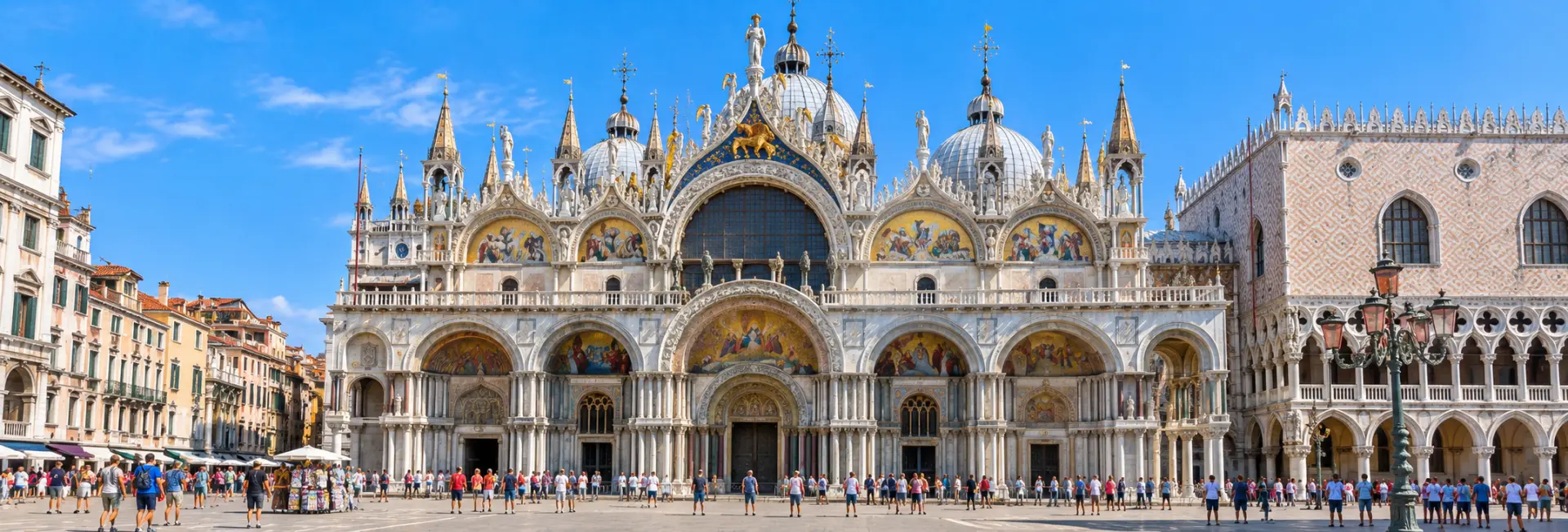
St. Mark's Basilica is the cathedral of Venice, standing at the eastern end of the square that shares its name. It is one of the finest surviving examples of Byzantine architecture in the world, a building where five domes, acres of gold mosaic and centuries of looted treasure combine into something that still looks foreign to the rest of Italy, which is entirely the point.
The basilica was built to hold the relics of St. Mark the Evangelist, smuggled out of Alexandria by Venetian merchants in the ninth century, and for most of its history it was not the city's cathedral at all but the doge's private chapel, attached to the seat of government next door. It only became Venice's official cathedral in 1807, after the fall of the Republic.
Its popular nickname, Chiesa d'Oro, the Church of Gold, comes from the interior, where more than 8,000 square metres of mosaic are set with gold leaf fused behind glass, designed to catch and scatter every available point of light. Entry to the nave is free; nearly everything else inside, the museum, the treasury and the Pala d'Oro, requires a separate ticket.
History
A body smuggled from Alexandria
According to Venetian tradition, the relics of St. Mark the Evangelist were smuggled out of Alexandria in 828 by Venetian merchants who concealed the body beneath a layer of pork to deter Muslim customs officials from inspecting the cargo too closely. The relics were brought to Venice and construction began soon after on a church attached to the Doge's Palace to house them.
Destroyed by fire and rebuilt
That first basilica did not survive. It burned down in 976, and the church standing today dates from the rebuilding that followed in the eleventh century. The new basilica was designed with a Greek-cross plan and five domes, probably by a Greek architect working with Venetian and Lombard builders, giving it the Byzantine silhouette with Romanesque touches that still defines it.
Built from the spoils of empire
For centuries afterward, whenever Venetian ships returned from trade or conquest in the eastern Mediterranean, they brought back columns, friezes, marble slabs and sculpture to add to the building. Much of what decorates the basilica today, inside and out, arrived this way rather than being carved for the building itself, making the church something close to a physical record of Venetian maritime power.
From doge's chapel to city cathedral
Despite its scale, the basilica functioned as the doge's private chapel rather than Venice's cathedral for nearly a thousand years; that role belonged to the comparatively modest Basilica di San Pietro di Castello. Only in 1807, after Napoleon had ended the Republic and reorganised the city's church administration, did St. Mark's formally become Venice's cathedral.
Architecture & Exterior
The facade is built in two tiers, each pierced by five large arched portals, and its outline ripples with domes, pinnacles and statuary in a way no other church in Italy quite matches. The central portal is the grandest, framed by Egyptian purple porphyry columns and stone reliefs carved between the thirteenth and fourteenth centuries.
Above the main doorway, an upper gallery known as the Loggia dei Cavalli holds copies of the famous bronze horses and gives access to one of the best views over Piazza San Marco below. The lunettes above each portal are filled with mosaics, several depicting episodes from the story of St. Mark's relics; the oldest, dating from 1270, shows the saint's body arriving at the basilica, while a later one from 1660 shows officials recoiling from the barrel that concealed it.
Inside, the plan is a Greek cross, each arm divided into three naves and topped by its own dome, with the largest, the Ascension Dome, rising over the crossing. The overall effect at ground level is of walking into a jewelled cave rather than a conventional church nave, and it is especially striking in the hour before sunset, when low light catches the gold overhead.
The Mosaics
The basilica's mosaics cover more than 8,000 square metres and were laid down over roughly six hundred years, making them one of the largest and longest-running mosaic programmes anywhere in the world. Most are set with gold leaf fused to the back of the glass tesserae, designed to reflect ambient light back into the church rather than simply display colour.
The oldest surviving mosaics, generally agreed to be the finest, are found in the vestibule and the Chapel of the Pentecost near the entrance, showing the Apostles with the Madonna and dating back more than 950 years. The Ascension Dome carries an early thirteenth-century mosaic cycle drawn from the New Testament, while other sections depict Old Testament scenes and the Last Judgment.
Because the mosaics are set at a slight angle to catch light rather than laid perfectly flat, their appearance shifts noticeably depending on where the sun is and where you are standing, which is part of why repeat visitors keep noticing new details.
The Pala d'Oro and Treasury
Behind the high altar stands the basilica's single greatest treasure, the Pala d'Oro, a gold altarpiece studded with more than 2,000 gemstones and 83 enamelled panels. It was originally commissioned in tenth-century Constantinople and then expanded and reworked by Venetian and Byzantine goldsmiths between the twelfth and fourteenth centuries, making it as much a record of shifting artistic taste as a single finished object.
St. Mark's relics rest in an urn within the high altar itself, supported by four marble and alabaster columns. Nearby, in its own chapel, is the Madonna Nicopeia, a bejewelled tenth-century icon also taken from Constantinople and revered as one of the basilica's most sacred images.
The Treasury, to the right of the main altar, holds a dense collection of Byzantine reliquaries, chalices and other plunder brought back after the sack of Constantinople in 1204, much of it looted during the Fourth Crusade alongside the horses on the facade. Each of these three, the Pala d'Oro, the Treasury and the museum upstairs, requires its own separate ticket beyond basic entry to the nave.
The Horses of St. Mark
The four gilded bronze horses associated with the basilica are among the most travelled works of art in Europe. Believed to date from classical antiquity, possibly originally displayed on a Roman triumphal arch, they stood for centuries at the Hippodrome of Constantinople before Doge Enrico Dandolo had them shipped to Venice as war spoils after the Fourth Crusade sacked the city in 1204.
They were installed on the basilica's facade around 1254 and remained there, with one dramatic interruption, for centuries. Napoleon had them removed and taken to Paris after his conquest of Venice in 1797, but they were returned and reinstalled following his defeat in 1815.
Pollution and weathering eventually forced their final move: the original horses were brought indoors in the 1980s for preservation and now stand in the basilica's museum in an upper gallery, with accurate replicas mounted on the facade in their place. Seeing the originals up close, in the museum, is a different experience from viewing the copies from the square below, and is one of the better reasons to pay for the upstairs ticket.
Ways to Experience It
A basilica visit can be as quick as ten minutes or stretch to well over an hour, depending on which tickets are added to the basic entry.
- Free entry to the nave: covers the main body of the church and its mosaics, though visits are brief and crowd-managed at busy times.
- Museo di San Marco: a paid ticket giving access to the upper gallery, close-up views of the ceiling mosaics, the original bronze horses, and the outdoor Loggia dei Cavalli overlooking the square.
- The Pala d'Oro: a small additional ticket to view the golden altarpiece up close behind the high altar.
- The Treasury: a separate ticket covering the collection of Byzantine relics and crusader plunder.
- Skip-the-line reservations: bookable in advance online for a fixed entry time, which avoids the queue that regularly forms across the square, especially in high season.
- Guided tours: offered in multiple languages, useful for interpreting the mosaic cycles, which are otherwise difficult to read without context.
Because the basilica is an active place of worship, it closes to sightseeing during Mass and on some religious holidays, and visitor routes may be altered at short notice.
Best Time to Visit
Time of day
Arriving right at opening is the most reliable way to see the interior without a long wait, since the queue across the square builds steadily through the morning. Late afternoon, close to closing, is a reasonable second option once day-trip groups have started to leave. Visiting in the hour before sunset, when light angles through the windows, is often mentioned as the moment the mosaics look their best.
Season
Spring and autumn bring the most manageable crowds, though the basilica sees heavy visitor numbers year-round given its position beside the square. Summer produces the longest queues and the warmest, most crowded interior. Winter is quieter but comes with the added variable of acqua alta, which can affect access to the square and, in serious cases, to the basilica's own entrance and narthex.
Booking a timed entry slot online is worth doing in any season if avoiding the queue matters more than flexibility.
Visitor Tips
- Modest dress is required and enforced: shoulders and knees must be covered, and bare shoulders or short shorts will mean turned away at the door.
- Large bags and backpacks are not permitted inside; there is a free bag drop nearby for visitors carrying luggage.
- Photography inside the basilica is generally restricted or banned, particularly with flash, so check current signage at the entrance.
- Silence and a respectful tone are expected throughout, as this remains an active place of worship, not solely a museum.
- Booking a timed entry online in advance is the single best way to avoid the queue that often wraps across Piazza San Marco.
- The museum and Loggia dei Cavalli involve stairs with no lift, so this section is not accessible for visitors with limited mobility; the ground-floor nave is step-free.
- Combine the visit with the Campanile or Doge's Palace next door, both a few steps away, to make the most of a single stop in the square.
Nearby Attractions
Standing at the heart of Piazza San Marco, the basilica is within a few minutes of nearly every other major sight in this part of Venice.
- Piazza San Marco: the square the basilica opens onto, ringed by arcaded buildings and historic cafés.
- Campanile di San Marco: the freestanding bell tower beside the basilica, with a lift to an observation level over the city.
- Doge's Palace: the former seat of Venetian government, directly adjoining the basilica and the Piazzetta.
- Bridge of Sighs: the enclosed bridge linking the Doge's Palace to the old prisons, a short walk from the basilica's southern side.
- Museo Correr: a museum of Venetian art and history facing the basilica from across the square.
- Torre dell'Orologio: the ornate Renaissance clock tower at the square's northern edge.
Because tickets for the Doge's Palace and the basilica's own museum are sold separately, many visitors plan the two together as one combined stop before moving on to the rest of the square.
FAQs about visiting St. Mark's Basilica
Is St. Mark's Basilica free to enter? +
The main nave is free to enter, though separate paid tickets are required for the upper museum, the Pala d'Oro altarpiece and the Treasury.
Why is it called the Church of Gold? +
Because of its interior mosaics, which cover more than 8,000 square metres and are largely made with gold leaf fused behind glass, designed to reflect light throughout the church.
What is the Pala d'Oro? +
A gold altarpiece behind the high altar, studded with more than 2,000 gems and 83 enamelled panels, originally made in tenth-century Constantinople and reworked by Venetian and Byzantine artisans over the following centuries.
Are the horses on the facade the originals? +
No. The originals, ancient bronze horses taken from Constantinople in 1204, were moved indoors in the 1980s for preservation and now stand in the basilica's museum. Accurate replicas are mounted on the facade in their place.
How long does a visit take? +
The free nave visit can take as little as ten minutes, but adding the museum, the Pala d'Oro and the Treasury can extend a visit to an hour or more.
Do I need to book in advance? +
It is not required for the free nave, but booking a timed entry online is strongly advisable to avoid the queue that regularly forms across Piazza San Marco, especially in high season.
What is the dress code? +
Modest dress is required and enforced: shoulders and knees must be covered, and visitors in beachwear or very short clothing will be turned away.
Is photography allowed inside? +
It is generally restricted, particularly with flash, so check the signage at the entrance on the day of your visit.
Is the basilica accessible for wheelchair users? +
The ground-floor nave is step-free, but the upper museum and the outdoor Loggia dei Cavalli are reached only by stairs.
When did it become Venice's official cathedral? +
Only in 1807, after Napoleon ended the Venetian Republic. For nearly a thousand years before that, it served as the doge's private chapel rather than the city's cathedral.
