
Table of Contents
Overview
Dublin Castle occupies the exact ridge where the city takes its name: the "Dubh Linn," or black pool, once formed here at the meeting point of the River Poddle and the River Liffey. What began in the early 1200s as a walled Norman stronghold grew, over seven centuries, into the administrative heart of English and later British rule in Ireland, before being handed to the new Irish state in 1922.
Today the complex is a working government site as much as a heritage attraction. Its Georgian State Apartments host presidential inaugurations and state banquets, while the surviving medieval tower and an excavated Viking site beneath the courtyards give visitors a rare look at layers of the city stretching back over a thousand years.
History
Norman Foundations
A fortification is believed to have stood on this ridge since at least the Viking period, but the stone castle visitors see traces of today was ordered by King John in the early 1200s as a defensive base for Norman Dublin. Curtain walls and corner towers enclosed a courtyard, with the Poddle river channelled around the site to act as a natural moat.
The Viceregal Centuries
For roughly 700 years, the castle served as the seat of the crown's administration in Ireland, home to the Lord Lieutenant, or Viceroy, who represented the monarch. A severe fire in the late 1600s destroyed much of the medieval fabric, clearing the way for the grand Georgian-era State Apartments that now dominate the Upper Yard. Through the 18th and 19th centuries the castle became as much a royal court and social hub as a military and administrative one, hosting balls, receptions and the ceremonial life of the viceregal court.
Handover to the Irish State
Following the Anglo-Irish Treaty, the castle was formally handed over to Ireland's new Provisional Government in 1922, an event widely seen as marking the symbolic end of British rule. Since then it has been repurposed for the ceremonial and administrative needs of an independent Irish state, most visibly as the venue for every presidential inauguration held since.
Architecture & Notable Rooms
The Record Tower
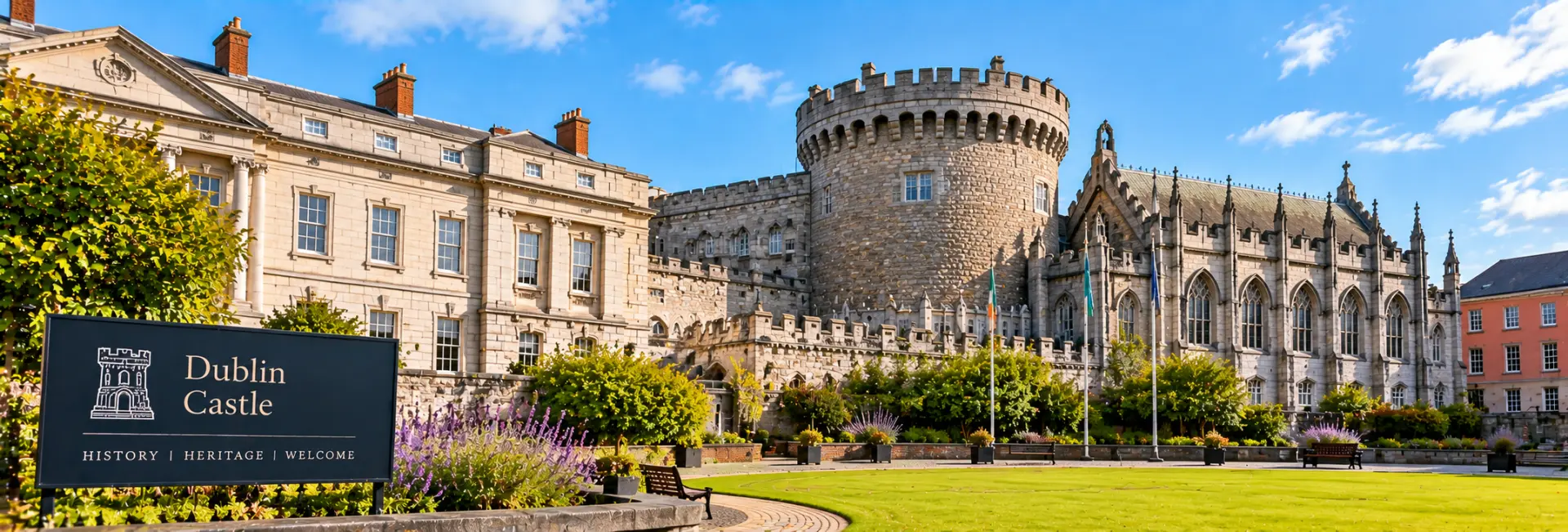
The Record Tower is the castle's only substantial surviving fragment from the medieval period, dating to the 1220s. Its thick circular walls once formed part of the original defensive circuit, and over the centuries it has done duty as an archive and a prison, most famously the site of a dramatic escape by the Ulster chieftain Red Hugh O'Donnell in the 1590s.
State Apartments and St Patrick's Hall
Built as residential and ceremonial quarters for the viceregal court, the State Apartments form a suite of richly decorated rooms used for state functions to this day. The grandest of these, St Patrick's Hall, features an ornate painted ceiling and now serves as the setting for presidential inaugurations and the hosting of visiting heads of state.
Chapel Royal
Completed in the early 19th century in a Gothic Revival style, the Chapel Royal is noted for its elaborate plaster and stone carving, including a run of carved heads on its exterior representing figures connected to British rule in Ireland. Deconsecrated in the 20th century, it is now used for exhibitions and events rather than regular worship.
Bedford Tower
Facing the Upper Yard, the Bedford Tower is remembered less for its architecture than for a mystery: in 1907 the Irish Crown Jewels, ceremonial regalia kept in a strongroom there, were stolen and never recovered, a case that remains formally unsolved.
Grounds & Gardens
The castle complex is arranged around two main courtyards, the Upper Yard and Lower Yard, which together with surrounding buildings cover roughly 11 acres. Beyond the formal courtyards, the Dubh Linn Garden occupies the site of the original black pool that gave Dublin its name, laid out as an open lawn that gives the modern complex some breathing room away from its stone facades.
- Upper Yard – the ceremonial core, fronted by the State Apartments and Bedford Tower
- Lower Yard – home to the Chapel Royal and the Record Tower
- Dubh Linn Garden – a green space marking the historic pool behind the castle
- Coach House Gallery – a converted stable building in the garden now used for temporary exhibitions
Cultural Significance & Historical Ties
Few buildings in Ireland carry as much symbolic weight as Dublin Castle. For centuries it stood for foreign administration of the country, making its 1922 handover a landmark moment in the national story rather than a routine change of ownership. That dual identity, as both a monument to colonial rule and a stage for the independent state that followed it, still shapes how the site is presented today.
The castle remains at the centre of Irish public life: it is the fixed venue for presidential inaugurations, a regular site for state visits and official banquets, and has served as a venue during Ireland's periods hosting the Presidency of the Council of the European Union. Within the grounds, the Chester Beatty, an internationally regarded museum of manuscripts and art from Asia, the Middle East and Europe, adds a further cultural layer entirely separate from the castle's own governmental role.
Ways to Experience It
Visitors can choose between a self-guided walk through the State Apartments and Chapel Royal, or a guided tour that also takes in areas not otherwise open, including the below-ground Viking excavation. The excavation, accessible via a stairway beneath the courtyards, exposes sections of the original defensive bank and waterways that predate the stone castle.
- Self-guided tour of the State Apartments and Chapel Royal
- Guided tour including the Medieval Undercroft and Viking excavation
- An audio guide option for visitors who prefer to move at their own pace
- Rotating exhibitions in the Coach House Gallery in the Dubh Linn Garden
Best Time to Visit
Dublin Castle is open year-round, so the main variable for visitors is crowding rather than seasonal closures. Weekday mornings tend to be quieter than afternoons and weekends, and visiting outside the busiest summer months generally means shorter waits for guided tours.
Because the castle remains a working state venue, individual rooms or the entire complex can close at short notice for official functions, and it has previously closed for extended stretches around major events such as Ireland's terms hosting the EU Council Presidency. Checking current opening status before travelling is worthwhile at any time of year.
Visitor Tips
Most visits to the State Apartments and Chapel Royal take around 30 minutes if self-guided, or closer to an hour with a guide. The Viking excavation is reached by stairs only, so it isn't accessible to wheelchair users, while the State Apartments and Chapel Royal above ground are.
- Book ahead for guided tours, particularly in peak season, since capacity is limited
- Watch your footing in the Upper Courtyard, where surfaces are uneven in places
- Note that the wider castle campus has, at times, closed entirely for extended periods around major state events — confirm current access on the official Dublin Castle website before you go
- Combine your visit with the on-site Chester Beatty museum, which has separate, typically free, admission
Nearby Attractions
Dublin Castle sits within easy walking distance of several of the city's best-known landmarks, making it a natural anchor for a half-day exploring historic Dublin.
- Chester Beatty – a major manuscript and art museum inside the castle grounds
- Christ Church Cathedral – a short walk away, among Dublin's oldest buildings
- Dublin City Hall – an elegant 18th-century civic building facing the castle
- Trinity College and the Book of Kells – a walk of a few minutes to the east
- Temple Bar – Dublin's best-known nightlife and cultural quarter, just north of the castle
FAQs about visiting Dublin Castle
What is Dublin Castle best known for? +
It's best known for being the centre of British administration in Ireland for around 700 years, and today for its Georgian State Apartments, its surviving medieval Record Tower, and an excavated Viking-era site beneath its courtyards.
Is Dublin Castle free to visit? +
The courtyards and exterior can be viewed without charge, but entry to the State Apartments, Chapel Royal and excavation areas requires a paid ticket, whether self-guided or on a guided tour.
How long should I plan to spend there? +
A self-guided visit to the main rooms typically takes about 30 minutes, while a guided tour that includes the Viking excavation and Medieval Undercroft runs closer to an hour, so allow extra time if you want to see everything at a relaxed pace.
Is Dublin Castle suitable for wheelchair users? +
The State Apartments and Chapel Royal are accessible, but the below-ground Viking excavation is reached only by stairs, so that section isn't wheelchair accessible.
What's the best time of day or year to visit? +
Weekday mornings are generally quieter than afternoons and weekends, and visiting outside the peak summer months tends to mean shorter waits for guided tours.
How do I get to Dublin Castle? +
The castle sits just off Dame Street in the city centre, within walking distance of central Dublin, and is well served by city bus routes, with no on-site parking for visitors.
What else should I see nearby? +
Christ Church Cathedral, Dublin City Hall and Trinity College's Book of Kells exhibition are all a short walk away, and the Chester Beatty museum sits within the castle grounds itself.
What's a common mistake visitors make? +
Assuming the castle is always fully open: as a working government complex, parts of it, or occasionally the whole site, can close for official events, so it's worth checking current opening times on the official website shortly before your visit.
