
Table of Contents
Overview
The National Museum of Ireland – Archaeology houses the country's most significant collection of ancient artefacts, tracing Irish history from around 7,000 BC through to the end of the Middle Ages. Set in a grand Victorian building on Kildare Street in central Dublin, it holds treasures ranging from prehistoric gold to intricately worked medieval metalwork, alongside the haunting remains of Iron Age bog bodies.
As Ireland's national repository for archaeological finds, the museum brings together more than two million objects, many uncovered on Irish soil, offering one of the most complete pictures anywhere of a single country's ancient and early medieval past. Admission is free, making it one of Dublin's most accessible cultural attractions.
History of the Museum
The museum was established in 1890 under the Dublin Science and Art Museum Act of 1877, built to house archaeological collections that had been growing since the 18th and 19th centuries under the Royal Dublin Society and the Royal Irish Academy. Its purpose-built home on Kildare Street was designed as a showcase for these growing national collections, standing alongside other institutions established in the same era, including the neighbouring National Library.
Over the following century, the museum's holdings expanded considerably through excavation, donation and acquisition, eventually surpassing two million objects. Today it operates as one branch within the wider National Museum of Ireland network, focused specifically on archaeology, while related collections covering decorative arts, natural history and folklife are held at separate branches elsewhere in the country.
Architecture & Building
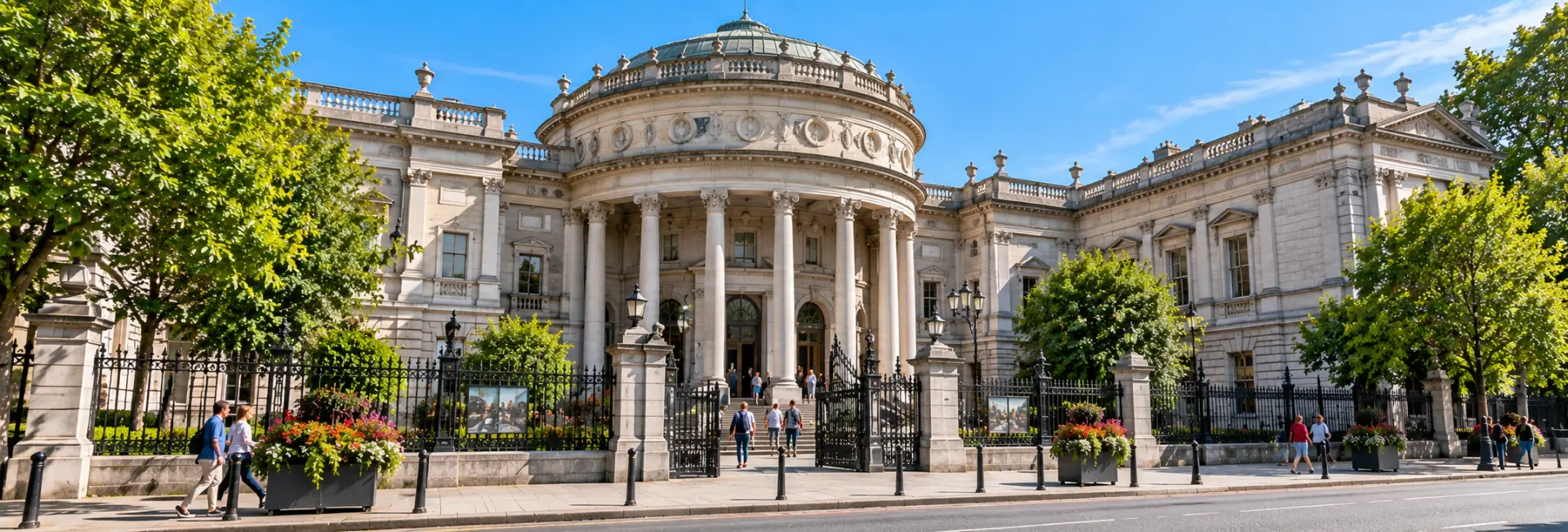
The museum occupies a grand late 19th-century building on Kildare Street, distinguished by a domed rotunda entrance hall that sets the tone for the treasures inside. Its architecture reflects the confidence of Victorian civic building, designed to impress visitors as much as to house the museum's growing collections.
- A domed rotunda entrance, often visitors' first striking impression of the building
- Galleries arranged broadly by period, guiding visitors from prehistory through to the medieval era
- A location on Kildare Street alongside the National Library of Ireland and Leinster House
Collections & Exhibits
The museum's core strength lies in its unbroken sweep of Irish material culture, from Stone Age tools through Bronze Age gold work to Viking and medieval artefacts. Its "Ór – Ireland's Gold" exhibition presents the finest collection of prehistoric gold objects in Europe, spanning roughly 2200 to 500 BC, while "The Treasury" gathers celebrated pieces of Celtic and medieval art in one dedicated space.
Other permanent exhibitions include "Kingship and Sacrifice," focused on Iron Age bog bodies and related ritual finds, and "Viking Ireland," built around discoveries from the museum's own excavations at Wood Quay in Dublin. A gallery on medieval Ireland from 1150 to 1550 rounds out the collection, alongside smaller displays of Ancient Egyptian, Cypriot and Roman material.
Must-See Highlights
- The Tara Brooch – an elaborately decorated Celtic brooch and one of Ireland's best-known archaeological finds
- The Ardagh Chalice – a masterpiece of early medieval metalwork and design
- The Derrynaflan Hoard – a collection of medieval ecclesiastical objects discovered in a Tipperary bog
- Iron Age bog bodies – remarkably preserved human remains displayed in the "Kingship and Sacrifice" exhibition
- The Faddan More Psalter – an early medieval manuscript recovered from a bog and painstakingly conserved
Ways to Experience It
Visitors are free to explore the galleries independently, following the collection roughly chronologically from prehistoric Ireland through to the medieval period. The museum also runs a regular programme of guided tours and talks, often free and requiring no advance booking, covering highlights of the collection or specific themes such as the Vikings in Ireland.
- Self-guided exploration of the permanent galleries
- Free guided tours offered on a scheduled basis throughout the year
- Workshops and talks aimed at both adults and school groups
- Temporary exhibitions on rotating historical and contemporary themes
Best Time to Visit
As a free, popular attraction in central Dublin, the museum can get busy with both tourists and school groups during weekday mornings and school holiday periods. Visiting on a weekday afternoon, or later in the museum's opening hours, tends to offer a quieter experience of the main galleries.
Opening hours differ across the week, with shorter hours on Sundays and Mondays compared with the rest of the week, so it's worth checking current times before planning a visit.
Visitor Tips
- Admission is free, though donations are welcomed to support the museum's work
- There is no on-site parking, but public car parks and disabled parking bays are available within a short walk
- Check the museum's current listings for free guided tours, which run on a set schedule and don't require booking
- Allow at least an hour or two to see the main highlights, longer if you want to explore every gallery in depth
Nearby Attractions
The museum sits in a cluster of major cultural and civic institutions in central Dublin.
- The National Library of Ireland – directly adjacent, sharing a similar Victorian design
- Leinster House – the seat of the Irish parliament, next door to the museum
- St Stephen's Green – a large public park a short walk to the south
- Trinity College and the Book of Kells – within easy walking distance to the north
- The National Gallery of Ireland – a short walk away via Merrion Square
FAQs about visiting the National Museum of Ireland – Archaeology
Is the National Museum of Ireland – Archaeology free to visit? +
Yes, admission is completely free, though donations are welcomed to help support the museum.
What are the must-see items in the collection? +
The Tara Brooch, the Ardagh Chalice, the Derrynaflan Hoard and the museum's Iron Age bog bodies are among its most famous and most visited exhibits.
How long should I plan to spend there? +
Most visitors spend one to two hours seeing the main highlights, though history enthusiasts could easily spend half a day exploring every gallery in detail.
Are there guided tours available? +
Yes, the museum runs a regular schedule of free guided tours and talks throughout the year, generally on a first-come, first-served basis without advance booking.
Is the museum suitable for children? +
Yes, it's a popular destination for families and school groups, with accessible displays and dedicated learning resources aimed at younger visitors.
Is there parking near the museum? +
There's no on-site parking, but public car parks and some accessible parking bays are available within easy walking distance.
What else is nearby worth visiting? +
The National Library of Ireland sits right next door, with Trinity College, St Stephen's Green and the National Gallery of Ireland all within easy walking distance.
What's a common mistake visitors make? +
Rushing through in a single pass: the collection rewards slower viewing, and many visitors find it worth returning to specific galleries, such as the bog bodies or prehistoric gold, for a closer look.
