
Table of Contents
Overview
Temple Bar is the tight knot of cobbled streets on the south bank of the River Liffey that most visitors picture when they imagine Dublin's nightlife. Bounded by the river, Dame Street, Westmoreland Street and Fishamble Street, it packs galleries, theatres, markets and a dense cluster of pubs into a compact, walkable area at the heart of the city.
Long before it became a byword for a night out, Temple Bar was Dublin's most run-down quarter, saved from demolition in the 1990s and rebuilt as an official cultural district. That history still shapes the area today, where independent arts venues sit alongside the bars and buskers that draw the bigger crowds.
History
Origins of the Name
The area likely takes its name from Sir William Temple, a 17th-century provost of Trinity College Dublin who kept a house and garden here; some accounts also point to a possible echo of London's own Temple Bar. The earliest known map reference to the name dates to 1673, by which point the area had developed as a riverside district just outside the old city walls.
Decline and Near-Demolition
Temple Bar's fortunes faded through the 19th and 20th centuries, leaving many of its buildings derelict. In the 1980s, the state transport company drew up plans to demolish much of the area for a new bus depot, and while properties awaited purchase they were let out cheaply, which drew in small shops, artists and galleries. Public opposition to the bus depot plan ultimately led to its cancellation.
Reinvention as a Cultural Quarter
In 1991, the government established a dedicated company to redevelop the area under new legislation, backed by significant European Union funding, transforming Temple Bar into Dublin's officially designated cultural quarter. That regeneration, marking its 35th anniversary in 2026, is widely credited with saving the district's historic streetscape while turning it into one of the city's busiest cultural and economic hubs.
Architecture & Streetscape
Unlike much of central Dublin, Temple Bar has kept its medieval street pattern largely intact, with narrow, winding, cobbled lanes that feel distinct from the wider Georgian layout surrounding it. Much of the visible building stock dates from the 18th and 19th centuries, including former warehouses and townhouses now converted into shops, studios and bars.
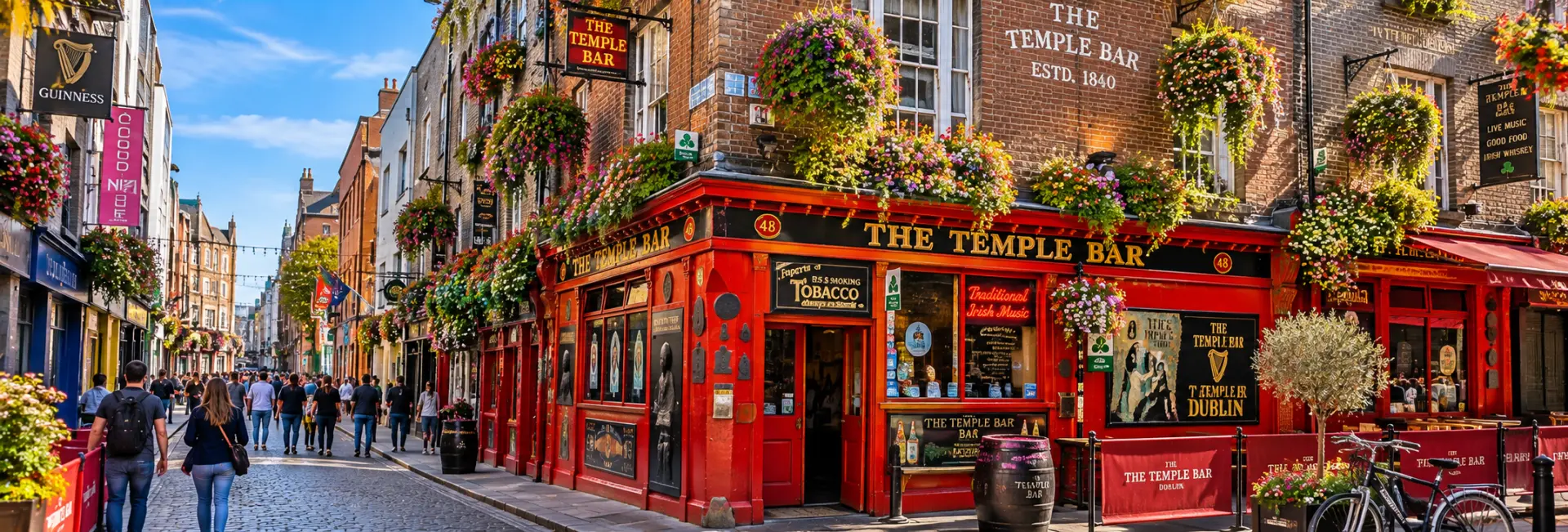
The area's colourful shopfronts, painted pub exteriors and street art have become part of its visual identity, particularly along streets like Fownes Street and Crown Alley, while quieter Georgian buildings on streets such as Eustace Street hint at the district's less rowdy past.
Key Areas
- Meeting House Square – an open public square used for markets, film screenings and outdoor performances
- Eustace Street – home to cultural institutions including the Irish Film Institute and The Ark children's cultural centre
- Fishamble Street – Dublin's oldest street, and the site of the first performance of Handel's Messiah in 1742
- Cow's Lane – known for its design-focused shops and weekend market
- Temple Bar Square and Crown Alley – dense with bars, shops and street performers
Notable Landmarks
The area's single most photographed spot is likely the Temple Bar pub, a red-fronted 19th-century building on the corner of Temple Lane South that has become an informal symbol of the district. Beyond it, a cluster of cultural venues gives the area its "quarter" identity as much as its pubs do.
- The Ark – a dedicated cultural centre for children
- Irish Film Institute – an independent cinema and archive
- Temple Bar Gallery + Studios – artist studios and exhibition space
- Gallery of Photography Ireland – dedicated to photographic art
- Project Arts Centre – a venue for contemporary theatre and performance
Ways to Experience It
Temple Bar rewards slow wandering as much as any single itinerary, but its markets, galleries and live performances give structure to a visit beyond the pubs. Weekend markets at Meeting House Square and Cow's Lane are a good way to see the area's creative side, while the Irish Film Institute and Project Arts Centre offer a quieter alternative to the bar scene.
- Weekend food and design markets around Meeting House Square and Cow's Lane
- Live traditional and contemporary music in bars throughout the area
- Independent cinema at the Irish Film Institute
- Walking tours covering the area's history and architecture
- Special events and festivals staged throughout the year, including anniversary programming marking the area's 1991 regeneration
Best Time to Visit
Temple Bar's character shifts dramatically over the course of a day. Mornings and early afternoons are relatively calm, better suited to exploring galleries, markets and cafés, while evenings, especially Friday and Saturday nights, bring large crowds drawn to the area's pubs and live music.
Visiting on a weekday or earlier in the day is the simplest way to see the district's quieter, more cultural side, while weekend evenings are the time to experience its nightlife reputation at full volume.
Visitor Tips
Temple Bar's popularity means prices in its pubs and restaurants tend to run higher than elsewhere in Dublin, so it's worth checking menus before sitting down if budget is a concern. The cobbled streets can be uneven and slippery when wet, so comfortable, sturdy footwear is worthwhile.
- Expect premium pricing at bars directly on the main tourist strips
- Weekend evenings get very crowded, particularly around big sporting or public events
- Check listings for Meeting House Square and Cow's Lane markets, which don't run every day
- Keep an eye out for seasonal festivals and cultural programming layered on top of the area's usual nightlife
FAQs about visiting Temple Bar
What is Temple Bar known for? +
It's best known as Dublin's cultural quarter, a compact area of cobbled streets combining galleries, theatres and markets with some of the city's busiest pubs and live music venues.
Is Temple Bar expensive? +
Pubs and restaurants directly in the busiest parts of Temple Bar tend to charge more than elsewhere in Dublin, so it's worth comparing prices, or heading a few streets further out, if cost is a concern.
Is Temple Bar worth visiting during the day? +
Yes, daytime is a good time to see the area's galleries, markets and quieter streets before the evening crowds arrive, offering a very different experience from its nightlife reputation.
What markets are held in Temple Bar? +
Meeting House Square and Cow's Lane both host weekend markets covering food, design and vintage goods, though schedules vary, so it's worth checking current listings before you go.
Is Temple Bar suitable for families during the day? +
Yes, daytime visits work well for families, with attractions like The Ark children's cultural centre and the area's markets and street performers, though the atmosphere shifts considerably once evening pub crowds build up.
How did Temple Bar become Dublin's cultural quarter? +
After plans to demolish much of the area for a bus depot were shelved in the 1980s, a dedicated redevelopment company was set up in 1991 with EU backing to regenerate Temple Bar as an official cultural district, a transformation the area marks the anniversary of in 2026.
What's within walking distance of Temple Bar? +
Trinity College, Dublin Castle, Christ Church Cathedral and the Ha'penny Bridge are all a short walk away, making Temple Bar a convenient base for exploring the surrounding historic core of the city.
What's a common mistake visitors make? +
Judging the whole area by its busiest evening pub strip: Temple Bar also has a genuine cultural side, with galleries, cinema and markets that are easy to miss if you only pass through at night.
