
Table of Contents
Overview
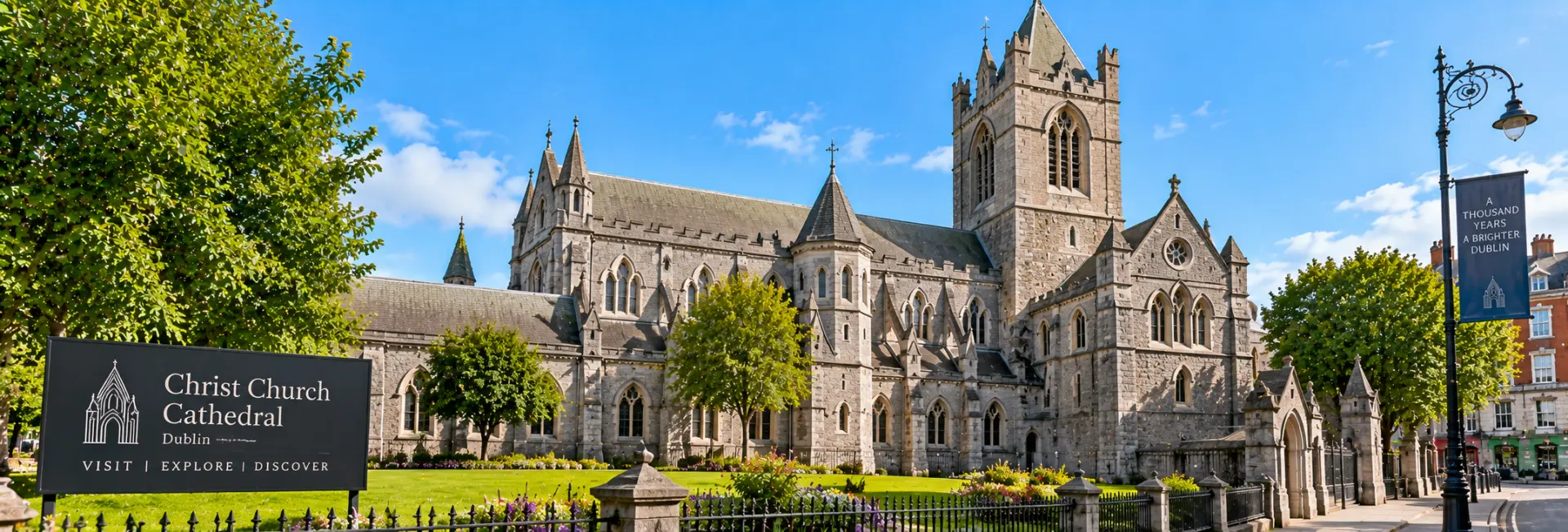
Christ Church Cathedral is the older of Dublin's two medieval cathedrals, founded in the early 11th century by the Viking king of Dublin and rebuilt in stone under the Norman lord known as Strongbow. Perched on a hill above Wood Quay, its Gothic exterior and flying buttresses make it one of the most recognisable landmarks in the city's historic core.
Below the main body of the cathedral lies its oldest surviving section, a vast 12th-century crypt that ranks among the largest of its kind in Britain and Ireland. Together with the tomb of Strongbow himself and centuries of continuous worship, it gives Christ Church a claim to being the spiritual heart of medieval Dublin.
History
Viking Foundations
Christ Church was founded around 1030 under Sigtrygg Silkbeard, the Norse-Gaelic king of Dublin, working with an early bishop named Dúnán. The first building was a modest wooden church, reflecting the settlement's Viking roots rather than the grand cathedral that would later rise on the site.
Norman Rebuilding
Following the Anglo-Norman invasion of Ireland, the cathedral was rebuilt in stone in the late 12th century, largely at the instigation of Richard de Clare, Earl of Pembroke, better known as Strongbow. Further enlargement in the early 13th century, using stone and craftsmen brought over from Somerset in England, gave the cathedral much of its Gothic character.
Collapse and Victorian Restoration
Structural problems plagued the medieval building for centuries, culminating in a partial collapse of the nave in the 16th century that left the building visibly out of alignment, a quirk still noticeable today. A major Victorian restoration in the 1870s, funded by the whiskey distiller Henry Roe and led by architect George Edmund Street, rebuilt large portions of the cathedral and added many of the external features, including its flying buttresses, that define its current appearance.
Architecture & Design
Christ Church combines Romanesque and Gothic elements reflecting its long, layered construction history, with pointed arches, ribbed vaulting and elaborate stonework throughout the nave. Its hilltop position and flying buttresses make it one of the most photographed exteriors among Dublin's historic buildings.
- The nave – rebuilt extensively in the 19th century, with a visible lean inherited from earlier structural collapse
- The choir and chancel – the ceremonial heart of the cathedral, used for regular services
- A covered bridge linking the cathedral to the former Synod Hall, now home to the Dublinia museum
- The bell tower, which houses one of the largest ringing peals of bells in the world
Notable Features
The Crypt
Dating to the 12th century, the crypt beneath Christ Church is the oldest surviving structure in Dublin and one of the largest cathedral crypts in Britain or Ireland. It houses historical artefacts and curiosities, including old stocks once used for punishment and statues of English monarchs, alongside the cathedral's treasury collection.
Strongbow's Tomb
A large stone monument in the nave is traditionally identified as the tomb of Strongbow, the Anglo-Norman lord whose invasion reshaped medieval Ireland and who was instrumental in rebuilding the cathedral in stone. It remains one of the most visited features inside the building.
The Mummified Cat and Rat
Among the crypt's more unusual exhibits are the preserved remains of a cat and rat, discovered trapped mid-chase inside an old organ pipe. The pair have become an enduring, slightly macabre curiosity for visitors and were referenced by James Joyce in his writing.
Cultural & Religious Significance
Christ Church serves as the cathedral of the Diocese of Dublin and Glendalough within the Church of Ireland, making it, technically, the seat of the Archbishop of Dublin, distinct from the nearby St. Patrick's Cathedral, which holds National Cathedral status. This dual arrangement, unusual for a single city, reflects centuries of overlapping ecclesiastical history in medieval and early modern Dublin.
The cathedral remains an active centre of worship and music, with resident choirs performing choral services through the year. Looking ahead to its approaching one-thousandth anniversary, the cathedral has also launched a long-term fundraising campaign aimed at conserving the building for future generations.
Visiting Etiquette & Tips
As a working place of worship, Christ Church asks visitors to be respectful during services, when access for sightseeing may be limited to certain areas. Modest dress is appreciated, and quiet behaviour is expected throughout, particularly in the crypt and near the tombs.
- Guided tours typically include access to the belfry, reached by more than 80 narrow, steep steps
- Children under a certain age are usually not permitted in the belfry, so check current rules if travelling with young kids
- An admission fee applies for sightseeing, with reduced rates for children, students and seniors
- Evensong services, usually held midweek and on Sunday afternoons, are open to visitors free of charge
Best Time to Visit
Mornings tend to be the quietest time to explore the cathedral and crypt before larger tour groups arrive later in the day. As one of Dublin's most visited attractions, queues can build up at peak times, so booking tickets in advance is worth considering, particularly in summer.
The cathedral's Christmas season events, including candlelit carol services, are a popular and atmospheric time to visit, though they draw larger crowds than an average visit.
Nearby Attractions
Christ Church sits at the centre of Dublin's medieval quarter, within easy reach of several other historic sights.
- Dublinia – a museum on Dublin's Viking and medieval history, connected to the cathedral by a covered bridge
- Dublin Castle – a historic government complex a short walk away
- St. Patrick's Cathedral – Dublin's other medieval cathedral, a few minutes on foot
- Temple Bar – Dublin's cultural and nightlife quarter, just across Dame Street
- Wood Quay – the site of major Viking archaeological excavations, next to the cathedral
FAQs about visiting Christ Church Cathedral
What is Christ Church Cathedral known for? +
It's known as Dublin's oldest cathedral, founded by a Viking king, and for its medieval crypt, the tomb traditionally attributed to the Norman lord Strongbow, and the preserved remains of a cat and rat found in its organ pipes.
Is Christ Church Cathedral free to visit? +
There is an admission charge for sightseeing visits, though attending a regular service, such as evensong, is generally free.
Can I visit the belfry? +
Yes, guided tours typically include access to the bell tower, though it involves climbing more than 80 steep, narrow steps and is usually not suitable for young children or visitors with limited mobility.
How long does a visit take? +
Most visitors spend around 45 minutes to an hour exploring the cathedral and crypt, longer if joining a guided tour that includes the belfry.
What's the difference between Christ Church and St. Patrick's Cathedral? +
Christ Church is technically the seat of the Archbishop of Dublin, while nearby St. Patrick's holds the separate status of National Cathedral of the Church of Ireland, an unusual arrangement of two cathedrals in one city.
Is Christ Church Cathedral suitable for kids? +
Yes, though the belfry climb usually has an age restriction, and younger children may find the crypt's historical detail more engaging with a guided tour or some background explanation.
What's nearby worth combining with a visit? +
Dublinia, connected directly by a covered bridge, Dublin Castle and Temple Bar are all within a short walk, making the cathedral a convenient stop while exploring medieval Dublin.
What's a common mistake visitors make? +
Skipping the crypt: it's included in standard admission and holds some of the cathedral's most memorable features, including the mummified cat and rat, so it shouldn't be missed even on a quick visit.
