
Table of Contents
Overview
Phoenix Park is a vast walled park on the western edge of Dublin's city centre, enclosing roughly 707 hectares behind an 11-kilometre perimeter wall, making it one of the largest enclosed parks in any European capital. Within its boundaries sit a working zoo, the residence of Ireland's president, a scattering of monuments, and a herd of wild fallow deer that has grazed its grasslands since the 17th century.
Originally laid out as a royal deer park, Phoenix Park has spent centuries balancing formal, ceremonial uses with everyday recreation, and today it functions as both a nature reserve on the edge of the city and one of Dublin's most-used open spaces for walking, cycling and sport.
History
Medieval and Royal Origins
The land that became Phoenix Park was granted in the 12th century to the Knights Hospitaller, a medieval religious order, before passing to the Crown following the dissolution of the monasteries under Henry VIII. In 1662, the Duke of Ormond, then Lord Lieutenant of Ireland, enclosed the land as a royal deer-hunting park, introducing the fallow deer whose descendants still roam it today.
Opening to the Public
The park remained a private hunting ground until 1745, when Lord Chesterfield, another Lord Lieutenant, opened it to the public and had the Phoenix Monument, a column topped by a mythical phoenix, installed near its centre. Over the following centuries it became the site of the Viceregal Lodge, home to the British administration's representative in Ireland, later repurposed as the official residence of the President of Ireland after independence.
A Park With Its Own History of Events
The park has witnessed dramatic moments alongside its quieter role as a recreational space, including a notorious 1882 political assassination and, almost a century later, an open-air Mass in 1979 attended by over a million people during a papal visit. It remains an active civic space today, hosting concerts, sporting fixtures and the occasional state occasion.
Flora & Fauna
Around 30 percent of Phoenix Park is covered by trees, including oak, ash, beech, horse chestnut and sycamore, interspersed with open grassland, wetland and small woodland areas that together support more than 20 distinct habitats. Botanists have recorded over 350 plant species within the park, including a few rare finds such as Hairy St John's Wort near the presidential residence.
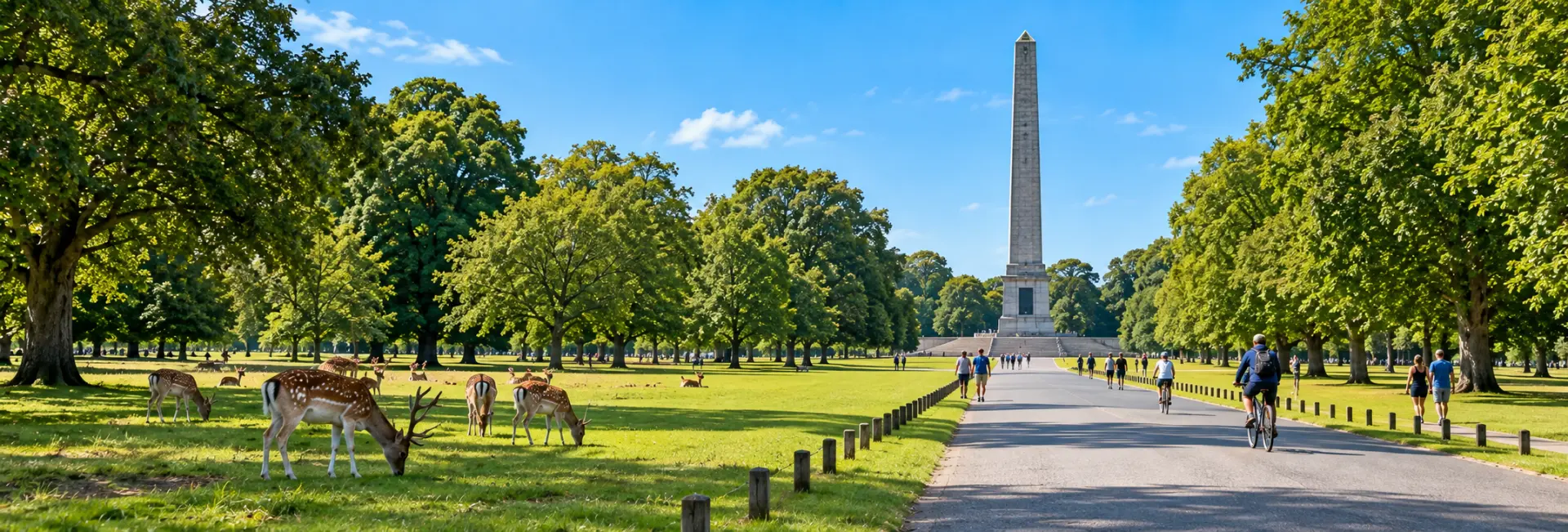
The park's best-known residents are its wild fallow deer, whose ancestors were introduced in the 17th century and which still roam freely across its open grasslands today. Birdwatchers have recorded more than 70 species within the park's boundaries, making it a notable pocket of biodiversity within the city.
Key Areas & Landmarks
- Áras an Uachtaráin – the official residence of the President of Ireland, built in 1754 and open for occasional public tours
- Dublin Zoo – one of the world's older zoos, home to more than 700 animals
- The Wellington Monument – a 62-metre obelisk, among the largest in Europe, commemorating the Duke of Wellington
- The Papal Cross – a 35-metre steel cross marking the site of the 1979 papal Mass
- Ashtown Castle – a restored 15th-century tower house that now houses the park's visitor centre
- The Fifteen Acres – a large open area used for sports, events and grazing deer, considerably bigger than its name suggests
Ways to Experience It
Phoenix Park is large enough to reward several different approaches, from a short stroll near the main gates to a full day spent cycling its network of roads and paths. The visitor centre at Ashtown Castle is a useful starting point, offering background on the park's history and wildlife before heading out to explore.
- Walking or cycling the park's network of roads and off-road paths
- Visiting Dublin Zoo, a separately ticketed attraction within the park
- Joining a tour of Áras an Uachtaráin, offered on selected days
- Spotting the wild deer herd, especially around dawn and dusk
- Using the park's shuttle bus service to cover longer distances between key sights
Best Time to Visit
Phoenix Park is open year-round, with its main gates accessible around the clock and side gates open from early morning into the evening. Spring and early autumn tend to offer the most comfortable conditions for walking or cycling, while a visit around dawn or dusk gives the best chance of seeing the deer herd active and visible.
Weekends can bring larger crowds near the main attractions, such as the zoo and visitor centre, so weekday visits generally mean a quieter experience of the park's open spaces.
Visitor Tips
- Wear comfortable footwear, as the park's paths and open ground can be uneven or muddy after rain
- Keep a respectful distance from the wild deer, which are free-roaming animals rather than a managed attraction
- Bring water and snacks for longer visits, as facilities are concentrated near the main gates and visitor centre
- Check ahead if you'd like to tour Áras an Uachtaráin, since access is limited to specific open days
Nearby Attractions
Phoenix Park sits just west of Dublin's city centre, within reach of several other notable sights.
- Dublin Zoo – located within the park itself
- Kilmainham Gaol – a former prison turned museum, a short distance south of the park
- The Guinness Storehouse – Dublin's brewing museum, a walk or short bus ride away
- Farmleigh – a historic estate and state guesthouse adjoining the park's northwestern edge
- Dublin city centre – easily reached on foot or by bus from the park's main gates
FAQs about visiting Phoenix Park
Is Phoenix Park free to visit? +
Yes, entry to the park itself is free, though attractions within it, such as Dublin Zoo, charge separate admission.
Can I see wild deer in Phoenix Park? +
Yes, a herd of wild fallow deer roams freely across the park's open grasslands, particularly around areas like the Fifteen Acres, and is most active in the early morning and evening.
How big is Phoenix Park? +
It covers around 707 hectares, or roughly 1,750 acres, making it one of the largest enclosed parks in any European capital city.
Is it possible to visit the President of Ireland's residence? +
Yes, Áras an Uachtaráin offers public tours on selected days, though access is limited and it's worth checking current availability before planning a visit.
How long should I plan to spend in the park? +
A short walk near the main gates can take under an hour, but exploring further afield, including the zoo or visitor centre, can easily fill half a day or more.
Is Phoenix Park suitable for cycling? +
Yes, the park has a network of roads and paths well suited to cycling, and bikes can be rented nearby for those without their own.
What's within walking distance of Phoenix Park? +
Kilmainham Gaol and the Guinness Storehouse are both a manageable walk or short bus ride away, making the park easy to combine with other Dublin sights.
What's a common mistake visitors make? +
Approaching or feeding the wild deer: they are free-roaming wild animals, not a petting attraction, and visitors are asked to keep a respectful distance for everyone's safety.
