
Table of Contents
Overview
St Stephen's Green sits at the top of Grafton Street in the very centre of Dublin, a 22-acre square of lawns, flowerbeds and tree-lined paths ringed by Georgian townhouses. It is the largest of the city's Georgian garden squares and one of Dublin's most-visited free attractions, drawing office workers on lunch breaks, students, and travellers alike.
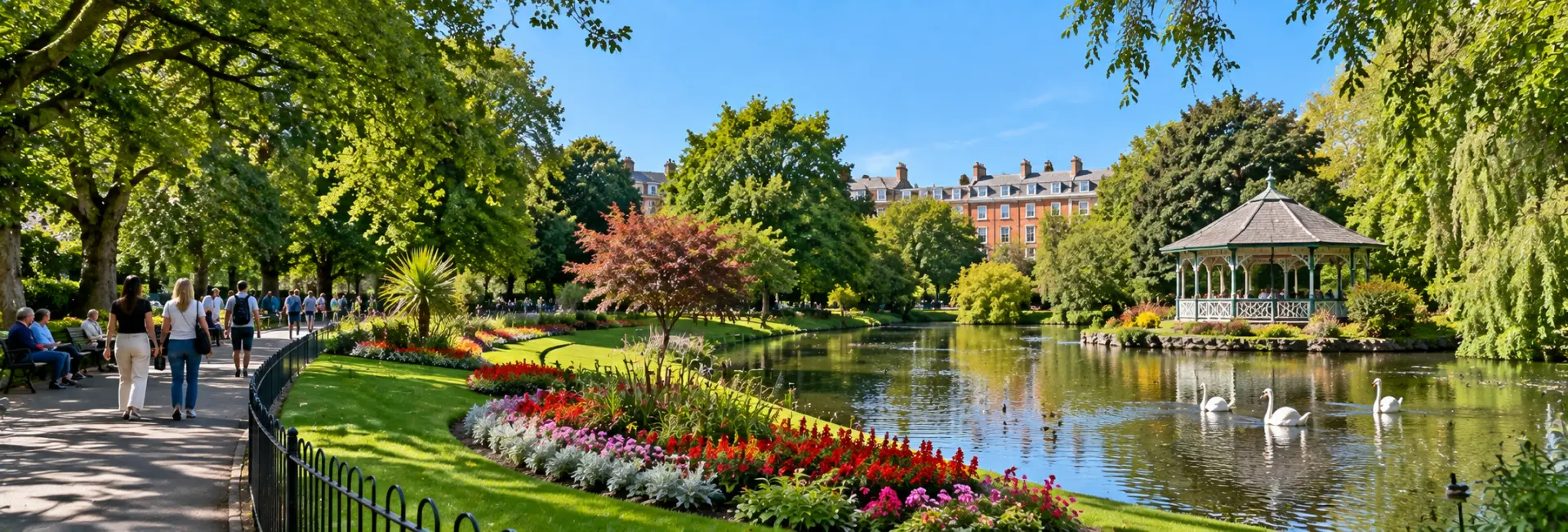
What makes the Green more than a pleasant patch of grass is the layer of Irish history built into it. Its paths pass Victorian rockwork, a lake used by swans and other waterfowl, and more than a dozen statues and memorials commemorating poets, patriots and pivotal moments in Ireland's past, including the 1916 Easter Rising. A protected National Monument, it is managed year-round by the Office of Public Works.
History
From Common Ground to Enclosed Green
Long before it was a park, the land now occupied by St Stephen's Green was open, marshy common ground on the edge of the old city, used for grazing livestock. In 1663, Dublin's civic authorities set out to turn this common into a source of income: a central area of 27 acres was marked off as a green, while the surrounding land was divided into building plots and sold or leased off. Tenants who took on those plots were required to help fund a boundary wall and were even obliged to plant trees along it, which helped establish the enclosed, private character the Green held for the next two centuries.
A Private, Fashionable Square
Access to the Green itself was restricted to key-holding residents of the surrounding houses. As grand Georgian townhouses replaced the original modest buildings during the 18th century, the square became a magnet for Dublin's wealthy, who paraded along its tree-lined walks in their finest clothes. Control of the Green passed to a body of local Commissioners in 1814, who replaced its walls with railings, but public access still was not granted.
The Victorian Green and 1916
The Green as it looks today dates from a major re-landscaping carried out in the late 1870s under designer William Sheppard and contractors Pulham and Sons, funded personally by brewer Arthur Guinness, later Lord Ardilaun. Guinness then passed the finished park to Dublin Corporation, and on 27 July 1880 it was formally reopened, for the first time, to the public of Dublin. A statue of Ardilaun was later placed in the park in gratitude. Less than four decades on, the Green found itself on a battlefield: during the 1916 Easter Rising, Irish Citizen Army volunteers under Michael Mallin and Constance Markievicz occupied the park and dug trenches, only to be forced back when British troops took up firing positions in surrounding buildings, including the nearby Shelbourne Hotel.
That mix of eras is part of what makes a walk through the Green rewarding today: the same paths that once belonged to key-holding Georgian residents now carry office workers, tourists and schoolchildren, and the monuments dotted among the flowerbeds mark everything from 18th-century rebellion to a 20th-century street battle fought just metres from where visitors now sit and eat lunch.
Design & Layout
The Green's Victorian layout survives largely intact today. Cast-iron railings on granite plinths enclose a rectangular park criss-crossed by more than 3.5 kilometres of paths, with sweeping lawns, a long herbaceous border, and flowerbeds that are replanted through the seasons to keep colour in the park from early spring into late autumn.
The Lake and Rockwork
An ornamental lake fills much of the northern half of the park, crossed by a stone bridge named for Daniel O'Connell and home to swans and other waterfowl. On the western side, Pulham-built rockwork and a small waterfall form one of the park's quieter, more picturesque corners.
Bandstand, Playground and Sensory Garden
A Victorian bandstand from 1887 stands south of the park's central flowerbeds and still hosts free lunchtime concerts on summer weekdays. Elsewhere in the park, a children's playground offers separate play areas for younger and older children, while a dedicated Garden for the Blind uses Braille signage and scented, textured planting to make the space accessible to visually impaired visitors.
Historic ironwork runs the length of the perimeter, too: the boundary railings sit on low granite plinths topped with spearhead finials, and much of the original bollard-and-chain edging along the surrounding footpath has survived, a reminder that the park's Victorian makeover extended down to its smallest details, not just its lawns and lake.
Statues & Monuments
Around fifteen statues and sculptural memorials are scattered through the Green, making a slow circuit of the park something of a walk through Irish history.
- Fusiliers' Arch, at the Grafton Street entrance, commemorates members of the Royal Dublin Fusiliers who died in the Second Boer War; its unpopularity with some nationalists earned it the nickname "Traitors' Gate."
- The Wolfe Tone Memorial, sculpted by Edward Delaney and unveiled by President Éamon de Valera in 1967, honours Theobald Wolfe Tone, leader of the 1798 rebellion; its backdrop of rough-hewn granite slabs has been nicknamed "Tonehenge."
- A memorial sculpture group nearby recalls the Great Famine, echoing the stark stone style of the Tone monument.
- The Yeats Memorial Garden holds a Henry Moore bronze, often called the "standing figure," dedicated to poet W. B. Yeats.
- A bronze bust commemorates novelist James Joyce, who set scenes of his work in and around the Green.
- A limestone fountain near the Leeson Street entrance was a gift from the people of Germany, in thanks for Irish assistance to refugee children after the Second World War.
Not every monument from the park's past has survived: a statue of King George II once stood at its centre but was destroyed by a bomb in 1937 and was never replaced.
Flora & Wildlife
St Stephen's Green is planted with around 750 trees, and its beds are replanted through the year so that something is usually in flower from spring through autumn. The long herbaceous border is one of the park's showpieces, giving a steady run of colour across the warmer months.
The lake and its margins support a small resident population of swans, ducks and other waterfowl, a longtime favourite with children visiting the park. Away from the water, the mature tree canopy and lawns provide shelter for songbirds and a green, shaded contrast to the surrounding city streets.
Ways to Experience It
Self-Guided Walking
Most visitors simply walk in through the Fusiliers' Arch on Grafton Street and follow the paths at their own pace, taking in the lake, gardens and statues along the way. A free official audioguide can be downloaded before a visit for those who want more context on what they are passing.
Guided Tours
Specialist guided tours of the Green can be arranged in advance through the Office of Public Works for small groups, and the neighbouring Little Museum of Dublin runs regular weekend-morning walking tours that take in the park as part of a wider look at the surrounding area.
Events and Everyday Use
In summer, free lunchtime concerts at the bandstand draw office workers and passers-by, while the lawns fill with people picnicking or simply resting between errands. The children's playground and sensory garden make the park a practical stop for families, not only a sightseeing spot.
Because it sits directly off Grafton Street, the Green also works well as a short breather slotted into a longer day of sightseeing or shopping rather than a destination in its own right, and many visitors simply cut through it on the way between the city's shopping district and the Georgian squares to the south and east.
Best Time to Visit
St Stephen's Green is open every day of the year and costs nothing to enter, so timing a visit is mostly about weather, light and crowds rather than opening dates. Spring and summer show the park at its most colourful, with the herbaceous border and seasonal bedding in full bloom and a livelier atmosphere from lunchtime concerts and visitors sitting out on the lawns.
The park opens at 7:30am from Monday to Saturday and 9:30am on Sundays and bank holidays, closing at dusk; because dusk shifts through the year, closing time can be as early as mid-afternoon in December and as late as around 9:30pm in midsummer, so it is worth checking the current closing time before planning an evening visit. Early mornings and weekday visits tend to be quieter, while a typical visit lasts one to two hours.
Visitor Tips
- Admission is free, and no ticket or booking is needed for a general visit.
- Closing time changes with the seasons, so check the current time before an evening walk to avoid being asked to leave early.
- Dogs are welcome on a lead but are not permitted in the playground or around the lake and fountains.
- The nearest stop on the Luas tram Green Line is named "St Stephen's Green," and numerous Dublin Bus routes serve the surrounding streets.
- Wear layers and bring a light rain jacket; Dublin's weather can change quickly even on a sunny day.
- Combine a visit with Grafton Street, which runs directly off the park's northwest corner, for shopping and street performers.
Nearby Attractions
The Green's location at the top of Grafton Street puts several of Dublin's best-known sights within easy walking distance. Grafton Street itself, one of the city's main shopping and pedestrian streets, runs north from the park's Fusiliers' Arch entrance.
- Little Museum of Dublin, a short walk away, tells the story of 20th-century Dublin inside a Georgian townhouse.
- Trinity College Dublin, home to the Book of Kells and the Long Room library, is a few minutes' walk to the north.
- The Iveagh Gardens, a quieter and lesser-known park, lie just to the south and include the city's only public waterfall.
- Stephen's Green Shopping Centre sits directly across from the park's northwest corner.
- The Shelbourne Hotel, overlooking the Green's north side, played a role in the events of the 1916 Rising and remains one of Dublin's most storied hotels.
FAQs about visiting St Stephen's Green
Is St Stephen's Green free to visit? +
Yes. It is a public park with no entrance fee, open to everyone every day of the year.
What are the opening hours? +
The park opens at 7:30am Monday to Saturday and 9:30am on Sundays and bank holidays, then closes at dusk, which can mean anywhere from mid-afternoon in winter to around 9:30pm in midsummer, so it is worth checking the current closing time before an evening visit.
How long should I plan for a visit? +
Most visitors spend one to two hours walking the paths, viewing the statues, and resting by the lake or on the lawns, though a quick pass-through can take as little as fifteen minutes.
What is St Stephen's Green best known for? +
It is best known as Dublin's grandest Victorian public park, for its ornamental lake and statues of figures like James Joyce and W. B. Yeats, and for the role it played in the 1916 Easter Rising.
Are dogs allowed in the park? +
Dogs are allowed on a lead in most of the park but are not permitted in the children's playground or around the lake and fountains.
How do I get to St Stephen's Green? +
The park sits at the top of Grafton Street in Dublin's city centre; the Luas Green Line tram stop named "St Stephen's Green" is right beside it, and many Dublin Bus routes stop nearby.
What can I combine a visit with? +
The park pairs naturally with a walk down Grafton Street, a stop at the Little Museum of Dublin, or a visit to Trinity College and the Book of Kells, all within a few minutes on foot.
