
Table of Contents
Overview
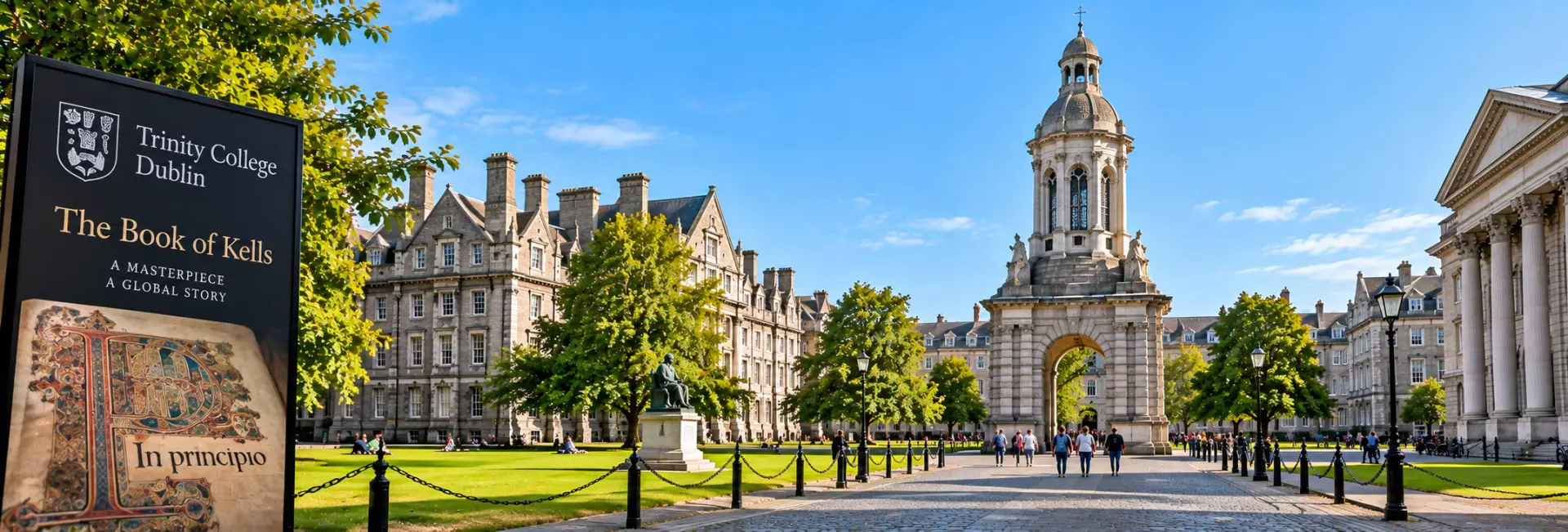
Trinity College Dublin is Ireland's oldest university, founded by royal charter in 1592 and still occupying its original site at College Green in the heart of the city. Behind its cobbled quads and Georgian facades sits one of Europe's great cultural landmarks: the Book of Kells, a richly illuminated 9th-century gospel manuscript that draws visitors from around the world.
Beyond the manuscript itself, the campus is worth exploring in its own right, with grand squares, a working chapel and examination hall, and centuries of academic history connected to figures from Jonathan Swift to Samuel Beckett. A major, multi-year conservation project is currently reshaping how the Book of Kells and the college's historic library are presented to visitors, so it's a particularly interesting time to visit.
History
Founding and Early Years
Trinity College was established in 1592 under a royal charter from Queen Elizabeth I, built on the site of a dissolved Augustinian priory just outside the old city walls. It was modelled on the collegiate universities of Oxford and Cambridge, though unlike them only a single college was ever founded, so "Trinity College" and the "University of Dublin" are, in practice, one and the same institution.
Growth and Reform
For much of its history, Trinity was closely tied to the Protestant Ascendancy, and restrictions on Catholic students remained in place for centuries. Reforms gradually opened admission more widely, with women first admitted in 1904. Over the 18th and 19th centuries the college expanded steadily, adding the squares, library and academic buildings that still define its campus today.
A Centre of Irish Intellectual Life
Trinity's alumni roll reads like a survey of Irish letters and science, including writers Jonathan Swift, Oscar Wilde, Bram Stoker and Samuel Beckett, philosophers George Berkeley and Edmund Burke, and mathematician William Rowan Hamilton. Several Irish presidents also studied here, reflecting the college's long, sometimes complicated, relationship with the country's political and cultural life.
Campus & Architecture
Trinity's campus spreads across roughly 47 acres in central Dublin, entered through the Front Arch on College Green beneath the college's 19th-century Campanile bell tower. Parliament Square, the first and grandest of the college's quadrangles, is lined with 18th-century buildings including the Chapel and the Public Theatre, or Examination Hall, both used for ceremonies and events.
- The Rubrics – a row of red-brick buildings dating to around 1700, among the oldest structures on campus
- The Museum Building – a Victorian showpiece known for its elaborate stone carving and mosaic floors
- Front Square and Library Square – linked quadrangles at the historic centre of the college
- The Printing House – an 18th-century building by architect Richard Cassels, recently restored as part of the wider library conservation project
Modern buildings, including the Berkeley Library and the Science Gallery, sit alongside these older structures, reflecting a campus that has continued to grow while keeping much of its historic core intact.
The Book of Kells & Old Library
The Book of Kells is an illuminated manuscript of the four Gospels, created by monastic scribes around the 9th century and renowned for the intricacy and colour of its decoration. Long associated with the monastery of Iona in Scotland before making its way to Ireland, it has been kept at Trinity since the 17th century and is considered one of the finest surviving examples of medieval European book art.
The manuscript's traditional home is the Old Library, an 18th-century building whose Long Room, a barrel-vaulted hall lined with towering shelves of historic books, is regarded as one of the world's most striking libraries. The Old Library is currently the subject of a major, multi-year conservation project to protect the building and its collections, meaning the Long Room itself is closed to the public while works are under way and its books are carefully relocated for safekeeping.
During this period, the Book of Kells remains on public display through a temporary "Book of Kells Experience," combining the manuscript with an immersive exhibition on its history, housed in a purpose-built space on campus. Given the scale and multi-year timeline of the works, visitors should check current arrangements before travelling, as the exact display location and access to the Long Room are expected to change again as the project progresses.
Ways to Experience It
Most visitors combine two elements: a look at the historic campus itself, which can be explored on foot at no charge, and a ticketed visit to the Book of Kells Experience. Guided walking tours of the college grounds are also available, often led by current Trinity students, and typically include entry to the Book of Kells exhibition as part of a combined ticket.
- Self-guided wander through the historic squares and courtyards, free of charge
- Ticketed entry to the Book of Kells Experience
- Guided campus walking tours, often combined with Book of Kells admission
- Occasional access to other collections and exhibitions staged around the conservation project
Best Time to Visit
Trinity's grounds are busiest in the middle of the day during peak summer months, when tour groups and day-trippers cluster around the main squares and the Book of Kells Experience. Arriving early in the morning, or later in the afternoon, generally means smaller crowds both on campus and at the exhibition entrance.
Outside the main tourist season, from autumn through spring, the college feels noticeably quieter, though it is also a working university, so term-time weekdays bring their own bustle of students moving between lectures.
Visitor Tips
Because the Old Library conservation project is ongoing, it's worth confirming the current Book of Kells display arrangements on Trinity's official visitor website shortly before you travel, since the location and ticketing details have changed more than once during the works and are likely to change again.
- Book Book of Kells Experience tickets online in advance to avoid queues, especially in summer
- Wear comfortable shoes for the cobbled quads, which can be uneven underfoot
- Remember the college is a working university, so some areas are restricted to staff and students during term time
- Allow extra time if you also want to see the Museum Building or wander College Park
Nearby Attractions
Trinity's location on College Green places it within walking distance of much of central Dublin's shopping, culture and history.
- Grafton Street – Dublin's best-known shopping street, just steps from the campus
- The National Gallery of Ireland and National Museum – a short walk via Merrion Square
- Dublin Castle – a historic government complex a few minutes' walk to the west
- Temple Bar – Dublin's lively cultural and nightlife quarter, just across the river Liffey
- The former Irish Houses of Parliament, now a Bank of Ireland branch, directly across College Green
FAQs about visiting Trinity College & the Book of Kells
What is the Book of Kells? +
It's an illuminated manuscript of the four Gospels, created by monastic scribes around the 9th century and famous for the intricacy and colour of its decorated pages, long held at Trinity College Dublin.
Can I see the Book of Kells in the Old Library right now? +
Not currently. The Old Library and its Long Room are closed to the public during a major, multi-year conservation project, and the manuscript is instead shown through a temporary Book of Kells Experience elsewhere on campus, so check Trinity's official visitor site for the current setup before you go.
Is it free to visit Trinity College? +
Walking around the historic squares and courtyards is free, but seeing the Book of Kells Experience requires a paid ticket, and guided campus tours are also ticketed.
How long should I plan to spend there? +
A visit to the Book of Kells Experience alone typically takes 45 minutes to an hour, while allowing time to also explore the campus grounds can easily stretch a visit to two hours or more.
Do I need to book tickets in advance? +
Booking online ahead of time is strongly recommended, particularly in summer, since the Book of Kells Experience has limited capacity and queues can be long for walk-up visitors.
Is Trinity College suitable for kids? +
Yes, the campus and exhibition are generally suitable for families, though younger children may find the historical detail more engaging with some guidance from an adult or a guided tour.
What's within walking distance of Trinity College? +
Grafton Street, the National Gallery of Ireland, Dublin Castle and Temple Bar are all a short walk away, making Trinity a convenient starting point for exploring central Dublin on foot.
What's a common mistake visitors make? +
Assuming the Book of Kells is still displayed in the famous Long Room: with the Old Library closed for conservation, the manuscript's location and the surrounding exhibition have changed during the works, so it's worth confirming current details rather than relying on older guides or photos.
