
Table of Contents
Overview
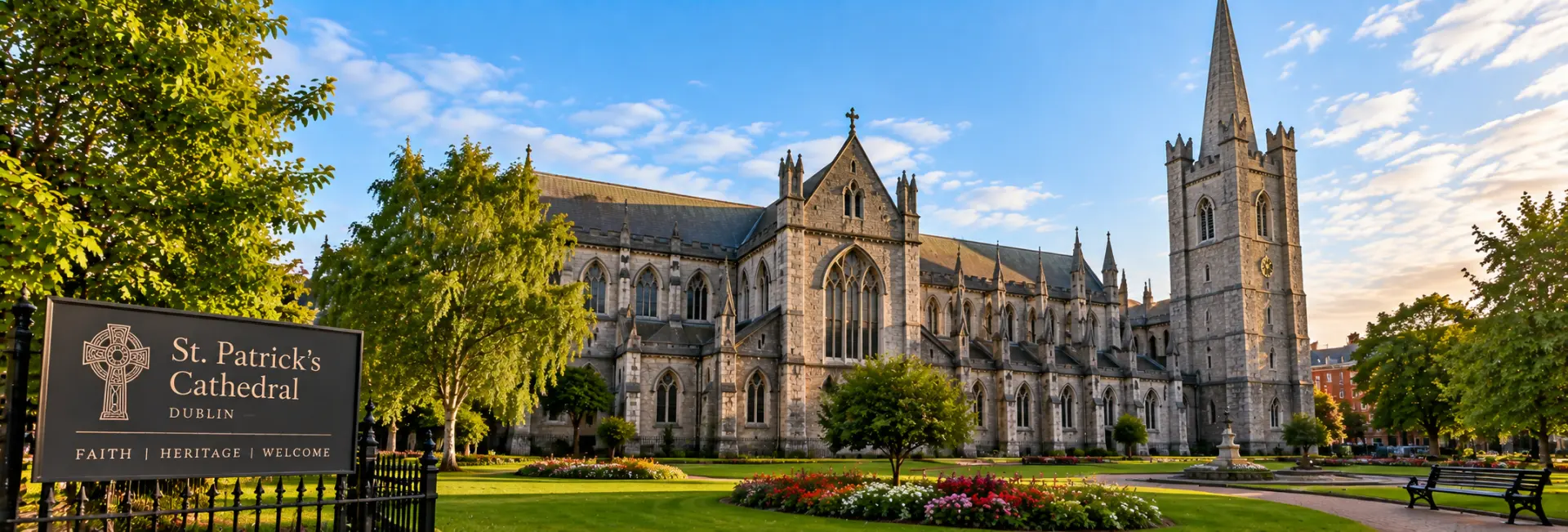
St. Patrick's Cathedral is Ireland's largest church, rising over the Liberties district of Dublin on a site tradition links to St. Patrick himself, who is said to have baptised converts at a well here in the 5th century. The present Gothic building dates largely to the 13th century and has served as the National Cathedral of the Church of Ireland since 1870.
Beyond its scale and architecture, the cathedral is closely tied to one of Ireland's best-known literary figures: Jonathan Swift, author of Gulliver's Travels, served as Dean here for over three decades and is buried within its walls. Its choir, one of the oldest in the country, still sings daily during the school term, giving the building a living connection to centuries of continuous worship.
History
Early Origins
A small church is thought to have stood on this site since at least the 9th century, close to a well where local tradition holds that St. Patrick baptised converts during his mission in the 5th century. Following the Norman arrival in Ireland, the existing timber church was rebuilt in stone, and in 1191 Archbishop John Comyn raised its status to that of a cathedral.
Medieval Construction and Growth
Most of the building visitors see today was constructed between 1220 and 1270, making it one of the few substantial survivals of medieval Dublin. Minot's Tower, the cathedral's main tower, was added in the 1370s under Archbishop Minot, with its distinctive spire following in the 18th century.
Decline and Victorian Restoration
Like many medieval buildings, the cathedral fell into disrepair over the centuries. A major restoration in the 1860s, funded by the brewing magnate Sir Benjamin Guinness, rescued the structure from serious decay and gave the building much of the appearance it retains today, alongside a set of bells later donated by the Guinness family.
Architecture & Design
St. Patrick's is built in the Gothic style typical of major medieval churches, with a long nave, pointed arches and ribbed vaulting running the length of the building. At roughly 90 metres from end to end, it remains the largest church in Ireland, its scale emphasised by Minot's Tower and spire rising some 43 metres above the surrounding streets.
- The nave – the long central body of the cathedral, lined with monuments and memorials
- Minot's Tower and spire – the cathedral's most recognisable external feature
- The Lady Chapel – a smaller chapel at the eastern end, used for quieter services
- Stained glass windows added during the Victorian restoration, illustrating biblical and historical scenes
Notable Features
The Baptistry
The baptistry is considered the oldest surviving part of the cathedral, believed to mark the entrance to the original medieval building. It retains 12th-century floor tiles and a medieval stone font that remains in occasional use for baptisms today.
Jonathan Swift and Stella
Jonathan Swift served as Dean of St. Patrick's from 1713 until his death in 1745, and is buried inside the cathedral alongside Esther Johnson, his close companion known as Stella, with Latin epitaphs he composed himself. Swift memorabilia displayed around the building includes his pulpit and death mask, reflecting his enduring association with the cathedral.
The Choir
The cathedral choir traces its origins to 1432, making it one of the oldest in Ireland, and continues to sing choral services during the school term, carrying a centuries-old musical tradition into the present day.
Cultural & Religious Significance
Since 1870, St. Patrick's has held the status of National Cathedral of the Church of Ireland, drawing representatives from dioceses across the country, even though it is not the seat of a bishop; that role belongs to nearby Christ Church Cathedral. The unusual presence of two cathedrals so close together reflects centuries of ecclesiastical history unique to Dublin.
The cathedral remains an active place of worship, hosting regular services alongside its role as one of Ireland's most visited historic sites. Its position at the heart of the Liberties, one of Dublin's oldest neighbourhoods, has made it a fixture of civic and cultural life well beyond its religious functions, from state ceremonies to recent community initiatives such as the restoration of its deanery mews for music and outreach programmes.
Visiting Etiquette & Tips
As a working cathedral, St. Patrick's asks visitors to be mindful during services, when sightseeing may be paused or restricted to certain areas. Modest dress is appreciated, and quiet, respectful behaviour is expected throughout, particularly near the tombs and memorials.
- Check service times in advance if you'd like to avoid, or specifically attend, a service during your visit
- Photography is generally permitted but should be discreet during acts of worship
- The cathedral floor is uneven in places underfoot, so comfortable shoes are worthwhile
- An admission fee applies for sightseeing visitors, with reduced rates for children, students and seniors
Best Time to Visit
Weekday mornings tend to be the quietest time to explore the cathedral, before tour groups and school parties tend to arrive later in the day. Attending choral evensong, held on most weekdays during term time, offers a different way to experience the building, combining sightseeing with its living musical tradition.
Visiting outside the busy summer season generally means smaller crowds, though the cathedral's Christmas services are a particularly popular, atmospheric time to visit if you don't mind larger congregations.
Nearby Attractions
St. Patrick's sits in the heart of the Liberties, one of Dublin's oldest districts, within walking distance of several other major sights.
- Marsh's Library – Ireland's oldest public library, standing directly beside the cathedral
- Christ Church Cathedral – Dublin's other medieval cathedral, a short walk away
- Dublinia – a museum exploring Dublin's Viking and medieval history, next to Christ Church
- Guinness Storehouse – the brewery's visitor attraction, a walk of about 15 minutes
- St. Patrick's Park – a green space beside the cathedral, popular for a break between sights
FAQs about visiting St. Patrick's Cathedral
Why is St. Patrick's Cathedral significant? +
It's Ireland's largest church, built on a site traditionally associated with St. Patrick's baptisms in the 5th century, and it's the final resting place of Jonathan Swift, one of Ireland's most famous writers.
Is St. Patrick's Cathedral free to visit? +
There is an admission charge for sightseeing visits, though attending a regular service is generally free, as the cathedral remains an active place of worship.
How long does a visit take? +
Most visitors spend around 45 minutes to an hour exploring the cathedral, longer if you plan to linger over the Swift memorials, the baptistry, or a guided tour.
Why are there two cathedrals in Dublin? +
St. Patrick's and Christ Church Cathedral have coexisted since medieval times, an unusual arrangement for one city; Christ Church is technically the seat of the Archbishop of Dublin, while St. Patrick's has served as the Church of Ireland's National Cathedral since 1870.
Can I hear the choir sing? +
Yes, the cathedral choir, one of the oldest in Ireland, sings choral services on most weekdays and Sundays during the school term, and visitors are welcome to attend.
Is the cathedral suitable for children? +
Yes, though younger visitors may get more out of the visit with some context on Swift and the building's history, which guided tours or an audio guide can help provide.
What else is nearby worth seeing? +
Marsh's Library sits right next door, Christ Church Cathedral and Dublinia are a short walk away, and the Guinness Storehouse is within easy walking distance for a longer day out.
What's a common mistake visitors make? +
Turning up during a service expecting a full sightseeing visit: parts of the cathedral may be closed to tourists while worship is under way, so it's worth checking service times if your visit is time-limited.
