
Table of Contents
Overview
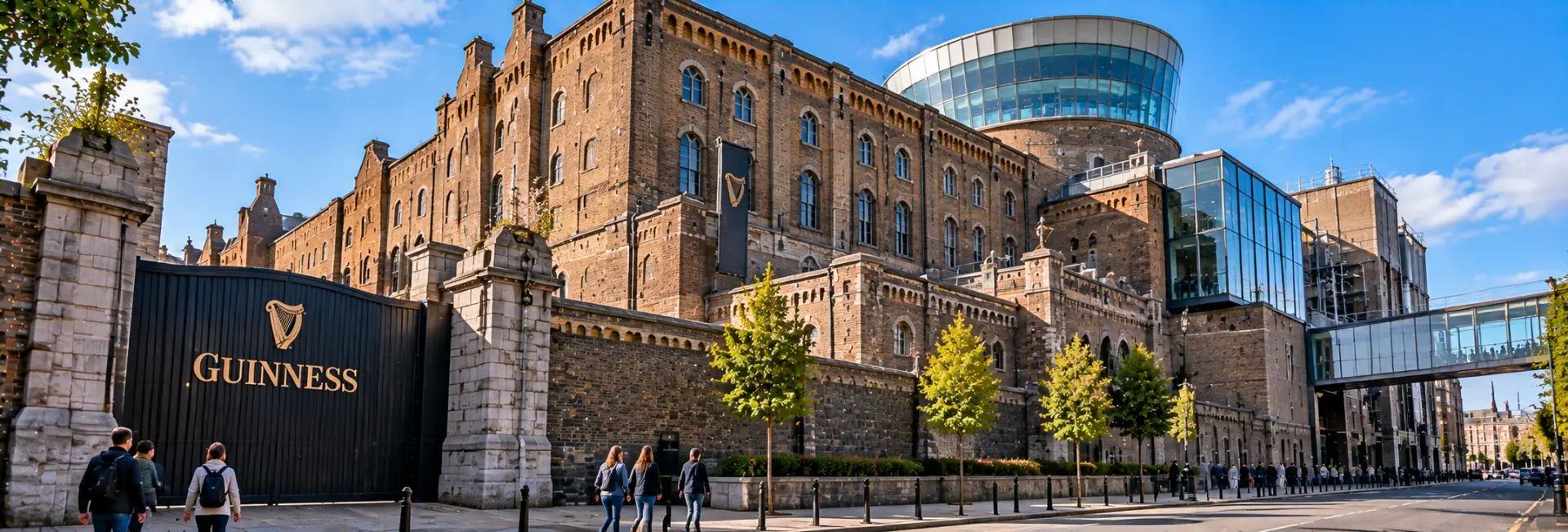
The Guinness Storehouse sits at St. James's Gate, the Dublin brewery where Arthur Guinness began producing his famous stout more than 260 years ago. Housed in a former fermentation plant, the Storehouse is a seven-floor visitor experience that walks guests through the ingredients, brewing process, advertising history, and global reach of one of Ireland's best-known exports, all built around a soaring central atrium shaped like a giant pint glass. The brewery sits in the Liberties, one of Dublin's oldest neighborhoods, an area long associated with brewing and distilling in the city.
It is consistently ranked among Ireland's most visited attractions, drawing millions of visitors since it opened in 2000. Beyond the exhibits, the building's top floor holds the Gravity Bar, where every ticket includes a complimentary pint of Guinness enjoyed against a 360-degree view of the city.
History
Arthur Guinness and the 9,000-Year Lease
Arthur Guinness signed a lease on the disused St. James's Gate brewery site on December 31, 1759, at just 34 years old, committing to an annual rent of £45 for a term of 9,000 years, a detail that has become part of the brand's origin story ever since. The site he took over covered about four acres and included a mill, two malthouses, and stabling for a dozen horses, a modest starting point for what would become one of the largest breweries in the world.
From Ale to Porter
Guinness began by brewing ale, but in the 1770s he started producing a dark, hopped beer style called porter, which had become popular in London. The new style caught on quickly, and by 1799 Guinness had brewed his last batch of ale, turning the brewery's full attention to porter and, later, the stronger stout style the brand remains known for today. Exports began soon after, with early shipments reaching England before the century was out, and by the mid-19th century Guinness barrels were traveling as far as South Carolina, Barbados, and Sierra Leone. A stronger export variant, sometimes called West Indies Porter, was developed specifically to withstand the long sea voyages to more distant markets, requiring a longer storage period before it was ready to ship.
Growth Into a Global Brand
Leadership of the brewery passed down through five generations of the Guinness family, and under their direction St. James's Gate became the largest brewery in Ireland by the 1830s and the largest in the world by the 1880s. The company registered its distinctive trademark, featuring the harp, Arthur Guinness's signature, and the Guinness wordmark, in 1876, cementing a visual identity still in use today. The harp itself was chosen as a deliberately Irish symbol, modeled on the 14th-century Brian Boru harp that remains on display at Trinity College Dublin, and it has since become one of the most widely recognized emblems associated with Ireland internationally.
From Fermentation Plant to Visitor Attraction
The building that now houses the Storehouse was constructed in 1904 as a fermentation plant, designed in a style influenced by the Chicago School of Architecture and notable as one of the first multi-story steel-framed buildings built in Ireland. It served that industrial purpose for most of the 20th century before being redeveloped into a visitor attraction, opening to the public in November 2000 following a major renovation of the historic structure. The redevelopment, reported to have cost around 42 million euros, converted a 113-year-old industrial building into a modern visitor experience while retaining much of its original architectural character.
The Building and Its Design
At the heart of the Storehouse is a vast central atrium, designed in the shape of a giant pint glass and rising through all seven floors of the building. Guinness has noted that filling the atrium with the stout it represents would take over 14 million pints, giving a sense of the building's scale. Visitors enter directly into the base of this glass-shaped void, with the exhibition floors arranged around its edges as the space narrows toward the top, mirroring the shape of a settling pint from bottom to head.
The building's steel-framed structure was considered architecturally advanced for its time, and much of the original industrial character has been preserved even as the interior was reworked into a modern exhibition space. Exposed brickwork, ironwork, and the building's original footprint remain visible throughout the visitor route, tying the experience back to the site's working brewery origins.
What's Inside
The seven floors of the Storehouse each cover a different part of the Guinness story, moving from raw ingredients up to the brand's advertising history and modern identity.
- Ingredients and brewing process: an introduction to the barley, hops, water, and yeast that go into Guinness, along with an explanation of how the stout is actually brewed
- Guinness Archive: a floor dedicated to historical documents and memorabilia from the brewery's long history, including material tracing the company's origins
- Advertising history: exhibits covering the brand's most famous marketing campaigns and slogans across the decades
- Tasting experience: a guided tasting designed to help visitors identify the flavors that define the stout
- Arthur's Bar and other dining spots: on-site pubs and cafes serving Guinness alongside Irish food throughout the visit
Self-guided tours let visitors move through the floors at their own pace, and audio guides are available in several languages for those who want more detail on individual exhibits.
The Gravity Bar
The visitor route ends on the seventh floor at the Gravity Bar, a circular, glass-walled bar offering a 360-degree panoramic view over Dublin. Every standard ticket includes a complimentary pint of Guinness, which most visitors drink while taking in the view, making it the traditional final stop of a Storehouse visit. The bar was expanded in a later renovation, roughly doubling its original size to accommodate the volume of visitors who make their way up through the building each day. On a clear day, the view extends across much of the city and out toward the surrounding hills, making it one of the more distinctive vantage points available to visitors in central Dublin.
Ways to Experience It
The Storehouse sits within easy walking distance of central Dublin, making it a straightforward stop to combine with a day exploring the city on foot.
- Self-guided tour: the standard visitor experience, moving through the seven floors at your own pace with a complimentary pint included at the end
- Guided tasting: a more structured session focused on identifying the flavors and brewing choices behind the stout
- Connoisseur experience: an upgraded ticket option that typically includes an extended tasting session with a wider range of Guinness products
- Arthur's Bar: an on-site pub serving pints and Irish food for visitors who want to linger after the main exhibits
- Gravity Bar views: the rooftop bar alone is worth timing for a clear day, when the panoramic view over Dublin is at its best
Best Time to Visit
The Storehouse is Ireland's most visited attraction, and it draws large crowds throughout the year, particularly around midday and during the busy summer months. Arriving close to opening time or later in the afternoon tends to mean shorter queues and a more comfortable pace through the exhibits, particularly on the lower floors where the self-guided route tends to be narrowest.
Because the experience is almost entirely indoors, it makes a reliable option regardless of Dublin's often unpredictable weather. The Gravity Bar's view is best on a clear day, so checking the forecast before a visit can help if the rooftop panorama is a priority.
Visitor Tips
- Book tickets online in advance, since the Storehouse regularly sells out, especially on weekends and during peak summer months
- Arrive near opening time to avoid the busiest midday crowds moving through the lower floors
- Bring ID if you plan to drink, since alcohol service throughout the building is restricted to the legal purchase age
- Set aside at least two hours for a full visit, more if you plan to eat on site or linger in the Gravity Bar
- Check the current opening hours before visiting, since they vary by day and season
- Consider walking to the Storehouse from central Dublin, since it's about twenty minutes from College Green and passes several other historic sights along the way
Nearby Attractions
The Storehouse sits in the Liberties, one of Dublin's oldest neighborhoods, within reach of several other major sights.
- Christ Church Cathedral: a medieval cathedral along the walking route between central Dublin and the Storehouse
- St. Patrick's Cathedral: Ireland's largest cathedral, a short walk from the brewery
- Kilmainham Gaol: a former prison turned museum, a short trip from the Storehouse and significant in Irish history
- Temple Bar: Dublin's well-known nightlife and cultural quarter, within walking distance of the brewery
FAQs about visiting the Guinness Storehouse
What is the Guinness Storehouse known for? +
It is known as the visitor attraction at Dublin's historic Guinness brewery, covering the stout's brewing process and history across seven floors and ending with a complimentary pint at the rooftop Gravity Bar.
How do you get to the Guinness Storehouse? +
It's about a twenty-minute walk from central Dublin, or reachable by the Luas red line to the James's stop, with taxis and buses also serving the area.
How long do you need to visit? +
Most visitors spend around two hours moving through the exhibits and enjoying their pint in the Gravity Bar, longer if dining on site.
Is the Guinness Storehouse free to visit? +
No, admission is ticketed, and booking online in advance is recommended since tickets regularly sell out.
Is a pint of Guinness included with the ticket? +
Yes, a standard ticket includes a complimentary pint of Guinness or a soft drink, typically enjoyed in the Gravity Bar at the end of the visit.
Is the Guinness Storehouse suitable for children? +
Yes, children are welcome throughout the building, though alcohol service is restricted to visitors of legal purchase age.
What is the Gravity Bar? +
It's the circular bar on the Storehouse's top floor, offering a 360-degree panoramic view of Dublin and serving as the traditional final stop of a visit.
What should I combine a Guinness Storehouse visit with? +
Christ Church Cathedral, St. Patrick's Cathedral, and Kilmainham Gaol are all within a short distance and commonly paired with a Storehouse visit.
