
Table of Contents
Overview
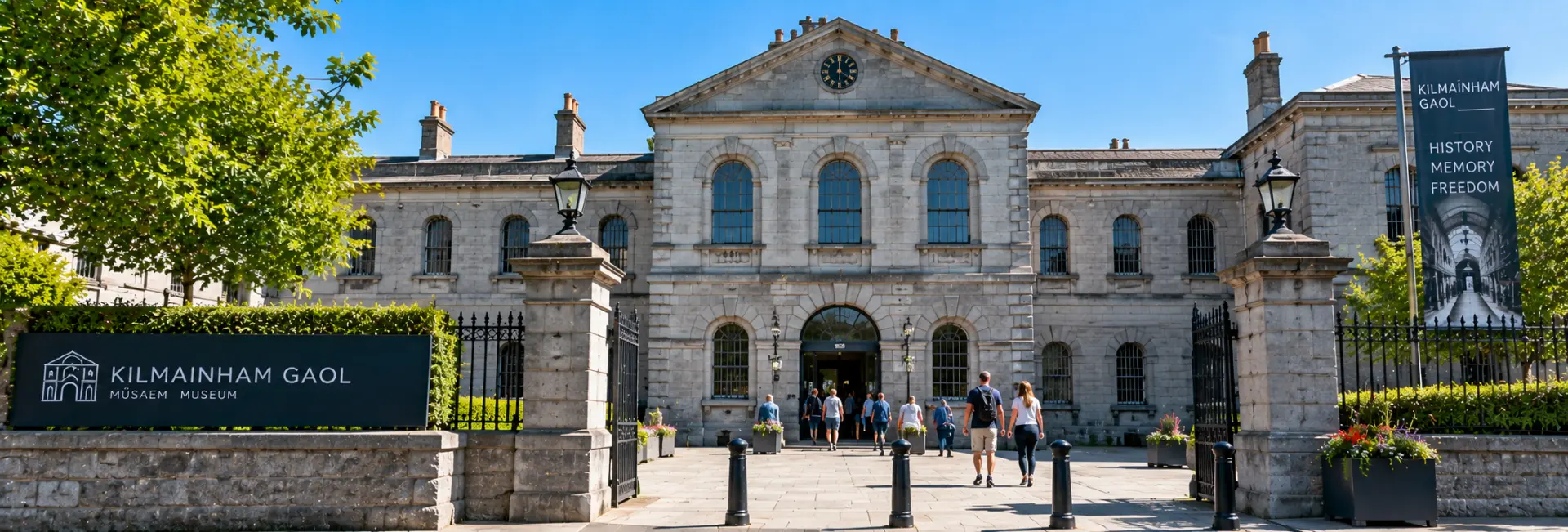
Kilmainham Gaol is a former prison in the Kilmainham area of Dublin, now preserved as one of Ireland's most visited historical museums. Opened in the late 18th century, it held ordinary criminals alongside generations of political prisoners, and its Stonebreakers' Yard is where the leaders of the 1916 Easter Rising were executed, cementing its place at the centre of Ireland's story of independence.
Closed as a working prison in 1924, the building sat derelict for decades before a volunteer restoration effort saved it, and it now operates as a guided-tour museum exploring both the harsh realities of 18th and 19th-century imprisonment and the political history layered on top of it.
History
Origins as a County Gaol
Kilmainham Gaol opened in 1796 as the County of Dublin Gaol, replacing an older, inadequate prison on the site that had been condemned as unsafe and unsanitary. Conditions in the new building were still harsh by modern standards, with cramped cells housing several prisoners, including children, sharing a single candle that had to last two weeks.
A Site of Political Imprisonment
Over more than a century, Kilmainham held many of the leading figures in Ireland's rebellions and independence movements, from the risings of 1798 and 1803 through to the Fenian activity of the 1860s. Its most defining moment came in 1916, when leaders of the Easter Rising, including Patrick Pearse and James Connolly, were executed by firing squad in the prison's Stonebreakers' Yard, an event that shifted public opinion firmly toward the cause of independence.
Closure and Restoration
The gaol later held prisoners through the War of Independence and the Civil War, with Éamon de Valera, later a central figure in Irish politics, its final inmate before its closure in 1924. Left derelict for decades afterward, the building was saved by a dedicated volunteer restoration society formed in 1958, and it reopened to the public as a museum in the 1960s, eventually passing into the care of the Office of Public Works.
Architecture & Building
The gaol is considered one of the largest unoccupied prison buildings in Europe, combining its original Georgian west wing with a later Victorian east wing added as prison design evolved through the 19th century. The east wing's design allowed guards a clear line of sight across multiple levels of cells from a single vantage point, reflecting contemporary ideas about surveillance and prison reform.
- The Georgian west wing – part of the original 1796 building
- The Victorian east wing – added later, with tiered cells overlooked by a central walkway
- The prison chapel – used for religious services, including a wedding held shortly before the 1916 executions
- Stonebreakers' Yard – the site of the 1916 executions, now a place of quiet reflection on the tour
Collections & Exhibits
The museum's exhibition traces both the everyday, often grim, experience of imprisonment at Kilmainham and its political significance, using personal artefacts, letters and documents connected to former prisoners. Original graffiti and artwork left by inmates on cell walls offer a direct, unfiltered link to the people once held there.
A dedicated section explores the events of 1916 in detail, including personal items connected to the Rising's leaders, while other displays place Kilmainham's story in a broader context of political imprisonment, drawing comparisons with similar sites internationally.
Must-See Highlights
- Stonebreakers' Yard, where the 1916 Rising's leaders were executed
- The Victorian east wing, with its dramatic tiered cells and central hall
- The prison chapel, tied to both religious life and personal stories connected to the Rising
- Original prisoner graffiti and artwork preserved on cell walls
- The museum's exhibition on the gaol's political and penal history
Ways to Experience It
Kilmainham Gaol is visited by guided tour only, typically lasting around an hour, combining a walk through the prison buildings with an audio-visual presentation on its history. Tours conclude in Stonebreakers' Yard, giving context to the site's most significant historical moment.
- Standard guided tours running at regular intervals throughout the day
- An on-site exhibition covering the gaol's penal and political history in greater depth
- Ground-floor tours that can be arranged in advance for visitors with mobility needs
Best Time to Visit
Kilmainham Gaol is a consistently popular attraction, and tours can sell out well in advance, particularly in summer and around anniversaries connected to the 1916 Rising. Visiting earlier in the day, and booking tickets online ahead of time, gives the best chance of securing a preferred tour slot.
Visitor Tips
- Book tickets online in advance, since tours regularly sell out, especially in peak season
- Arrive at least 15 minutes before your scheduled tour time
- There is no on-site parking, though parking is available nearby at the Irish Museum of Modern Art
- Contact the museum directly in advance if you require a ground-floor tour or other accessibility arrangements
Nearby Attractions
Kilmainham Gaol sits within a cluster of other historic and cultural sites on Dublin's south side.
- The Irish Museum of Modern Art – housed in the nearby Royal Hospital Kilmainham
- Phoenix Park – a large city park a short distance to the north
- The Guinness Storehouse – Dublin's brewing museum, a walk or short bus ride away
- Heuston Station – Dublin's main rail hub for onward travel, within walking distance
FAQs about visiting Kilmainham Gaol
What is Kilmainham Gaol famous for? +
It's best known as the site where the leaders of the 1916 Easter Rising were executed, and for its long role holding generations of Irish political prisoners from the 1790s through the Civil War.
Do I need to book tickets in advance? +
Yes, booking online ahead of time is strongly recommended, since guided tours are the only way to visit and regularly sell out, particularly in summer.
How long does a visit take? +
Tours typically last around an hour, including an audio-visual presentation, though many visitors also spend additional time in the museum's exhibition afterward.
Is Kilmainham Gaol suitable for children? +
It can be suitable for older children, though its subject matter, including imprisonment and executions, is serious, so it's worth considering the age and sensitivity of younger visitors.
Is there parking at Kilmainham Gaol? +
No, the site has no dedicated parking, though visitors can park nearby at the Irish Museum of Modern Art and walk a short distance to the gaol.
Is Kilmainham Gaol wheelchair accessible? +
The ground floor is accessible, and tours for visitors with mobility needs can be arranged, but it's recommended to contact the museum directly in advance rather than booking online.
What else is nearby worth visiting? +
The Irish Museum of Modern Art, Phoenix Park and the Guinness Storehouse are all within easy reach, making Kilmainham a good anchor for exploring this part of Dublin.
What's a common mistake visitors make? +
Turning up without a booking: since Kilmainham Gaol can only be visited on a guided tour and demand is high, walk-up visitors risk being turned away or facing a long wait.
