Table of Contents
Overview
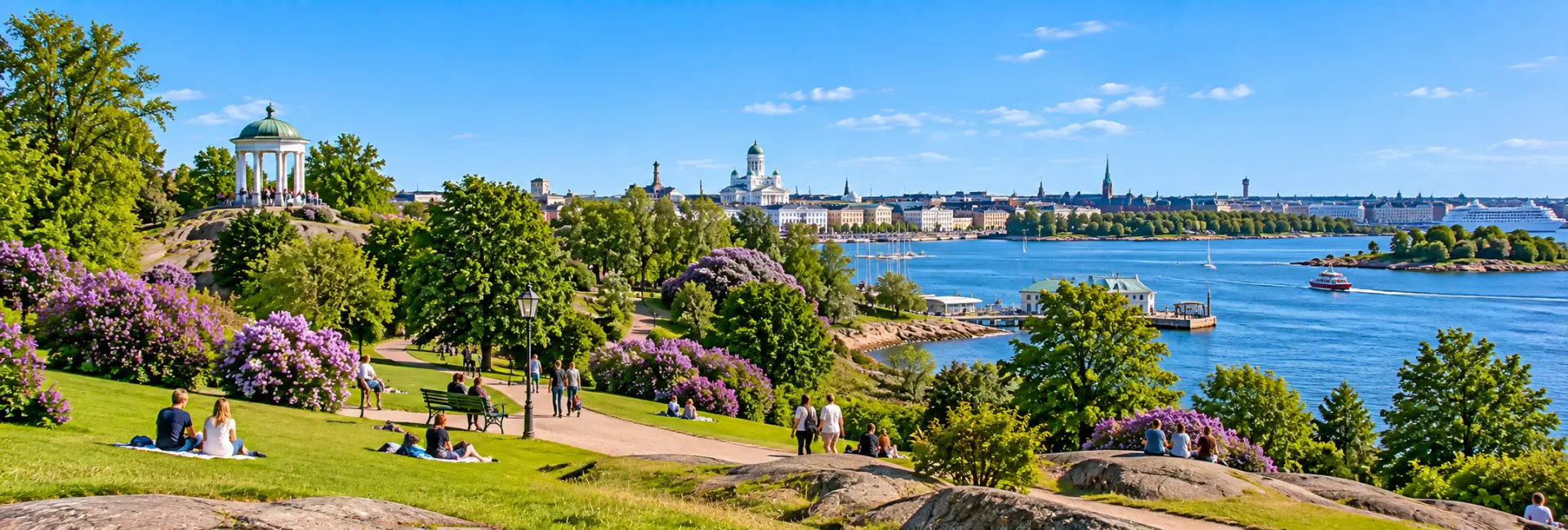
At the southern tip of Helsinki, where the city meets the open Gulf of Finland, Kaivopuisto is one of the oldest and most cherished parks in the capital. Its sweep of lawns, rocky outcrops and winding paths, ringed by grand old villas and foreign embassies, began life not as a public park at all but as a fashionable nineteenth-century sea spa.
Today "Kaivari," as locals often call it, is Helsinki's favourite setting for picnics, sea views and open-air gatherings, most famously on May Day, when its lawns fill with tens of thousands of revellers.
History
A Speculator's Spa
Until well into the 1800s, the southern tip of the Helsinki peninsula was undeveloped land of bare rock, scattered forest and marsh, used mainly for informal walks and picnics. Its transformation began in 1834, when the businessman Henrik Borgström leased the land from the city for fifty years and founded a company to build a fashionable sea spa on the site, a type of resort then in vogue across Europe. The location suited the purpose well: far enough from the city centre to feel like a retreat, yet easily reached by both land and sea.
Regular steamship service between Saint Petersburg, Tallinn and Helsinki began in 1837, at a time when all three cities belonged to the Russian Empire, and the new route made Helsinki a convenient, faintly exotic destination for wealthy residents of the Russian capital.
Cholera, War and Decline
The spa's fortunes did not last. Cholera epidemics in the 1840s and 1850s, followed by the Crimean War, drove away much of its wealthy clientele, and the business turned instead to entertainment, music and theatre to draw a more local crowd of Finnish officials and the bourgeoisie. Financial difficulties eventually caught up with the venture, and by the time Borgström's fifty-year lease expired in 1886, the park had fallen into disrepair. The City of Helsinki took over the land, selling off villa plots to new private owners; only two of the original spa-era villas, Kalliolinna and Villa Kleineh, survive today.
A Diplomatic Quarter
Following Finnish independence, the surrounding streets became popular with foreign embassies, and Kaivopuisto remains one of the most diplomatically dense corners of Helsinki, its historic villas now serving as ambassadors' residences and legations as much as private homes.
The Spa Era
The Kaivopuiston kylpylä spa opened in 1838, built around the Kaivohuone restaurant, where visitors drank mineral water on their doctors' instructions. Despite the ritual, there was no natural spring on site; the water was supplied by the factory of the chemist Victor Hartwall. Down at the shoreline, a separate bath house, the Merikylpylä, offered guests sheltered sea bathing and other treatments, while the wooded park itself, laid out by the German gardener Carl Helm, gave visitors somewhere to walk between treatments, its marshy hollows transformed into ornamental ponds stocked with swans on one side and carp on the other.
Kaivohuone and Surviving Villas
The Kaivohuone building, designed by the architect Carl Ludvig Engel and completed in 1838, still stands at Iso Puistotie in the middle of the park, though its present appearance owes more to an 1867 remodelling by the architect Theodor Höijer. Through the nineteenth century it was one of Helsinki's foremost entertainment venues, hosting circus performances, cabaret and music alongside its role as a restaurant, and it later operated for many years as a private restaurant and nightclub.
The original spa building itself did not survive the twentieth century: it was destroyed during Soviet aerial bombing of Helsinki in 1944. A railway line laid across the peninsula in the 1890s to serve the area was removed decades later, in the 1980s, and the construction of the coastal road Ehrenströmintie in the 1940s permanently separated the park's lawns from the water's edge.
Ursa Observatory
On the highest bedrock in the park stands a small, domed observatory dating to 1926, run by the Ursa Astronomical Association. On clear nights and during notable solar events, Ursa opens the observatory for public star and sun-viewing sessions, giving Kaivopuisto an unusual astronomical landmark alongside its historic villas and sea views.
Modern-Day Kaivopuisto
Kaivopuisto today covers roughly 16 hectares of varied terrain, from open lawns shaded by old lime trees to bare granite outcrops with sweeping views over the Gulf of Finland and its islands. The park holds a children's playground, a dog park, outdoor gym equipment, and a dedicated area for park chess and sand-court games, and in winter its gentle slopes become one of the city's most popular spots for sledding, while a section of the park is maintained as an ice-skating rink.
Small boats depart from the park's shoreline to the nearby islands of Särkkä, Harakka and Uunisaari, each with its own cafés and restaurants, extending a Kaivopuisto visit out onto the water for those who want it.
Vappu and Other Events
Kaivopuisto is at its most crowded, and arguably its most Finnish, on Vappu, the first of May, when tens of thousands of people spread picnic blankets across its lawns and rocks to celebrate the arrival of spring, often with sparkling wine in hand. The park has also hosted the Helsinki Pride Park Festival and, in past summers, rock, pop and classical concerts, though the city has since limited the number of large public events held there to protect the park's grass and terrain from overuse.
Best Time to Visit
Summer brings the fullest use of the park, from sunbathing on the rocks to swimming off the shoreline and boat trips to the nearby islands, while autumn turns its old lime and other deciduous trees a striking yellow and orange. Winter visits suit those after quiet snow-covered views or an afternoon of sledding on the park's slopes, and Vappu, despite the crowds, remains the single most distinctive day of the year to experience the park as locals do.
Visitor Tips
- Head to the park's highest bedrock for the best sea views, and check Ursa's schedule if an observatory visit is of interest
- Bring a picnic; there are few food kiosks inside the park itself away from Kaivohuone
- Visit on a weekday if avoiding crowds is a priority, since Vappu and summer weekends draw very large numbers of people
- Combine a visit with a short boat trip to Uunisaari or Harakka island from the park's own shoreline
- Wear sturdy shoes for the park's uneven, rocky terrain, especially away from the main paved paths
Nearby Attractions
- Uunisaari, Harakka and Särkkä islands, reachable by small boat from the park's shoreline
- The Ullanlinna and Eira districts, known for their Art Nouveau architecture, bordering the park
- Market Square (Kauppatori), a walkable distance north along the shore
- The many foreign embassies housed in the villas surrounding the park
FAQs about visiting Kaivopuisto Park
What is Kaivopuisto known for? +
It is one of Helsinki's oldest and most popular parks, known for its seaside views, historic villas and embassies, the Ursa Observatory, and its huge Vappu (May Day) picnic gathering.
Is Kaivopuisto free to visit? +
Yes, the park is a free, open public space accessible at all times.
Was Kaivopuisto originally a spa? +
Yes, it began in 1834 as a fashionable sea spa built around the Kaivohuone restaurant, before financial troubles and the expiry of its lease in 1886 led the City of Helsinki to take over the land.
Is the historic spa building still standing? +
No, the original spa building was destroyed in Soviet aerial bombing in 1944, though the nearby Kaivohuone restaurant building, dating to 1838, still stands.
What is the Ursa Observatory? +
It is a small domed observatory built in 1926 on the park's highest point, run by the Ursa Astronomical Association, which opens it to the public for star and sun-viewing on clear days and nights.
When is the best time to visit? +
Summer offers the fullest range of activities, including swimming and island boat trips, while the first of May (Vappu) is the park's single busiest and most distinctly Finnish day of the year.
Can I get to nearby islands from the park? +
Yes, small boats depart from Kaivopuisto's shoreline to the islands of Särkkä, Harakka and Uunisaari, each with cafés and restaurants of their own.