
Table of Contents
Overview
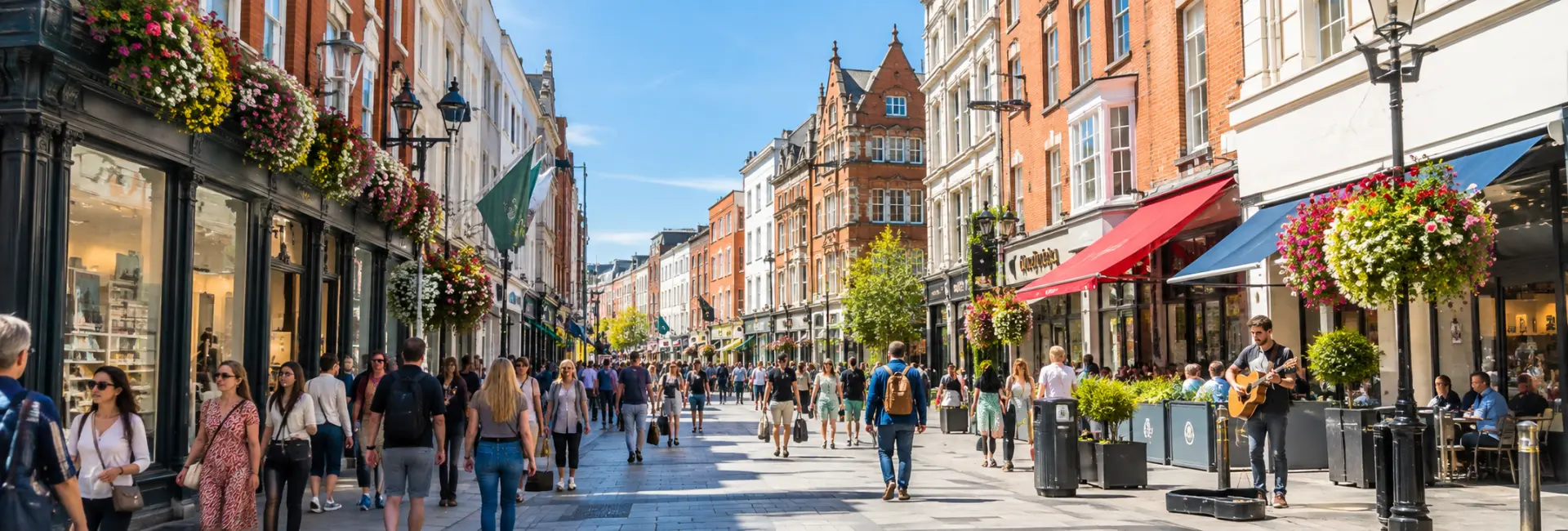
Grafton Street is one of Dublin's two principal shopping streets, running for around 500 metres from College Green, beside Trinity College, up to the northwest corner of St Stephen's Green. Fully pedestrianised, it packs three centuries of the city's retail and social history into a short, car-free stroll lined with department stores, boutiques, cafés and buskers.
Once counted among the most expensive shopping streets in the world by rental value, Grafton Street today draws locals and visitors alike as much for its atmosphere as for its shops: flower sellers on the corners, musicians performing on the hour, and window displays that have become part of the city's own folklore, especially at Christmas.
History
From Cattle Track to Georgian Lane
Grafton Street began life as a modest medieval cattle track running alongside the Stein, a small river that once flowed where St Stephen's Green meets Trinity College and now runs underground. In 1708, the Dawson family laid the lane out as a proper street, developing it as a residential address for well-off Dublin families and giving the parallel Dawson Street its name in the process. The street itself takes its name from the Duke of Grafton, whose family held land in the area.
Georgian Growth and a Change of Fortune
A building boom through the 1760s to 1790s replaced many of the street's earlier Dutch Billy houses, recognisable by their triangular gable fronts, with flatter Georgian facades; traces of the older style are thought to survive behind some of today's shopfronts. When the Act of Union abolished the Irish parliament in 1801 and sent much of the aristocracy to London, Dublin's northside went into decline, but Grafton Street's mix of shops and professional residents helped it avoid the same fate, gradually shifting from a purely residential address toward the commercial street it is today.
A Modern Pedestrian Street
Cars were banned from Grafton Street in the late 19th century, and pedestrianisation was trialled in 1971 before finally becoming permanent in 1983 and being repaved in 1988. That change opened the street to buskers, flower sellers and slow-moving crowds in a way traffic never would have allowed. Bewley's Oriental Café, one of the street's best-loved landmarks, opened in 1927, closed briefly in 2004 amid public protest, and reopened again in 2017 after a lengthy refurbishment.
The debate around pedestrianisation was not one-sided at the time: some councillors and shopkeepers argued that removing traffic would hurt trade and even encourage petty crime. In practice, the opposite happened, and Grafton Street's car-free identity became central to its appeal, to the point that later, smaller pedestrianisation trials on nearby side streets have explicitly cited Grafton Street's success as their model.
Streetscape & Architecture
Grafton Street's buildings today mostly present Victorian and Edwardian shopfronts, layered over the Georgian structures built during the 18th-century boom, giving the street a more ornate, commercial character than the plainer Georgian squares nearby. Decorative details survive here and there for those who look up from the shop windows, from Arts and Crafts-style signage to carved figures on some of the older commercial buildings.
The most distinctive building on the street is Bewley's Oriental Café, an Egyptian Revival-style café whose stained glass windows, designed by artist Harry Clarke in 1931, remain one of the street's signature architectural details. At the street's southern end, the glass-roofed Stephen's Green Shopping Centre adds a very different, Victorian-glasshouse-inspired note to the streetscape.
Because so many buildings were altered rather than demolished as the street evolved, a walk from north to south effectively moves through layers of the same history: a Georgian structure behind a Victorian shopfront, itself now fronted by a modern retail fit-out at street level, with the older fabric of the building often still visible in the upper floors above the shop signs.
Shops & Landmarks
Grafton Street's retail reputation rests on a mix of long-established Irish institutions and international fashion names. Brown Thomas, Ireland's best-known luxury department store, has traded since 1848 and moved to its current Grafton Street building in the mid-1990s, where its elaborate window displays, especially around Christmas, have become an attraction in their own right.
- Weir & Sons, a jeweller on the street since the 19th century, remains one of its most recognisable names.
- Bewley's Oriental Café is as much a landmark as a place to eat, having served Dubliners since 1927.
- International and Irish high-street fashion chains fill much of the rest of the street, alongside smaller specialist shops tucked into its upper floors.
Many of the city's more independent shopping finds sit just off Grafton Street itself, along tributary streets such as Duke Street, Wicklow Street, Drury Street and Castle Market, as well as the covered Georges Street Arcade a short walk away.
By the mid-2000s, rents on Grafton Street had climbed high enough to rank it among the most expensive shopping streets in the world by area, a status that has shaped which kinds of retailers can afford a presence directly on the street itself, as opposed to the smaller, often more affordable units on the surrounding side streets.
Buskers & Street Life
Since pedestrianisation, Grafton Street has become one of the world's best-known busking pitches, drawing musicians, poets and mime artists to perform for the shopping crowds. Several well-known Irish musicians got their start here, including Glen Hansard of The Frames, whose time busking on the street partly inspired the 2006 film "Once."
Dublin City Council regulates performances on the street through a busking permit system introduced in 2015, which governs amplification, sets time slots so acts rotate roughly on the hour, and restricts performances before late morning on days when delivery vehicles need access. Alongside the musicians, generations of flower sellers have traded from stands at the street's corners, a tradition so tied to the street's identity that a 2019 proposal to reduce their presence drew a swift public backlash and an apology from the company involved.
The rules have shifted more than once since 2015, as the council has balanced complaints about noise against the strong public affection for busking as part of the street's character; buskers themselves have periodically raised concerns that new residential developments on and around the street could bring further restrictions in the years ahead.
Best Time to Visit
Grafton Street is a year-round destination, but it takes on a particular energy in the run-up to Christmas, when Brown Thomas's window displays and festive lighting draw crowds specifically to see the decorations rather than to shop. Outside the holiday season, the street is busiest on weekend afternoons, when both shoppers and buskers are at their most active.
Weekday mornings offer a noticeably calmer version of the same street, better suited to browsing shopfronts or getting a table at Bewley's without a wait. Because the street is entirely pedestrianised and largely uncovered, a dry spell in the forecast makes for a more comfortable visit, though the surrounding arcades and shopping centres offer shelter if a shower rolls in.
Sales periods, particularly the post-Christmas and midsummer sales common across Irish retail, also draw larger crowds than an average weekday, so shoppers hoping to browse rather than queue may prefer to time a visit outside those windows.
Visitor Tips
- Grafton Street is fully pedestrianised and free to walk, with no admission or booking required at any point.
- Most shops keep shorter hours on Sundays, so check individual store listings if a specific purchase is the goal of a Sunday visit.
- Street performances rotate roughly on the hour under the city's busking permit system, so a few minutes' wait can bring a completely different act.
- The street's side streets, including Duke Street, Wicklow Street and Drury Street, are worth a detour for independent shops away from the main crowds.
- The nearest Luas tram stop is St Stephen's Green, at the street's southern end, with Trinity College and College Green a short walk from the northern end.
- Keep bags and phones in sight in the busier stretches, as with any crowded pedestrian shopping area.
Nearby Attractions
Grafton Street's short length means it connects directly to several of Dublin's other major sights at either end, making it a natural link in a longer walking route around the city centre.
- Trinity College Dublin and the Book of Kells sit just beyond the street's northern end at College Green.
- St Stephen's Green, Dublin's best-known city park, begins directly at the street's southern end.
- The Molly Malone statue, one of Dublin's most photographed landmarks, stands a short walk away on Suffolk Street, having been relocated from Grafton Street itself in 2014.
- The National Gallery of Ireland and Merrion Square are around a ten-minute walk to the east.
Because so much of central Dublin's Georgian core sits within easy reach of either end of the street, many visitors treat Grafton Street less as a single destination and more as the connecting spine of a longer walk that takes in the college, the park, and the streets around Merrion Square in one loop.
FAQs about visiting Grafton Street
Is Grafton Street free to visit? +
Yes, it is a public pedestrianised street with no admission fee; you only pay for what you buy in its shops and cafés.
How long is Grafton Street? +
It runs for about 500 metres between College Green, near Trinity College, and St Stephen's Green.
Why is Grafton Street pedestrianised? +
Cars were banned in the late 19th century, and full pedestrianisation was trialled from 1971 before becoming permanent in 1983, opening the street to shoppers, buskers and flower sellers.
Where can I see buskers on Grafton Street? +
Performers set up along the street throughout the day, rotating roughly on the hour under Dublin City Council's busking permit rules; look for the largest crowds for the most established acts.
Where is the Molly Malone statue? +
It once stood on Grafton Street but was relocated to nearby Suffolk Street in 2014 to make way for tram construction, where it remains today.
What is Grafton Street's most famous landmark? +
Bewley's Oriental Café, open since 1927 and known for its Egyptian Revival facade and 1931 Harry Clarke stained glass windows, is the street's best-loved landmark.
Are shops open on Sundays? +
Most are, though typically with shorter hours than the rest of the week, so it is worth checking individual store listings before a Sunday visit.
