
Table of Contents
Overview
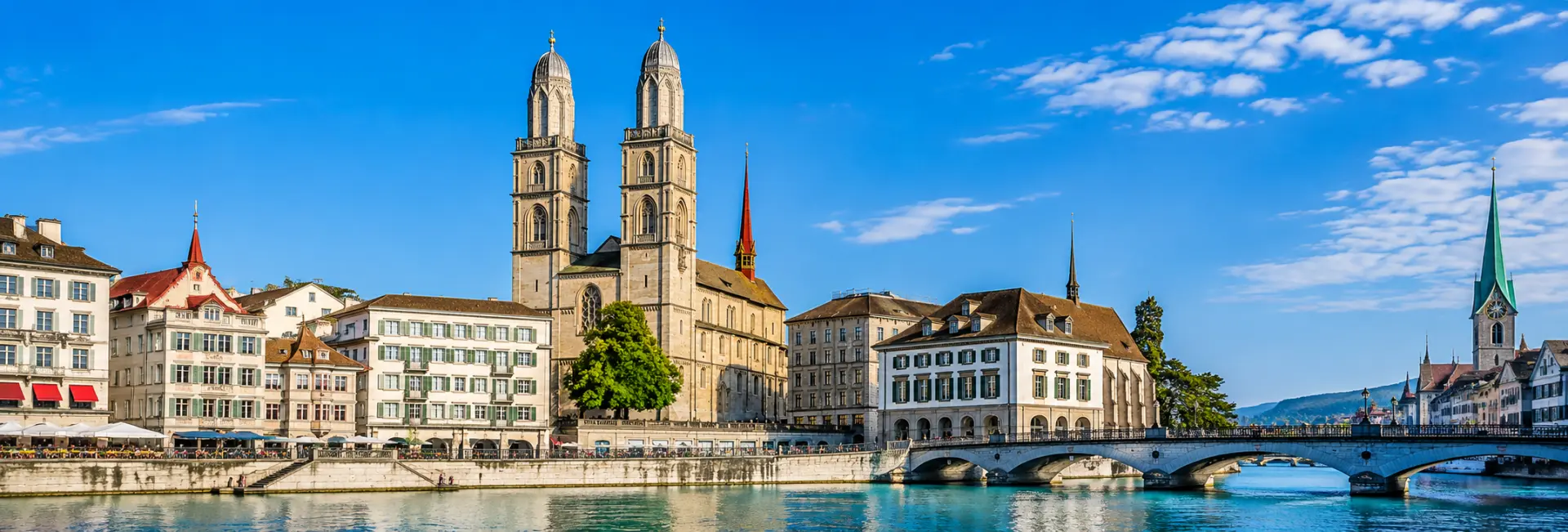
Rising above the eastern bank of the Limmat River, the Grossmünster is the single most recognizable silhouette in Zurich's skyline. Its two square towers, capped with dark octagonal spires, have watched over the Old Town for close to a thousand years, and they appear on postcards, coins, and city crests as shorthand for the city itself.
The church began life as a Carolingian foundation and was rebuilt in its present Romanesque form between roughly 1100 and 1220. It is more than an architectural set piece, though: in the 1520s it became the launching point for the German-speaking Reformation, led by the priest Huldrych Zwingli, an event that reshaped religious and civic life across Switzerland. Today the Grossmünster functions as an active Protestant parish church, a small museum of Reformation history, and one of the best viewpoints in the city, reachable by a steep but rewarding climb up its south tower.
Part of what makes the building compelling is how visibly its two identities sit side by side. The founding legend and the medieval stonework speak to an older, almost mythic Zurich, while the deliberately unadorned interior and the modern stained glass reflect the austere, reform-minded city that grew out of Zwingli's era. Few single buildings anywhere in Switzerland pack in that much layered history within such a compact footprint.
History & the Charlemagne Legend
A Legendary Founding
Medieval chroniclers credited the Frankish emperor Charlemagne with founding the church around the early 9th century. As the story goes, while riding near Zurich his horse suddenly buckled to its knees, and the spot turned out to mark the forgotten graves of Felix and Regula, two of the city's early Christian martyrs. Reading this as a sign, Charlemagne is said to have ordered a church built directly over the burial site. Whether or not the emperor ever set foot in Zurich, the tale gave the church a claim to seniority over its rival across the river, the Fraumünster, which tradition instead links to his grandson.
From Roman Burial Ground to Romanesque Church
Archaeological work beneath the building has confirmed a genuine Roman-era burial ground on the site, lending the legend a grain of historical footing even if the Charlemagne connection itself cannot be verified. The Romanesque structure visitors see today replaced an earlier Carolingian building and was raised gradually over the 12th and early 13th centuries, with the first parts of the crypt consecrated in the early 1100s. Later centuries added the church's distinctive tower tops, cloister buildings, and a series of restorations that kept the medieval core intact while modernizing its finishes.
Architecture & the Twin Towers
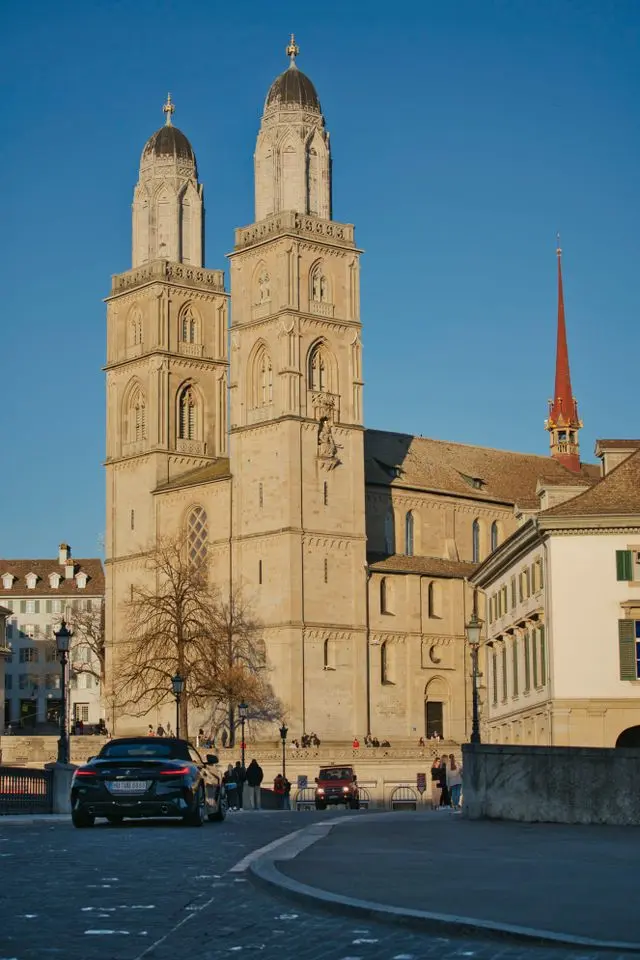
The Grossmünster is built in the restrained, thick-walled Romanesque style typical of the first wave of pan-European church architecture, favoring solid masonry and rounded arches over the soaring verticality of later Gothic buildings. Its plan follows a traditional basilica layout, with a long nave flanked by side aisles leading to a raised choir at the eastern end.
The Towers
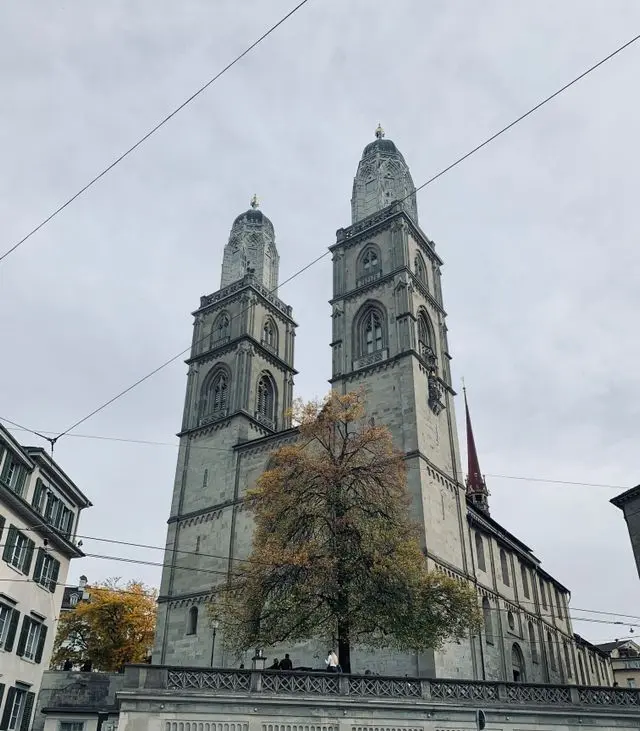
The building's two front towers, unusually paired rather than positioned singly, were completed with their current neo-Gothic spires in the late 18th century, replacing earlier tops lost to fire and decay. The southern tower, known as the Karlsturm or Charles Tower in honor of the founding legend, carries a seated statue of Charlemagne looking out over the city and can be climbed by the public. Visitors who make the ascent, a run of roughly 187 narrow steps, reach a platform around 62 metres up, with viewing windows facing the Limmat, Lake Zurich, the rooftops of the Old Town, and, on a clear day, the distant Alps.
An Unusual Entrance
Rather than the conventional west-facing doorway found in most European churches, the Grossmünster is entered from the north, a quirk tied to a former pilgrimage route that once linked the church to the small Wasserkirche nearby and on to the Fraumünster across the river.
The Reformation & Religious Significance
The Grossmünster's greatest historical weight comes not from its founding legend but from the 1520s, when the priest Huldrych Zwingli used his position here to challenge core practices of the Roman Catholic Church. His preaching and a series of public debates convinced Zurich's civic authorities to break with Rome, making the city one of the first strongholds of the Swiss Reformation and setting the template that other reformed cities across German-speaking Switzerland would follow.
After Zwingli's death in 1531, his successor Heinrich Bullinger continued to lead the congregation and further shaped Reformed theology from the same pulpit. The Reformation's influence is still visible in the building's austere interior: statues, paintings, and much of the ornamentation that a Catholic church of the period would have displayed were deliberately stripped away, leaving plain stone walls that let the architecture speak for itself. A small Reformation-history exhibition in the former cloister buildings now traces this period in more depth, covering Zwingli's writings, the debates that split the church from the papacy, and the wider spread of reformed ideas from Zurich.
Art & Notable Features
Despite the Reformation-era stripping of decoration, the Grossmünster has gained striking modern artworks over the past century that now count among its main draws. The choir windows, added in 1932, were designed by the Swiss artist Augusto Giacometti in bold, luminous colour. In the early 2000s the German artist Sigmar Polke created a further set of windows for the nave, using thin slices of natural agate stone alongside coloured glass to scatter unusual patterns of light across the interior.
- Bronze entrance doors by Otto Münch, added in the 1930s and cast with scenes from biblical and civic history
- A Romanesque crypt beneath the choir, among the largest of its kind in Switzerland, containing a medieval statue of Charlemagne
- Carved capitals in the adjoining cloister depicting both real and mythical creatures, dating to the 12th century
- A weathered exterior statue of Charlemagne on the Karlsturm, with the original medieval figure preserved indoors from the elements
The crypt's Charlemagne figure is one of the oldest surviving monumental statues in the country and remains a focal point for visitors tracing the church's founding legend. Together, the medieval stonework and the 20th- and 21st-century glass give the Grossmünster an unusual mix of eras, with light filtered through contemporary art falling across capitals and doorways carved nearly a thousand years earlier.
Ways to Experience It
Most visitors begin at ground level, where the nave and crypt can be explored freely and at a relaxed pace, taking in the stained glass, the bronze doors, and the general austerity of the Reformed interior. From there, the main additional activity is the climb up the Karlsturm to the viewing platform, which is treated as a separate, ticketed experience from the main church.
- Self-guided visit of the nave, choir, and Romanesque crypt
- Karlsturm tower climb for panoramic views over the Limmat and Old Town
- Reformation history displays in the former cloister buildings
- Regular organ recitals and choral concerts held in the nave
- Sunday worship services, which visitors are welcome to attend
Guided city walking tours of the Old Town frequently stop at the Grossmünster as a highlight, pairing it with the nearby Fraumünster and Lindenhof hill for a fuller picture of medieval Zurich.
Best Time to Visit
Zurich's Old Town, and the Grossmünster with it, is at its most pleasant in the late spring and early autumn, when daytime temperatures are mild and the summer's tourist crowds have not yet peaked or have already thinned out. Early morning visits, shortly after opening, tend to offer the quietest experience of the nave and crypt before tour groups arrive.
For the tower climb specifically, a clear day makes a real difference: the payoff view toward the Alps only materializes when visibility is good, so checking the forecast before committing to the 187-step ascent is worthwhile. Winter visits bring shorter opening hours for the tower and a real chance of a closure in poor weather, but the church interior itself remains a calm, uncrowded stop year-round.
Visitor Tips
- Entry to the main church interior is free; only the Karlsturm tower climb carries a small admission fee
- The tower climb involves a narrow spiral staircase with no elevator, so it is not well suited to visitors with mobility limitations, young children who tire easily, or anyone uneasy with tight, enclosed spaces
- As an active place of worship, modest dress and quiet behaviour are appreciated, and access may be limited during services
- Renovation work is scheduled at the Grossmünster in the coming years, so some areas or the tower climb may have restricted access at certain times; checking current status before a visit is worthwhile
- The church sits directly on Zwingliplatz in the pedestrianized Old Town, an easy walk from Zurich's main train station and well served by nearby tram and bus stops
- Combining a visit with the Fraumünster across the river makes for an efficient way to see both of Zurich's landmark churches in a single outing
Nearby Attractions
The Grossmünster sits at the heart of a compact cluster of historic sights, making it easy to combine with a short walk through Zurich's Old Town.
- Fraumünster – the Grossmünster's historic rival church, just across the Limmat, known for its own set of modern stained glass windows by Marc Chagall
- Wasserkirche – a small Gothic chapel on the riverbank traditionally linked to the execution of the city's patron saints
- Lindenhof – a raised terrace on the site of a former Roman fort, offering open views over the river and Old Town rooftops
- Bahnhofstrasse – Zurich's main shopping boulevard, a short walk to the west
- Lake Zurich promenade – reachable on foot along the river, a pleasant extension to an Old Town walk
FAQs about visiting the Grossmünster
Is entry to the Grossmünster free? +
Yes, walking through the main nave and crypt is free of charge. Only climbing the Karlsturm tower requires a paid ticket, and it is a small fee.
How many steps are there to the top of the tower? +
The Karlsturm climb involves roughly 187 steps up a narrow spiral staircase, with no elevator option, so it's a moderate physical effort best suited to visitors who are reasonably fit and not uncomfortable in tight spaces.
How long should I plan to spend at the Grossmünster? +
Most visitors spend 30 to 45 minutes exploring the church interior and crypt, plus another 20 to 30 minutes if they add the tower climb, making it an easy stop of about an hour in total.
What is the Grossmünster famous for? +
It's known both for its role as the starting point of Huldrych Zwingli's Swiss Reformation in the 1520s and for its twin Romanesque towers, which have become the defining symbol of Zurich's skyline.
Is the Grossmünster suitable for children or visitors with mobility issues? +
The ground-floor church and crypt are accessible to most visitors, but the tower climb's narrow stairs and lack of an elevator make it unsuitable for wheelchair users, strollers, or anyone who struggles with stairs.
How do I get to the Grossmünster? +
It sits in the pedestrianized Old Town on the east bank of the Limmat, within easy walking distance of Zurich's main train station, and is served by several nearby tram and bus stops.
What can I combine with a Grossmünster visit? +
Its location makes it simple to pair with the Fraumünster just across the river, the Wasserkirche chapel, and a walk up to the Lindenhof terrace, all within a few minutes on foot.
Do I need to book tickets in advance? +
Advance booking generally isn't required for the church or the tower climb, though it's worth checking current hours ahead of a visit, especially given ongoing renovation work that may affect access at times.
