Table of Contents
Overview
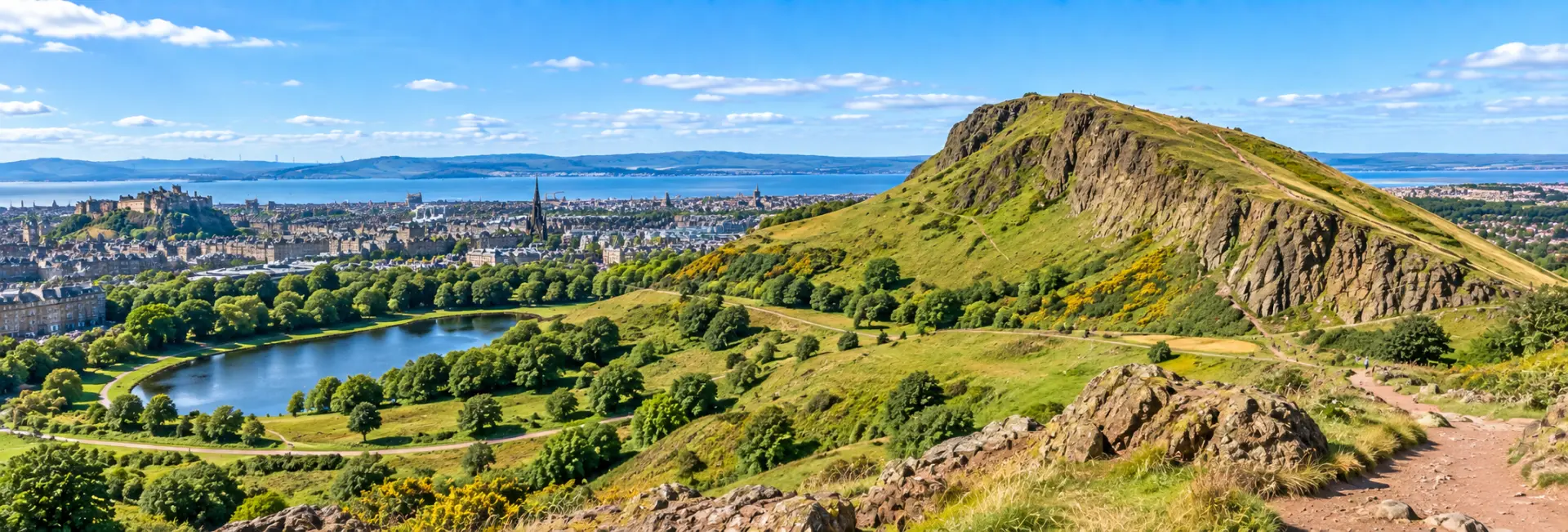
Holyrood Park is a stretch of genuine wilderness sitting improbably close to Edinburgh's Old Town, just a few minutes' walk from the Royal Mile. Where much of the city centre is stone and pavement, this royal park offers grassy hills, rocky crags, small lochs and open moorland across roughly 650 acres, all within view of the surrounding rooftops.
At its centre rises Arthur's Seat, the remains of an ancient volcano and the highest point in Edinburgh, flanked by the dramatic cliffs of Salisbury Crags. The park has been shaped by both geological forces and centuries of royal history, having once served as a hunting ground for Scottish monarchs, and today it draws walkers, joggers and sightseers who want a taste of the Highlands without leaving the city.
Formation & Natural History
The hills of Holyrood Park owe their existence to volcanic activity roughly 350 million years ago, during a period when much of the region saw repeated eruptions of magma. Over millions of years that followed, erosion and successive ice ages wore away the softer surrounding rock, leaving behind the harder volcanic cores visible today as Arthur's Seat and the neighbouring crags.
Salisbury Crags, the long cliff line to the west of Arthur's Seat, is particularly notable to geologists for exposing a clear boundary where molten rock once forced its way between older layers of sedimentary stone. This feature was studied by 18th-century geologist James Hutton, whose observations here contributed to early ideas about how the Earth's crust forms over long periods of time, making the park a site of genuine scientific significance as well as scenic interest.
Flora & Fauna
Despite sitting inside a capital city, Holyrood Park supports a surprising range of habitats, from open grassland and gorse-covered slopes to reedy lochside margins. In spring and early summer the lower slopes turn a vivid yellow as gorse comes into bloom, while rougher grassland areas support wildflowers and grasses adapted to thin, rocky soil.
The park's three lochs, St Margaret's Loch, Dunsapie Loch and Duddingston Loch, attract a steady population of waterbirds, including swans, geese and various duck species, making them popular spots for casual birdwatching. The variety of terrain and its protected status as a site of special scientific interest have helped the park remain a refuge for wildlife that might otherwise struggle to find space within a built-up city.
Key Areas & Viewpoints
Arthur's Seat
The park's main summit rises to around 251 metres and is reachable via several marked paths, with the most direct routes taking a moderately fit walker roughly 30 to 45 minutes from the base. The top offers a sweeping panorama that takes in the city centre, the Firth of Forth and, on a clear day, the hills of Fife across the water.
Salisbury Crags
Running along the western edge of the park, these dolerite cliffs offer a lower-level alternative to the summit walk, with a popular path known locally as the Radical Road tracing the base of the crags and giving closer views of the rock formations Hutton once studied.
St Margaret's Loch and St Anthony's Chapel
Near the park's northern entrance, St Margaret's Loch is overlooked by the ruined St Anthony's Chapel, a small medieval structure perched on a rocky outcrop. The combination of water, ruin and hillside makes this one of the most photographed corners of the park.
Duddingston Loch
Tucked into the park's southeastern edge, this quieter loch borders the village of Duddingston and is designated as a wildlife reserve, offering a calmer contrast to the busier paths around Arthur's Seat.
Ways to Experience It
Most visitors explore Holyrood Park on foot, whether tackling the full climb to Arthur's Seat or opting for one of the gentler circular walks around the lower paths. Queen's Drive, the road that loops through the park, is also popular with cyclists and is partly closed to motor traffic at weekends, making it a quieter route for those on two wheels.
- Guided walks are occasionally run by the park's ranger service, covering geology, history or wildlife.
- Runners frequently use the park's mix of flat paths and hill routes for training.
- Rock climbers and boulderers use a designated section of Salisbury Crags, though much of the crag face is off-limits to protect the rock.
- Picnicking on the lower grassy slopes is a common way to enjoy the park without tackling the summit.
Best Time to Visit
Early morning is generally the quietest time to climb Arthur's Seat, particularly in summer when the paths can otherwise fill with visitors by mid-morning. Clear, dry days offer by far the best rewards at the summit, since the panoramic views are the main draw and can disappear entirely in low cloud or heavy mist.
Spring brings flowering gorse across the lower slopes, while autumn offers cooler walking conditions and softer light for photography. Winter visits are possible year-round, though paths can become slippery underfoot, so sturdy footwear is worth bringing regardless of season.
Visitor Tips
- Wear sturdy, grippy footwear, since paths can be steep, loose or slippery even in dry weather.
- Bring a windproof layer, as the exposed summit is noticeably colder and windier than the streets below.
- Check the weather before setting out, since visibility and wind conditions can change quickly at height.
- The park is free to enter and open year-round, with no set closing time, though visiting during daylight hours is recommended for safety.
- Stick to marked paths where possible to help protect the park's fragile grassland and rock habitats.
Nearby Attractions
Holyrood Park sits at the eastern end of the Royal Mile, putting several major Edinburgh landmarks within easy reach of the park's main entrances.
- The Palace of Holyroodhouse, directly adjacent to the park's northwest corner.
- The Scottish Parliament Building, a short walk from the same entrance.
- St Giles' Cathedral and the wider Royal Mile, a walkable route west of the park.
- The village of Duddingston, bordering the park's southeastern edge.
FAQs about visiting Holyrood Park
How long does it take to climb Arthur's Seat? +
Most walkers reach the summit in around 30 to 45 minutes from the base, depending on fitness level and which path is chosen, with a similar time needed for the descent.
Is Holyrood Park free to visit? +
Yes, the park has no entry fee and is open to the public year-round, though the Palace of Holyroodhouse on its edge charges separately for entry.
Do I need hiking boots for Arthur's Seat? +
Sturdy, grippy shoes are strongly recommended, since the paths include loose gravel and rock and can become slippery in wet weather, even though the climb itself does not require technical hiking gear.
Is Holyrood Park suitable for children or less able walkers? +
Yes, several lower paths around the lochs and lower slopes are relatively flat and manageable, though reaching the summit of Arthur's Seat involves a steady uphill climb that may not suit everyone.
What is the best viewpoint in Holyrood Park? +
The summit of Arthur's Seat offers the widest panorama, taking in the city and the Firth of Forth, while Salisbury Crags offers strong views at a lower, less strenuous level.
Can I cycle in Holyrood Park? +
Yes, Queen's Drive is popular with cyclists and is partly closed to cars at weekends, though off-road cycling away from the main road is generally discouraged to protect the terrain.
What wildlife might I see in Holyrood Park? +
The park's lochs attract swans, geese and various duck species, and the grassland and gorse slopes support a range of birds and small wildlife typical of open Scottish landscape.
Is Holyrood Park connected to the Royal Mile? +
Yes, the park's main northwest entrance sits right beside the Palace of Holyroodhouse at the eastern end of the Royal Mile, making it easy to combine with a walk through the Old Town.