Table of Contents
Overview
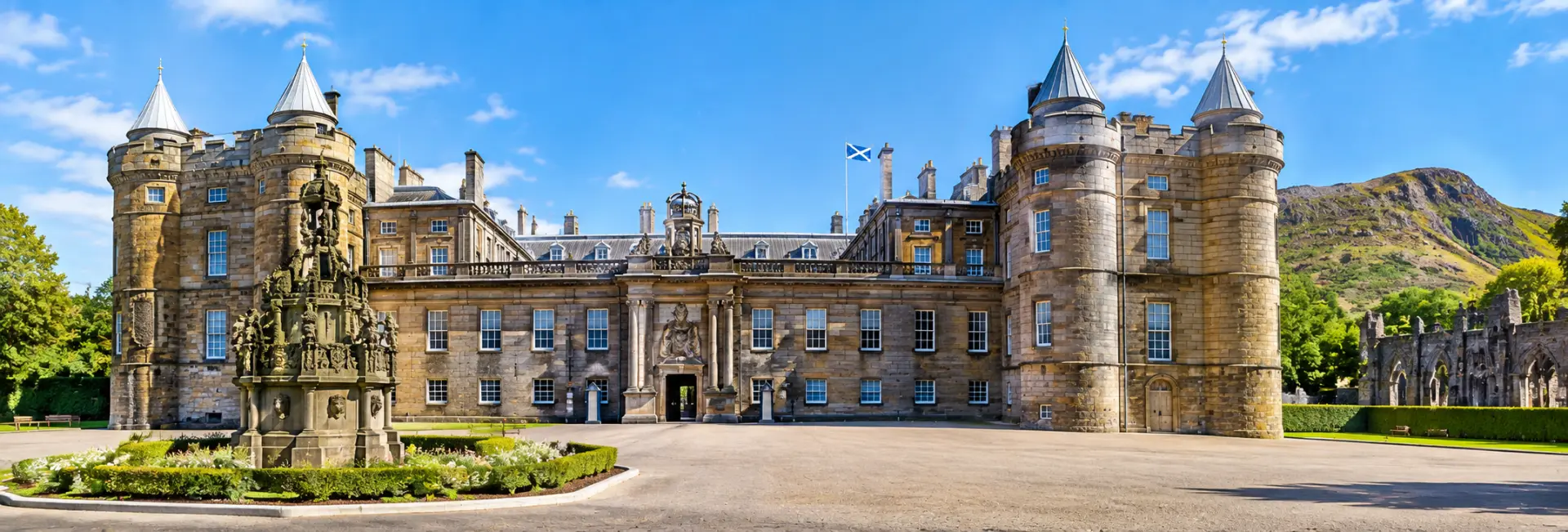
The Palace of Holyroodhouse stands at the bottom of Edinburgh's Royal Mile, with the crags of Arthur's Seat rising directly behind it. It is the official residence of the monarch in Scotland, and it has served as a royal home for more than five centuries. Unlike a ruined castle or a museum-only palace, it is still used today for state ceremonies, official receptions and the King's annual visit to Scotland.
A visit combines several different experiences in one place. There are richly decorated State Apartments, the historic chambers of Mary, Queen of Scots, the shell of a medieval abbey church and a garden with a long royal history. The palace also has its own gallery space for changing exhibitions drawn from the Royal Collection.
Holyrood is a good counterpart to Edinburgh Castle at the opposite end of the Mile. Where the castle is a rocky fortress built for defence, the palace was built for comfort, ceremony and court life, and its story is closely tied to some of the most dramatic episodes in Scottish history.
History
An Abbey Founded on a Legend
The site began as an abbey rather than a palace. King David I founded an Augustinian abbey here in 1128, and the tale goes that he was inspired after seeing a vision of a stag with a glowing cross between its antlers while hunting. The name Holyrood comes from Holy Rood, meaning Holy Cross. Over time the abbey grew, and it included rooms for the monarch to use when staying.
James IV and James V
Around the time of his marriage to Margaret Tudor in 1503, James IV began turning the abbey's royal lodgings into a proper palace, and work started on the gardens. His son James V added a massive tower from 1528, and rebuilt the west front to hold more reception rooms. That tower is the oldest part of the palace that survives today.
Mary, Queen of Scots
Mary lived at Holyrood between 1561 and 1567, one of the most turbulent periods in Scottish history. She married Lord Darnley in the abbey in 1565, and in 1566 her secretary David Rizzio was murdered close to her in a plot involving her husband. After Mary's reign the palace fell into a quieter phase, particularly once her son James VI moved south to become king of England in 1603.
Fire and Rebuilding
In 1650, while Cromwell's troops were stationed in Edinburgh, a fire destroyed a large portion of the palace apartments. After the restoration of the monarchy, Charles II had Holyroodhouse almost entirely rebuilt between 1671 and 1679 to designs overseen by Sir William Bruce. The palace seen today is largely the result of that project.
Victorian and Modern Changes
Queen Victoria stayed here in 1850, when interiors and surroundings were improved. George V later modernised the building, and the palace became recognised as the sovereign's official residence in Scotland. The gallery for exhibitions opened in 2002 during Queen Elizabeth II's Golden Jubilee year.
Architecture & Notable Rooms
The palace is arranged around a central courtyard, and Bruce's design blends the older tower of James V with a matching tower on the opposite corner. The result is a balanced, symmetrical entrance front in pale stone, with columns framing a central doorway and the royal arms above. The palace is a Category A listed building, and the ground around it is protected for its archaeological importance.
Mary, Queen of Scots' Chambers
These rooms sit in the 16th-century tower and are the oldest part of the visit. They have a darker, more intimate feel than the State Apartments, and they are the setting for the story of Rizzio's murder. Small displays help explain the political tensions of the period and the personalities involved.
The Great Gallery
The largest room in the palace is the Great Gallery. It is hung with 111 portraits of Scottish kings painted by the Dutch artist Jacob de Wet II. Many of the earliest kings depicted are legendary rather than historical, so the room is as much about national storytelling as it is about portraiture. It is also associated with Bonnie Prince Charlie's stay at Holyrood in 1745.
The State Apartments
Created under Charles II, these rooms are known for their ornate plaster ceilings, carved woodwork, tapestries and fine furniture. They are still used for official entertaining, so they have a lived-in grandeur rather than a museum feel. A visit usually follows a set route, moving from room to room in one direction.
Holyrood Abbey & the Gardens
The Abbey Ruins
Beside the palace stands the roofless nave of Holyrood Abbey, all that remains of the church built by David I's successors. It was once the setting for royal weddings, coronations and burials, and Charles I was crowned here in 1633. Its roof collapsed in the 18th century, but the tall arches and carved stonework still give a strong sense of the building's former scale.
Several important royal figures are connected with the abbey, including James V, who was the last Scottish monarch to be buried at Holyrood. Along the walls are old tombs and memorials, and a royal burial vault is tucked away at one end. Access to the ruins is included with palace entry.
The Palace Garden
The garden was first laid out in the early 16th century and is still used today for royal events. It has wide lawns, mature trees and views up to the cliffs of Arthur's Seat, which make it one of the most attractive parts of the visit. Each summer the garden hosts garden parties for thousands of guests, a tradition that began in the early 20th century.
Look out for Queen Mary's Bath House, a small historic structure in the grounds that is a protected monument in its own right.
Royal & Historical Ties
Holyroodhouse is the official residence of the monarch in Scotland, and each year the King spends a week here, usually at the start of summer, carrying out engagements and ceremonies. During this period, often called Holyrood Week, the palace is closed to the public.
The building has been the backdrop for some of the biggest events in Scottish royal history. Weddings, coronations and state occasions took place here, and it remained an important base for the Stuart monarchs. Even after James VI moved to London, Holyrood kept its role as a symbolic centre for the Scottish crown.
Today the palace also plays a part in Scotland's civic life. The Scottish Parliament building stands almost opposite, so the two form the ceremonial and political ends of the Royal Mile. The presence of both at the bottom of the street is a neat reminder that the route has always linked royal, religious and governing power.
The palace is also known for its stories and legends. Visitors often ask about ghosts, particularly the spirit said to be linked to Agnes Sampson, a woman executed for witchcraft in 1591. Whether or not you believe such tales, they show how thoroughly Holyrood has entered the imagination of the city.
Ways to Experience It
Most visitors follow the main route through the palace and abbey with a multimedia guide, which adds depth to the rooms and stories. There are a few ways to tailor a visit.
- The standard visit, which covers the State Apartments, Mary, Queen of Scots' Chambers, the abbey ruins and the garden.
- Guided or specialist tours, which are offered at certain times and go into more detail on the rooms and their history.
- The King's Gallery, which hosts changing exhibitions from the Royal Collection and is a good add-on if you enjoy art and decorative objects.
- The cafe, which can be visited without a palace ticket and is a handy stop after a walk down the Royal Mile.
- Seasonal events and special openings, which may include garden visits and themed programmes.
Guiding is allowed in the external areas of the palace precinct, so walking tours often stop outside the gates to talk about the palace's history.
Best Time to Visit
The palace can be visited for much of the year, but it is worth checking the official calendar first. It is closed whenever the royal family is in residence, and it also has regular closing days and occasional private events, so it is best not to leave a visit to chance.
Weekday mornings are usually the calmest, and the first slots of the day offer the best chance of having rooms to yourself. Summer is the busiest period, and August brings large crowds because of the Edinburgh festivals. Late spring and early autumn combine good weather with more comfortable visiting conditions.
The garden and abbey ruins look best on dry, bright days, when the light picks out the stonework and the view of Arthur's Seat behind is at its clearest. On wet days the indoor apartments and the gallery take up more of the visit, so it is a good choice for changeable Scottish weather.
Visitor Tips
- Allow around two to three hours to see the palace, abbey ruins and garden without rushing.
- Book in advance during busy periods, and always check opening days and any royal closures before you travel.
- The route through the palace is one-way, so pause in rooms you want to look at properly as you may not be able to go back.
- Access is generally good, although there are some restrictions in Mary, Queen of Scots' rooms. Concessions and a free access companion ticket are available, and guides are offered with subtitles, British Sign Language and audio description.
- Registered assistance dogs are welcome, and there are accessible toilets in the cafe.
- Check the current rules on bag sizes and photography before arriving, as these can change.
- Confirm prices and opening hours with the official source before you go, as they change from season to season.
The palace is a relatively short walk downhill from Waverley station via the Royal Mile, and several bus routes stop close by.
Nearby Attractions
The palace sits at the foot of one of Edinburgh's best sightseeing areas, so it is easy to pair with other places.
- The Scottish Parliament, directly across the road, with a striking modern design and public access on certain days.
- Holyrood Park and Arthur's Seat, a large public park with trails and one of the best viewpoints in Edinburgh.
- Our Dynamic Earth, a science attraction close to the palace that suits families.
- Canongate Kirk and the Museum of Edinburgh, both a short way up the Royal Mile.
- The Royal Mile itself, which leads uphill to St Giles' Cathedral and Edinburgh Castle.
- Calton Hill, a short walk away, for another popular view over the city.
Many visitors walk the Royal Mile from the castle down to the palace and finish here, which makes for a satisfying end to a day in the Old Town.
FAQs about visiting the Palace of Holyroodhouse
What is the Palace of Holyroodhouse? +
It is the official residence of the monarch in Scotland, located at the bottom of Edinburgh's Royal Mile. It combines State Apartments, the historic chambers of Mary, Queen of Scots, the ruins of Holyrood Abbey and a garden.
Who lives at Holyroodhouse? +
The King stays here for a week each summer and at other times when carrying out official duties in Scotland. Outside those periods it is open to the public, although it is closed when the royal family is in residence.
How long does a visit take? +
Most people spend two to three hours, including the apartments, the abbey ruins and the garden. If you also visit the King's Gallery or the cafe, allow a little longer.
Do I need to buy tickets in advance? +
It is a good idea, especially in summer and during the festival season. Entry to the abbey ruins is included with the palace ticket, and it is worth checking the official site for current prices and opening days.
What are the main highlights? +
Highlights include Mary, Queen of Scots' Chambers, the Great Gallery with its portraits of Scottish kings, the State Apartments and the ruins of Holyrood Abbey. The garden, with its view of Arthur's Seat, is also a favourite.
Is the palace accessible for wheelchair users? +
It is largely accessible, though there are some restrictions in Mary, Queen of Scots' rooms. A free access companion ticket, accessible toilets and multimedia guides in different formats are available.
How do I get there from the Royal Mile? +
Walk downhill along the Royal Mile until it ends at the palace gates, or take a bus that stops close to the palace. From Waverley station it is a short walk.
What else is there to see nearby? +
The Scottish Parliament is opposite, Holyrood Park and Arthur's Seat are just behind, and Our Dynamic Earth, Canongate Kirk and the Museum of Edinburgh are all close.